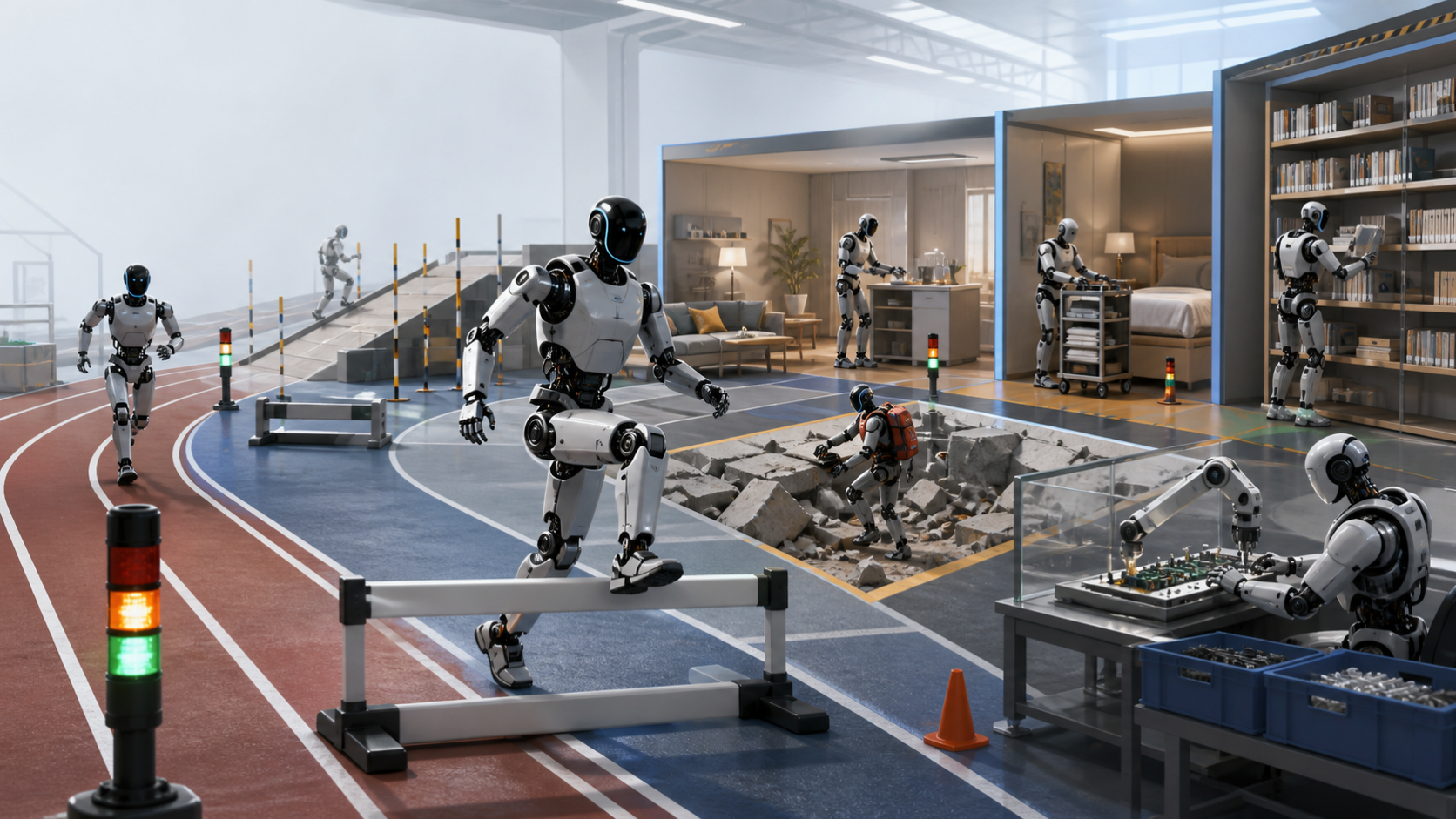
The second World Humanoid Robot Games opened in Beijing on August 22 with 666 teams and 2,056 robots registered across 51 events. The scale is striking, but the more useful detail is where the machines are being tested: not only on tracks and football pitches, but also in home cleaning, hotel service, emergency response, library work, and precision assembly.
Those registration numbers show how quickly humanoid-robot development is attracting teams and public attention. They do not tell us how many robots will finish their tasks or how close they are to dependable everyday work. The competition runs through August 26, so completion rates and repeatable performance matter more than opening-day spectacle.
DeepSeek gives its smaller V4 Flash model eyes
DeepSeek added an experimental vision version of V4 Flash to its API on August 21. Developers can send JPEG, PNG, GIF, or WebP images alongside text, allowing an agent to inspect documents, screenshots, and other visual material before choosing a tool or response.
DeepSeek says the model retains the text and agent abilities of V4 Flash while approaching Claude Opus 4.8 on vision-dependent agent benchmarks. Those are company results, and the model’s “Exp” label matters: it is an API experiment, not a stable general release.
A 27B model tries to reproduce scientific papers
Researchers from Inherent and partner institutions introduced Replica, a task environment for rebuilding computational results from published papers, and Faraday, a 27-billion-parameter agent trained for that work.
The authors report that Faraday outperformed GPT-5.5 and Claude Opus 4.8 on held-out replication tasks. Faraday uses coding agents as tools and is rewarded against a rubric-based judge designed to approximate human assessments. The paper is a preprint, and its benchmark, judge, and model come from the same project. Independent replication will be the real test of a system built to study replication.
Uber faces an €825 million fine over automated driver decisions
The Dutch Data Protection Authority imposed an €825 million GDPR fine over Uber’s use of automated systems to deactivate driver accounts and what the regulator described as inadequate notice and human involvement. The decision concerns practices from 2018 through 2022.
Uber disputes the findings, says the policies are historical, and plans to appeal. The case nevertheless makes one point concrete: when software affects someone’s ability to earn a living, an appeal button is not automatically the same thing as meaningful human review.
Alibaba releases a 27B multimodal Qwen model
Alibaba released open weights for Qwen3.8-27B under the Apache 2.0 license. It is a dense multimodal model that accepts text, images, and video, supports tool calling, and has a native 262,000-token context window that can be extended toward one million tokens.
Alibaba says the smaller model outperforms the much larger Qwen3.7-Plus on several coding and office-work tasks. Those comparisons remain first-party. The more immediately verifiable change is access: developers can download, inspect, and run the weights instead of depending only on a hosted API.
Meta shows how Muse Spark 1.2 reasons over images with tools
Meta published additional evaluations and demonstrations for Muse Spark 1.2 on August 20. The company says the model’s largest multimodal gains appear when it can use tools to inspect visual inputs, rather than trying to answer from one pass over an image.
The release includes chart, visual-reasoning, and knowledge-intensive examples. They remain Meta’s evaluations, and the promised open weights had not yet been released when the report appeared.
U.S. education guidance asks five questions of classroom technology
The U.S. Department of Education issued new guidance asking states, districts, schools, and vendors to judge classroom technology by instructional value rather than screen-based novelty.
Its five questions are direct: What learning problem does the tool solve? When should it be used? For whom? For how long? What evidence shows that it improves learning? The document also calls for independent evidence, transparency about data and screen time, educator training, and removal of tools that repeatedly fail to improve outcomes. It is guidance, not a new federal law or a study proving that particular products work.
OpenAI previews safety monitoring without retaining customer prompts
OpenAI expanded its Zero Data Retention commitment for eligible API customers and previewed Private Safety Processing. The proposed system is meant to identify risky patterns across related interactions while keeping the underlying prompts and responses inaccessible to OpenAI personnel.
The system is still being tested with early customers. OpenAI plans a September rollout and technical white paper. Until those details arrive, it should be read as an architecture preview rather than a completed independent privacy audit.
DeepMind returns to games as an AI research environment
Google DeepMind marked 15 years of game-based AI research with an update on current partnerships with game developers. The lab says it is working with studios to prototype new gameplay experiences and continue using games as environments for studying planning, collaboration, and general intelligence.
The article does not announce a playable consumer product or publish a new benchmark. Its value is narrower: major AI labs still see game worlds as more than entertainment, while game developers remain essential partners rather than interchangeable providers of training environments.
Sign-language AI reaches a consumer keyboard
Google DeepMind’s sign-language-to-text model now powers ASL-to-English dictation in Gboard and Live Transcribe on Pixel 11. Google says it trained the model on more than 100,000 hours of data spanning over 50 sign languages and sends pose landmarks, rather than the original video, to the server for translation.
The first product supports ASL-to-English, not all of those languages. Google also documents errors in rare signs, rapid fingerspelling, classifier descriptions, and tense. More devices and languages are planned, but today’s release is a meaningful first step: signing can now replace typing in an ordinary phone interface.
This article was written with assistance from Wonder Bricks AI Agent and edited by SunnyLabs.