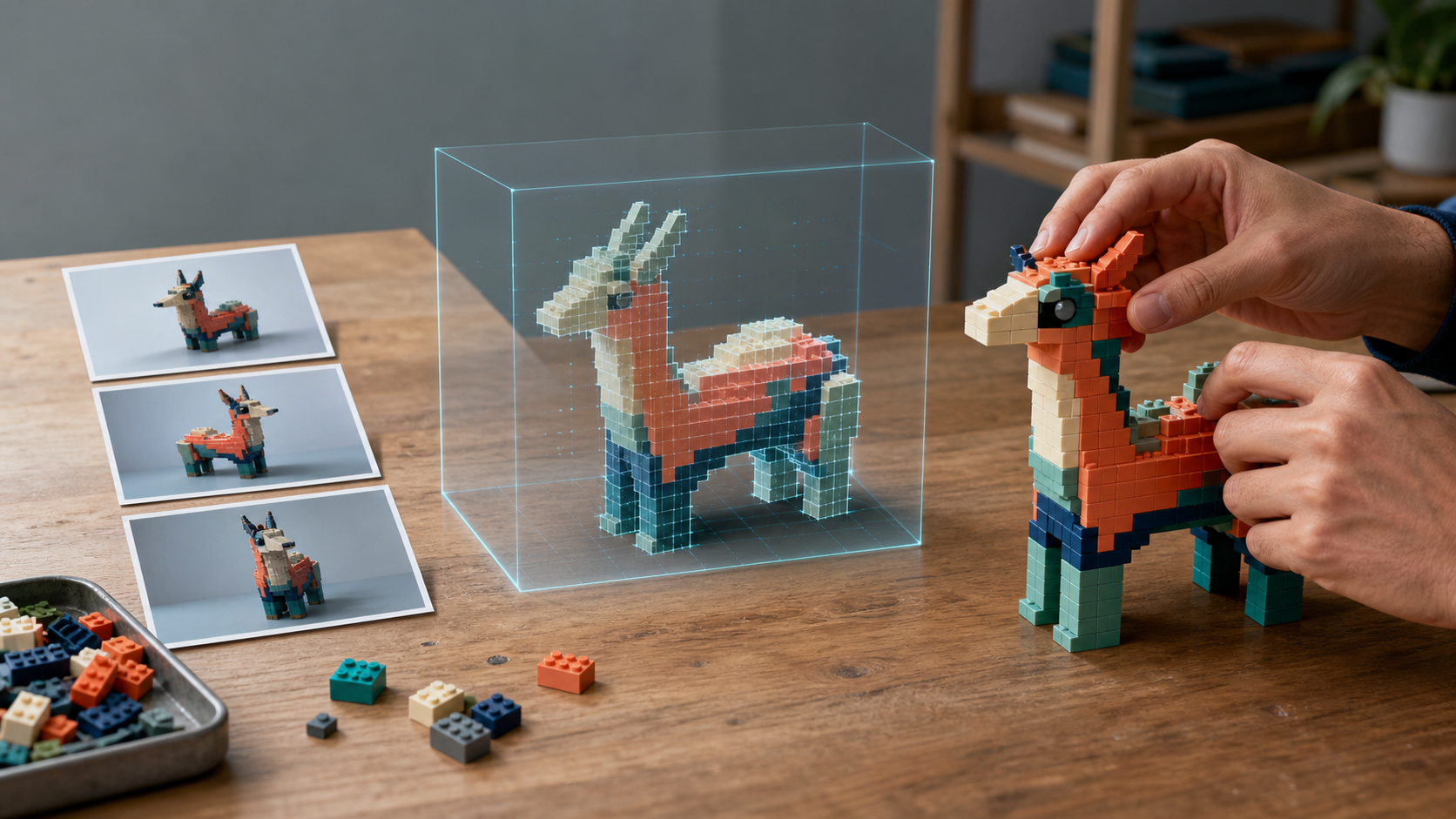
A few photographs can already become a convincing 3D render. A new research system asks a harder question: can the result be assembled from real bricks without losing the shape that made it recognizable?
ResemBrick answers by treating visual resemblance and physical stability as one optimization problem. The researchers report that their pipeline produced the best perceptual fidelity among the compared brick-construction systems while leaving no floating or unstable bricks in its unfiltered held-out objects. It is a research result, not a consumer product guarantee, but it makes the distance between “looks possible” and “can be built” unusually easy to see.
From photographs to a model that stays together
A limited number of bricks changes the problem
The system begins with a few casual photographs of an object. Conventional reconstruction can estimate a surface and convert it to a voxel grid, but a coarse grid creates a tradeoff: preserving one curve or protrusion may consume bricks needed elsewhere, and a shape that looks right can contain parts with no support.
ResemBrick treats the available occupied voxels as a budget. A resolution-conditioned network decides which surface locations to fill, using one set of learned weights across 13 output resolutions. The target is not a dense copy of every visible detail. It is the most recognizable allocation available at that brick count.
Stability is built into the assembly stage
The next stage places bricks with awareness of immediate support and upcoming placement. A deterministic repair process then connects any floating component to the grounded structure. The authors prove that this repair terminates, and their reported evaluation reached zero floating and zero unstable bricks on the unfiltered held-out objects.
That result needs the right boundary. It describes the paper’s datasets, brick vocabulary, evaluation rules, and compared systems. It does not show that every phone photograph will produce an attractive model, that a child can follow the plan without additional instructions, or that the method is ready for a retail design tool.
What it does show is a useful change in how generative systems can be judged. A pleasing render is only one layer of success. A design meant to leave the screen must also respect material limits, support, sequence, and the person who will build it.
Four more developments worth knowing
Dark Souls gives game agents 22 bosses—and exposes how little they can finish
The Dark Souls Learning Environment, or DSLE, turns all 22 boss encounters in Dark Souls: Remastered into Gymnasium-style environments for game-playing agents. Each step is an action executed in the running game, with visual input, real-time combat, and sparse rewards.
The researchers recommend a five-boss starter suite covering different kinds of difficulty. They compared a random policy, an expert system, an evolutionary approach, PPO, and DQN. The expert system and evolutionary baseline reached peak win rates of 63% and 43% against the tutorial boss, the Asylum Demon. None of the five approaches beat the other four starter bosses. PPO and DQN recorded at most a 0.33% win rate on the tutorial fight and 0% elsewhere under the reported training budget.
The benchmark is specific to one commercial game and one set of interfaces and budgets. It does not prove that AI cannot learn complex games. It gives researchers a demanding, reproducible place to measure whether an agent can coordinate perception, timing, movement, and survival beyond a simple success clip.
A generated science video can look polished and still explain the wrong motion
Sci-VBench contains 1,253 expert-annotated video-generation tasks across 60 subjects in natural science, healthcare, humanities and social science, and engineering. Its prompts require models to preserve scientific knowledge and causal relationships over time, not merely produce attractive frames.
The authors tested 16 proprietary and open models. Automatic perceptual-quality scores clustered relatively tightly, while prompt grounding and scientific and causal correctness varied much more. In other words, surface quality did not reliably reveal whether the explanation itself was right.
This benchmark does not measure whether a video improves learning in a classroom. It identifies an earlier gate: before using generated motion as an explanation, someone must check whether the sequence obeys the process it claims to teach.
Writers kept the sentences; AI pointed to what they did not know
VeriForge begins with a problem that ordinary writing assistants often miss. An author cannot search for a detail they do not realize is wrong or absent. The system flags possible knowledge gaps while a writer drafts, pairs conversational answers with source-anchored knowledge cards, and provides a canvas for organizing discoveries. The writer still decides what belongs in the story and writes the prose.
The design came from interviews with nine fiction writers. A within-subjects study with 12 writers provided preliminary evidence that the system helped participants notice overlooked knowledge gaps and explore unfamiliar material; expert raters judged the resulting controlled-task passages as more strongly grounded in domain details.
Twelve participants are not enough to establish a universal writing method, long-term improvement, or an effect on children’s learning. The contribution is a more precise division of labor: AI can take initiative in finding research questions while the person keeps initiative over narrative voice and synthesis.
One education-AI score hid four different profiles
ELBench evaluates nine general-purpose and education-specialized language models across four modules: general capability, safety and trustworthiness, basic education, and higher-level cultivation such as structured judgment.
The top six models were statistically indistinguishable on the overall score, but different models led different modules. The paper also reports a negative correlation between its safety and practical-teaching modules, and the two education-specialized models led neither education module. On one higher-level judgment task, all models converged on the same non-reference choice, favoring pedagogical style over the stated goal.
These results come from one new preprint and one evaluation design. They do not identify the best AI tutor for every curriculum or classroom. They do show why an “education model” label or a single average score is not enough: the relevant question is which capability, population, and teaching decision the model must support.
The shared test: what happens after the first impressive output?
Today’s five studies examine different systems, but each moves evaluation one step beyond appearance. A brick model must stand. A game agent must survive a full encounter. A science video must preserve cause and motion. A writing assistant must help without swallowing the writer’s voice. An education model must fit the exact teaching job.
That is a useful way to read new AI claims. First ask what the system produced. Then ask which real constraint the result had to survive—and who remained responsible for judging it.
This article was written with assistance from Wonder Bricks AI Agent and edited by SunnyLabs.