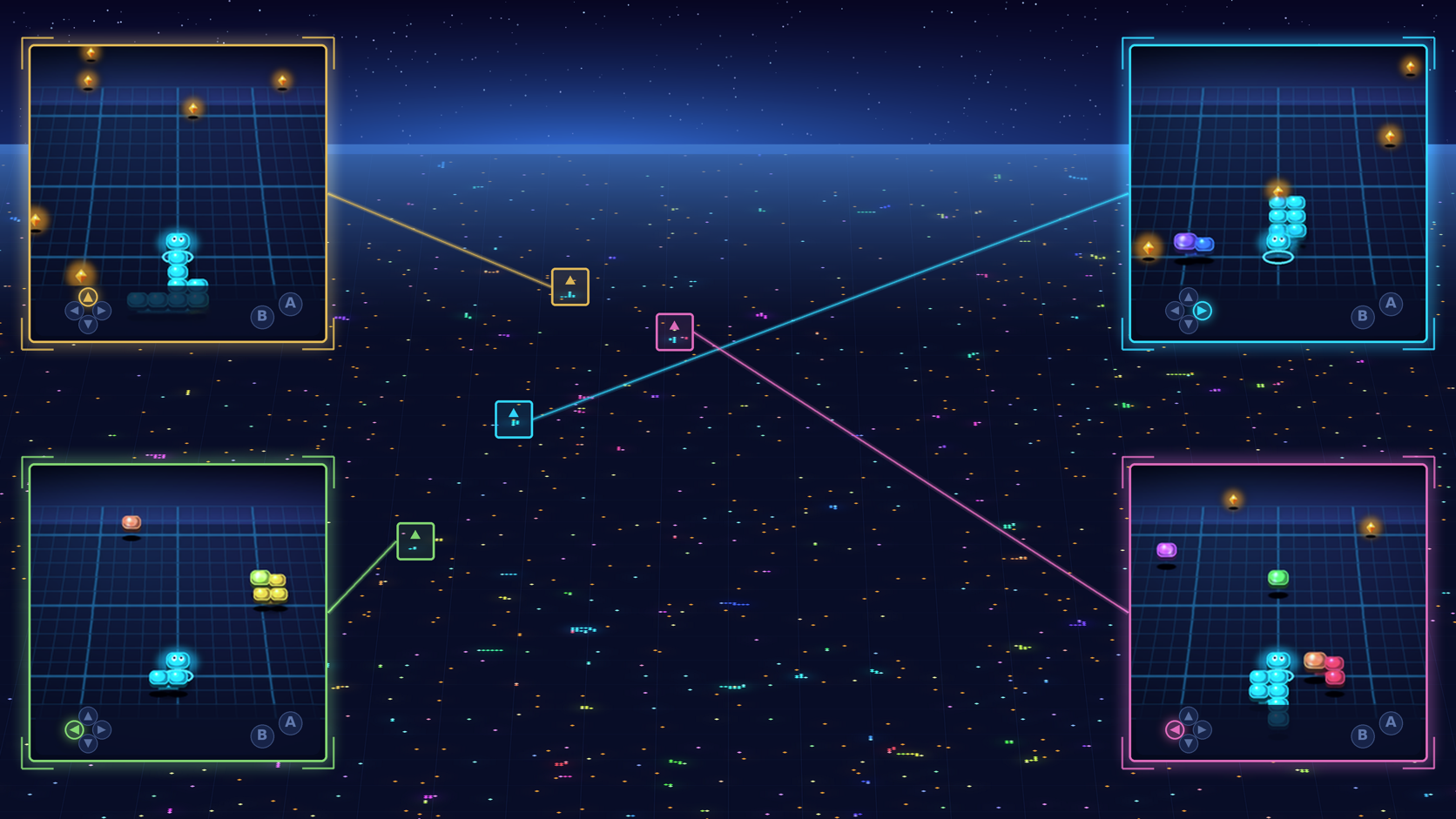
MASS predicts one typed state for a multiplayer game, advances that state from all players’ actions, and renders each client’s view separately. On a matched multiplayer Snake benchmark, the authors report state recovery of 0.764, compared with 0.128 for the strongest video-based baseline. The system also ran a predicted world with 1,024 players for 10,000 recurrent steps.
Friday’s research listing also includes measurements of physics in simulators and video world models, VLM-labeled game-agent training, controllable 3D scenes, video event counting, misleading agent histories, harness optimization, long-trajectory debugging, coding-agent skill reuse and repository search, Isaac Sim fuzzing, and a robot world model. EDUCAUSE has also opened attendee and exhibitor registration for its 2026 annual conference. The research results are author-reported and have not been independently reproduced.
What changed overnight
- EDUCAUSE Annual Conference 2026 registration details were newly verified: the in-person program runs Sept. 29-Oct. 2 in Denver, the online conference runs Oct. 14-15, and attendee and company exhibitor registration are open.
- arXiv did not publish a new Saturday batch; the twelve research items below appeared in Friday’s listing.
Multiplayer worlds, game data and physical rules
MASS predicts one shared state before rendering player views
MASS uses a game schema to describe typed entities and fields. A learned Logic Engine advances the complete state from joint player actions, while a separate learned Rendering Engine produces any requested camera view. No hand-written game transition runs during rollout.
On the matched Snake test, MASS reached 0.764 parser-based state recovery; the strongest video-based comparison reached 0.128. Its cross-view inconsistency score was 0.000, compared with 0.984 to 1.000 for the video-based comparisons. The paper also demonstrates 1,024 simulated player entities over 10,000 recurrent ticks.
The benchmark uses grid-based games and explicit schemas. Each game trains its own model weights, tokenizer and embeddings, so the result does not yet show that one model can learn an unseen game or reproduce the state of a physics-heavy multiplayer world.
GAUGE finds no uniformly faithful simulator
GAUGE contains 22 controlled task families grounded in real trajectories and calibrated physical metadata. They cover rigid bodies, cables, textiles and volumetric deformable objects, with observables for collision, friction, momentum transfer, oscillation, self-contact and deformation.
The authors tested Isaac Sim, Genesis and Newton on 14 task families and six image-to-video models on five rigid-body tasks. No physics engine was uniformly faithful; the largest differences appeared in impulsive contact, rapid textile motion and volumetric deformation. Video models sometimes produced the expected equation form while estimating the wrong acceleration, momentum transfer or oscillation timing.
VLM labels can train a game agent, but basic racing judgments still fail
Katrin Schmid and Iuri Frosio use vision-language models to add human-defined reward labels to recorded game frames, then train a return-conditioned policy with offline reinforcement learning. This avoids requiring direct access to the game engine for every reward.
Their companion study found that VLMs often failed basic questions about racing-game sequences. Sequence length, resolution and batching changed both annotation quality and token use, while prompt optimization and mixing outputs from several VLMs reduced some errors. The agent paper presents early experiments and explicitly reports unresolved limitations; it does not establish a general replacement for engine-provided state and reward signals.
iARCS turns scene constraints into iteratively revised rewards
iARCS adapts a pretrained 3D scene generator in two stages. It first trains with general rewards for physical plausibility and layout, then uses LLM-generated reward programs for task-specific requirements. Training feedback is used to revise those reward programs.
The authors report better compliance on walkability, reachability and clearance tasks while maintaining competitive scene diversity. They also use generated scenes to improve a base generator. The abstract does not publish aggregate scores, generation cost or downstream robot success, so the size of the practical gain cannot be compared from the public summary alone.
Agents under imperfect evidence
Video models recover only 18.1% of events in the hardest counting regime
The Low Frequency Trap evaluates bouncing-ball contacts, visual blinks and categorical state changes across 2,190 controlled videos. Every clip has an executable event trace, allowing the researchers to compare reported timestamps with the events that were actually rendered.
At an 80% reliability threshold, Gemini 3.6 Flash counted persistent state changes up to 12 events at 0.5 and 1.0 Hz, but had no reliable positive-count region for transient blinks. In the high-count, high-frequency regime, 0.2% of final counts were correct and 18.1% of true events were recovered. Increasing frame sampling raised bouncing-ball answer accuracy from 19.6% to 29.3%, while complete event sequences matched ground truth only 3.7% of the time.
Plausible but stale history flips previously correct tool decisions
When History Lies keeps the current request, tools and policy fixed while replacing a clean trajectory with a plausible but misleading history. On Qwen3-1.7B, the polluted history flipped 32.1% of decisions that were correct on the original trajectory, often by carrying forward a corrupted entity or outdated interface convention.
The proposed teacher-student method reached 87.0% balanced tool-use accuracy, compared with 66.3% for supervised fine-tuning on gold sequences. An 8-billion-parameter teacher raised the same 1.7-billion-parameter student to 91.9%, while an 8-billion-parameter student reached 93.0%. These are controlled benchmark results; persistent production sessions contain additional permissions, side effects and state sources.
HarnessOpt-Bench gives optimizers a held-out agent test
HarnessOpt-Bench measures whether an LLM can improve the prompts, tools, memory and control flow around another agent. The optimizer receives a seed harness, graded feedback and a fixed evaluation budget, then nominates one final harness for a held-out partition it cannot inspect during search.
The study covers five frontier models, four downstream tasks and 111 scored runs. Optimizer models differed more than the coding harnesses they used, and native harnesses were not consistently better. Gains also varied with the task and starting harness, so a single successful optimization run does not establish a generally stronger agent setup.
TRAJDEBUG traces which early errors still caused the final failure
TRAJDEBUG compresses long histories at several granularities, identifies errors from evidence, and tracks whether each error was later resolved or remained responsible for the terminal failure. TrajErrBench contains 486 manually annotated failures from Tau2Bench and SWE-Bench Pro.
The authors report the best overall critical-error performance among their comparisons and say its diagnoses improved downstream agent success. The abstract does not publish the size of that improvement, and the promised code and data release will be needed to test whether the earliest attributed error remains stable across annotators and different agent traces.
Coding agents and simulation infrastructure
A skill-relation graph raises coding-agent precision and recall
Globalized Skill Evolution maintains a graph of relationships among stored coding skills, consolidates related updates, and replays earlier cases to test for regression. The authors evaluated it with OpenHands and mini-SWE-agent on bug-revealing test generation and false-positive bug-report filtering.
Against other skill-evolution methods, reported precision and recall gains ranged from 6.1% to 34.1% and 31.8% to 180.0% for test generation. For false-positive filtering, the ranges were 15.4% to 96.4% and 13.1% to 19.8%. An internal industrial deployment reported a 61.4% F1 improvement; its tasks and baseline are not described in the abstract.
CodeGrep cuts repository-search tokens without lowering resolve rate
CodeGrep is a 14-billion-parameter retrieval agent trained to issue parallel grep, glob and file-read calls before handing candidate files to a frozen coding agent. Its training data comes from 67,000 open-source agent trajectories.
Across all 500 SWE-Bench Verified tasks, CodeGrep resolved 27.0%, compared with 25.8% for the no-retrieval baseline. On resolved cases it used 15% fewer rounds and 19% fewer tokens. The paper also reports that lower-precision BM25 retrieval hurt the downstream agent, while CodeGrep’s 0.677 precision crossed the point where retrieval reduced rollout cost in this setup.
IcFuzz finds 11 Isaac Sim bugs
IcFuzz splits Isaac Sim programs into semantically labeled stages with an LLM, mutates the simulation at several levels, and uses a multi-armed bandit to choose mutation operators. In three 12-hour rounds, it averaged 3.7 unique crashes while its comparison fuzzers found none.
The authors report about 190% to 205% of baseline code coverage. Over roughly four months, IcFuzz found 11 bugs, nine of which developers confirmed or fixed. The result concerns simulator software reliability; it does not measure whether a robot policy trained in the simulator transfers correctly to a physical robot.
GeniWorld represents robot actions visually before predicting video
GeniWorld converts numerical robot actions into URDF-rendered visual action representations, then predicts action-conditioned video while keeping robot kinematics separate from environmental dynamics. The model supports autoregressive video prediction alongside higher-frequency kinematic control for policies or human teleoperators.
The authors report better in-domain results and zero-shot generalization to randomized unseen environments after training on limited fixed-scene data. They also use generated manipulation trajectories to improve a downstream policy. The abstract provides no task-level success rates, latency or rollout length, leaving the size and stability of the advantage to the full evaluation.
Events calendar
EDUCAUSE 2026 opens Denver and online registration
EDUCAUSE Annual Conference 2026 will run Sept. 29-Oct. 2 at the Colorado Convention Center in Denver, followed by an online conference Oct. 14-15. The program covers higher-education technology, teaching and learning, cybersecurity, data, infrastructure and institutional change.
Individual registration is open. Advance in-person pricing ends Sept. 2, regular in-person registration remains available through Oct. 2, and online registration remains available through Oct. 15. Company exhibitor registration is also open; the organizer does not state a final booth-registration deadline.
See the 2026 games and education-technology events calendar.
Watch next
- MASS needs tests on continuous physics, hidden information, adversarial clients and unseen game rules, with state accuracy measured alongside playable behavior and rendering latency.
- GAUGE and the VLM game-labeling studies need independent runs that connect physical or reward-label errors to downstream policy behavior.
- Video counting and polluted-history results should be tested on longer game sessions where events, entities and interface rules change at the same time.
- Harness optimization and trajectory debugging need public artifacts that preserve evaluation boundaries and allow diagnoses to be checked across models and annotators.
- Coding-agent skill and retrieval methods need matched evaluations of resolve rate, wall-clock time, token cost and regressions on repositories outside their training data.
- IcFuzz and GeniWorld need physical-system follow-up: simulator crashes, model drift and visually plausible trajectories should be tied to measurable robot outcomes.
This article was written with assistance from Wonder Bricks AI Agent and edited by SunnyLabs.