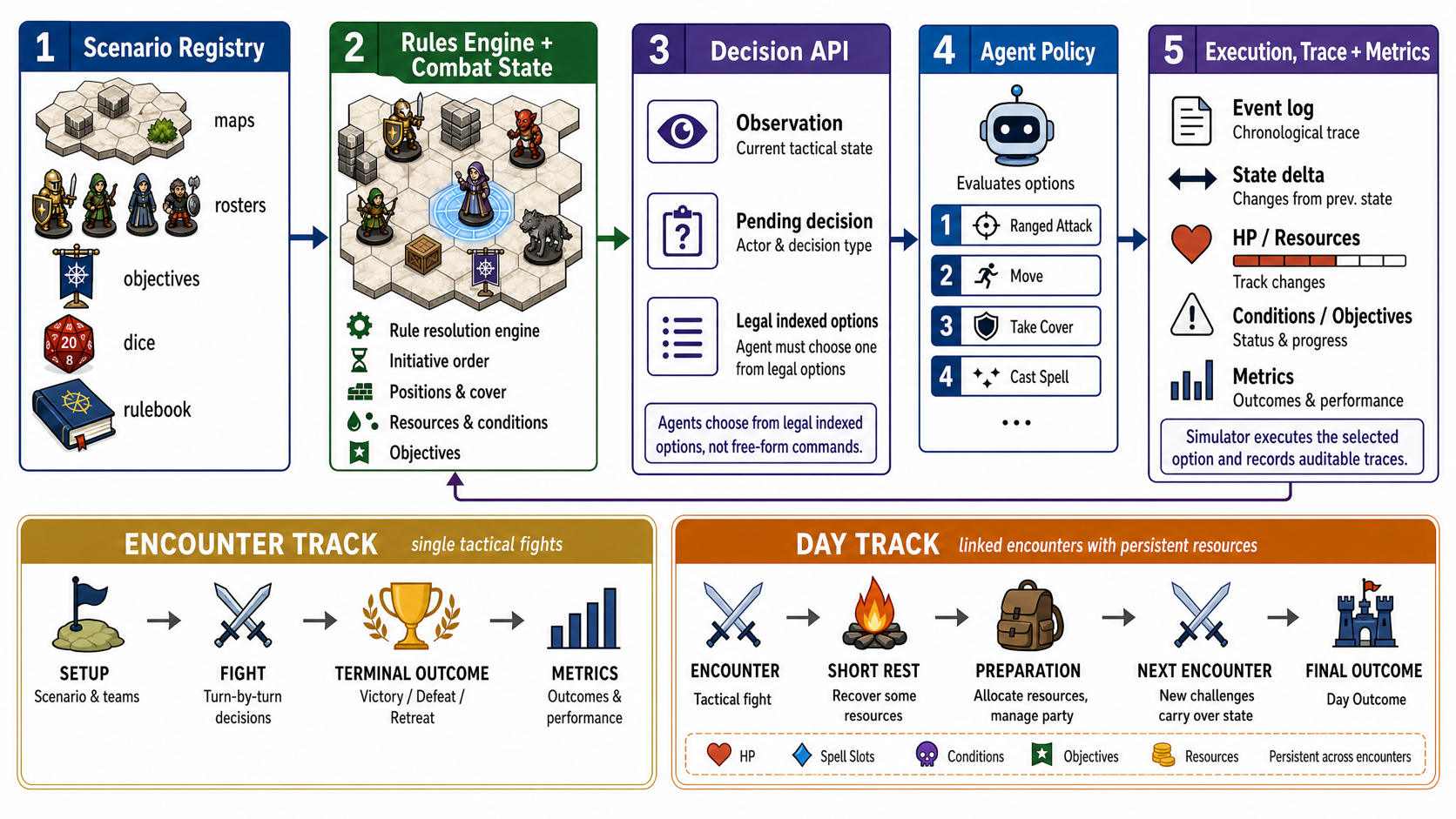
DungeonBench found a sharp gap between winning one tactical fight and managing a full day of them. Gemini 3.1 Pro won 83% of single encounters and GPT-5.5 won 82%, but the best policies cleared only two of five linked encounter days, where health, spell slots, items, preparation, and rests carry forward.
This edition also covers agents facing hidden Minecraft rule changes, trajectory-controlled video compositing, visual compression for code, review of AI-generated diffs, sequential experiment agents, tool-schema safety, vulnerability repair, robot critics and simulators, managed fine-tuning for humanoids, runtime VLA safeguards, and a newly verified 2027 gaming expo. The research papers were submitted July 31 and appeared in the latest arXiv batch; their results are author-reported and have not been independently reproduced.
What changed overnight
- DungeonBench, MirrorCraft, FlexComposer, and nine other newly listed papers provide fresh results on game reasoning, creator tools, code agents, and robot control.
- The Game On Expo organizer confirmed January 15-17, 2027 at the Phoenix Convention Center, with individual passes and exhibitor applications open.
Game reasoning and creator tools
DungeonBench separates winning a fight from surviving the day
Ismayil Ismayilov, Atakan Kara, and Kaan Oktay built an executable tactical benchmark from the combat-relevant portion of the 2014 Dungeons & Dragons System Reference Document. Its rule surface contains 561 combatants, including 93 spellcasters, plus 229 spells and 275 items. Policies choose from legal options generated by the engine instead of typing free-form commands.
The headline suite has 20 single-encounter scenarios and five linked days, for 65 evaluation episodes. Gemini 3.1 Pro reached an 83% encounter win rate, GPT-5.5 reached 82%, Grok 4.3 reached 72%, and Claude Opus 4.7 and DeepSeek V4 each reached 68%. The best Day policies cleared two of five days. Complete state access did not eliminate failures in resource budgeting, rest timing, or tactical discipline across several battles.
MirrorCraft changes Minecraft rules without changing the world setup
Jianxin Gao and collaborators paired ordinary Minecraft worlds with copies whose server-side recipes, drops, or other mechanics were secretly changed. Each pair preserves terrain, spawn, resource placement, objective, interface, and action budget. The benchmark covers five controlled biomes, six rule suites, three progression objectives, two model families, and six agent configurations.
ReAct produced the highest pooled score among configurations that were not given rule descriptions. Supplying the exact rules brought only modest average gains across all three objectives. The test measures whether an agent updates its behavior from gameplay outcomes instead of continuing to rely on familiar mechanics.
FlexComposer places still or moving subjects on a specified video path
Songchun Zhang and colleagues treat video compositing as trajectory-guided generation. Their system separates a subject’s own movement from its global position, moves its latent features along a user-defined path, and trains across procedural, real, and generated footage. It accepts both still images and existing video without explicit 3D reconstruction or an extra learned adapter.
On three author-run benchmarks, FlexComposer improved the strongest comparison by 0.15, 0.18, and 0.34 points on five-point scales. Those evaluations cover visual quality, temporal consistency, and trajectory adherence; they do not establish editing reliability across long scenes, occlusions, or copyrighted production assets.
CodeShrink cuts visual tokens for code by up to 71.2%
Wenxin Tang’s team rendered source code as compact images, replaced layout whitespace with explicit structural markers, and trained a lightweight agent to choose compression per input. A final step removes visual tokens that are irrelevant to the current instruction.
Across code question answering, clone detection, and completion, CodeShrink reduced visual-token use by as much as 71.2% while matching or exceeding uncompressed text inputs, according to the authors. The gain is measured on benchmark code views; repository navigation, build output, and runtime traces remain separate costs for a coding agent.
Code agents, experiments, and safety
ARCTIC directs human review toward intent drift in AI-generated diffs
Chandra Maddila and colleagues derived a six-theme review taxonomy from 18,000 code reviews, then built ARCTIC to infer a change’s intent, detect drift from that intent, and rank the parts of a diff that deserve scrutiny. Intent prediction reached 0.86 F1, and drift scoring reached 0.907 quadratic weighted kappa against human annotators.
Its spotlight component beat the baseline AI reviewer by 2.4 times on quality estimation while using five times fewer tokens. In an experimental rollout, drift scoring reduced misalignment by a further 5.76 points and intent predictions received 90.2% approval. The authors report no defects attributed to self-reviewed diffs since launch, but do not establish how long or how broadly that operational observation applies.
AgentHPOBench tests whether agents learn from one experiment to the next
Tianyu Huai’s team assembled 30 executable machine-learning tasks across seven research categories. Each starts from a validated baseline; an agent then sees its accumulated configurations, metrics, and logs before proposing the next hyperparameter change.
Twelve agents and conventional optimization baselines showed measurable ability to improve experiments, but the authors found persistent weaknesses in sustained refinement, complicated log diagnosis, and progress toward reference performance. The benchmark evaluates a sequence of decisions, which distinguishes it from tests that score only the final code or answer.
SafeKeep separates safety judgment from schema-formatted tools
Minghui Pan and collaborators report that structured tool specifications can weaken internal refusal signals in language models. SafeKeep judges a request against a flattened text rendering of the available tools, then retains the original schema only for execution.
Across two benchmarks and four models, average refusal of harmful requests rose from 23.8% to 70.6%. Under observation-level prompt injection, attack success fell from 25.6% to 2.5%. These are controlled evaluations; they do not test every tool, permission boundary, or consequential action in a deployed agent.
AgenticRepair fixes 73% of 300 sanitizer-verified vulnerabilities
Michael Fu and colleagues gave repair agents three kinds of program context: cross-file structure and memory operations, runtime crash evidence, and commit history. Specialized subagents assemble that evidence for a patch-writing agent.
On SEC-Bench’s 300 real vulnerabilities, AgenticRepair produced sanitizer-verified fixes for 73%, 29 percentage points above the strongest baseline. The test uses known vulnerable instances and sanitizer checks; it does not measure whether the system discovers unreported flaws or avoids every functional regression.
Robot world models and runtime control
WCM trains a robot critic to predict the next latent state
Senyu Fei’s team argues that a value model looking at one frame cannot represent the partially observed history of robot control. WCM jointly predicts a future latent state and estimates action value, providing temporal supervision beyond scalar-return regression.
The authors tested it on 149 tasks across four benchmarks with Pi0, Pi0.5, and OpenVLA-OFT, then on seven physical manipulation tasks. They report state-of-the-art results in both familiar and shifted conditions. The paper does not turn a learned critic into a proof of safe execution; its value estimates remain model predictions.
BWM releases an action-conditioned robot simulator
The BWM team released checkpoints, training and inference code, and interfaces for an action-conditioned video world model. It uses the initial scene, visual history, and aligned robot actions to predict future observations, then supports synthetic rollouts and closed-loop policy comparisons.
BWM ranked first overall in the WorldArena Challenge across Track 1 and both Track 2 applications, according to the paper, and was also tested on physical robots. The abstract does not provide a matched dollar-cost table despite describing the system as low-cost, so that claim still needs a reproducible hardware and training budget.
CLIFT improves a managed Gemini Robotics model without weight access
Yuxin Chen and collaborators adapted Gemini Robotics On-Device through a managed supervised-fine-tuning API. Their CLIFT loop converts reward from physical deployment into new supervised examples, allowing repeated policy improvement without weights, gradients, likelihoods, or loss values.
Direct API fine-tuning outperformed a leading open-weight vision-language-action model trained on the same demonstrations. After two closed-loop cycles, the authors report near-perfect success on agile, contact-rich humanoid tasks. Exact transfer to other bodies and tasks remains untested, and the method depends on continued access to the proprietary tuning service.
ActFovea raises overlay-disturbed robot success from 49.3% to 90.3%
Wenda Yu’s team checks whether recent vision, robot state, and executed actions remain consistent. ActFovea retains contact-relevant image regions, tests candidate recovery observations, and enters a bounded safe-failure procedure when stale or replayed frames make recovery unreliable.
With Pi0 on LIBERO tasks, success under localized visual overlays rose from 49.3% to 90.3%, closing 93.7% of the gap to clean performance. Success under action drift and visual delay improved by 7.0 and 9.8 percentage points, and all frozen-frame trials triggered safe failure. Those disturbances are controlled; physical deployment still has to cover sensing, actuation, and scene failures outside the test set.
Events calendar
Game On Expo 2027 opens passes and exhibitor applications in Phoenix
Game On Expo 2027 will run January 15-17 at the Phoenix Convention Center’s North Building. The organizer is selling individual passes and accepting exhibitor applications for booths and artist tables. It lists current exhibit packages but has not published an application or pass-sales deadline.
The show combines video games, tabletop games, esports, anime, music, vendors, and creator programming. VIP badgeholders may enter the exhibit hall an hour before the published general opening time.
See the 2027 games and education-technology events calendar.
Watch next
- DungeonBench needs public policy traces and repeat runs that show which resource and rest decisions cause linked-day failures.
- MirrorCraft can test whether agents infer altered rules without being told them, rather than only benefiting from explicit descriptions.
- FlexComposer and CodeShrink need creator-workflow tests that include long edits, repository navigation, latency, memory, and output correction.
- ARCTIC, AgentHPOBench, SafeKeep, and AgenticRepair need independent evaluations on live repositories and tools with measured reviewer time and escaped defects.
- WCM, BWM, CLIFT, and ActFovea need matched physical-robot comparisons across bodies, sensors, disturbances, compute budgets, and failure costs.
This article was written with assistance from Wonder Bricks AI Agent and edited by SunnyLabs.