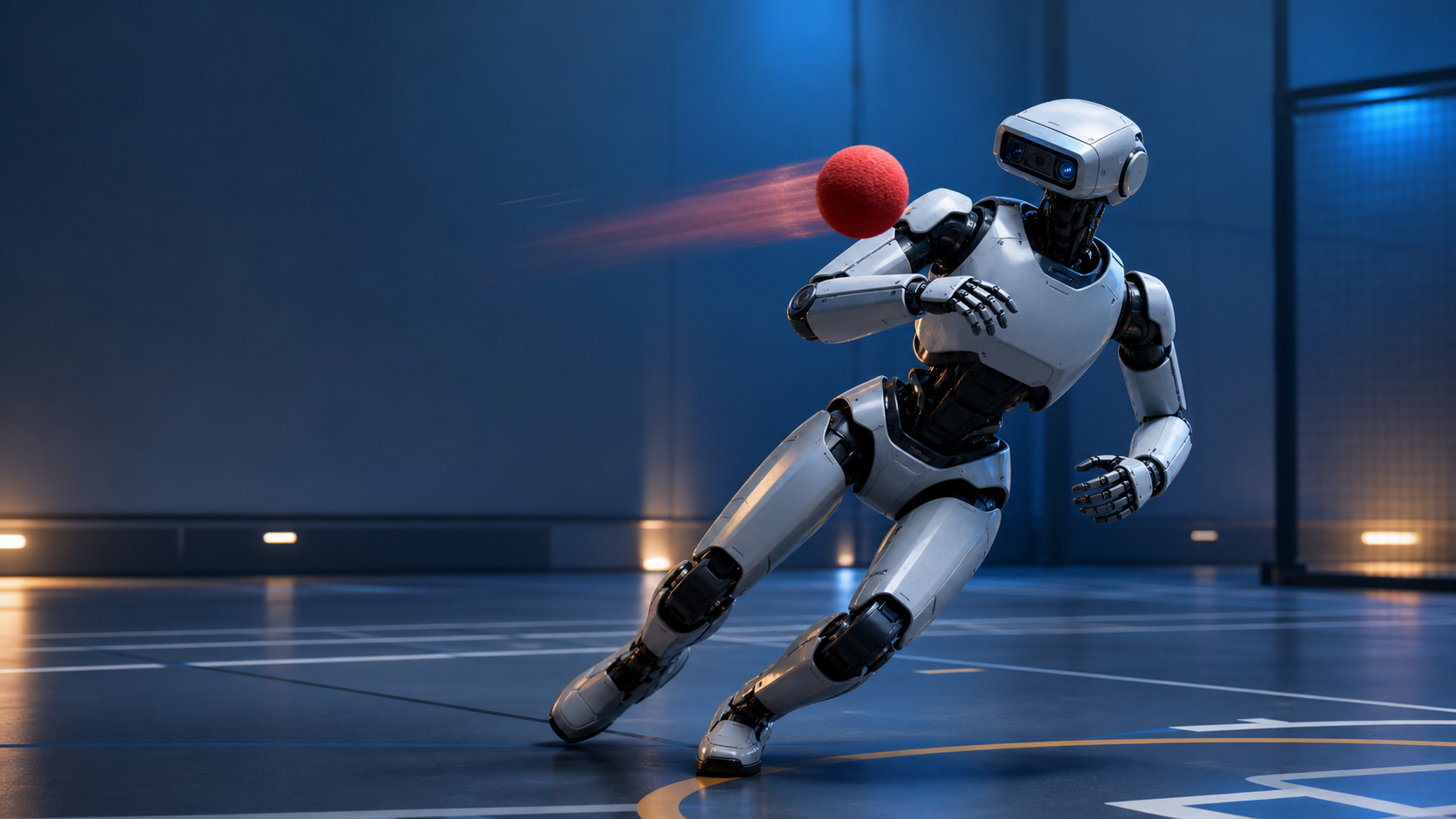
A humanoid robot guided by its own head-mounted depth camera dodged 95% of real throws in PAC-MAN’s reported tests. This morning also brings a 75,000-episode embodied dataset, training-free 3D question answering, a physical-language world model, a more efficient visual-diffusion backbone, data-efficient 3D generation, long-video retrieval, production-incident and coding-agent benchmarks, asynchronous multi-agent collaboration, and a new education-conference calendar entry. Unless noted otherwise, the results are author-reported from new preprints and have not been independently replicated.
What Changed Overnight
- ArXiv’s July 31 announcement added new work on humanoid control, embodied data, physical world models, visual generation, 3D reasoning, long-video retrieval, coding-agent evaluation, and multi-agent coordination.
- AASA opened attendee registration and company exhibit applications for its Feb. 25–27, 2027 National Conference on Education in Atlanta.
Robots, Embodied Data, And Spatial Reasoning
PAC-MAN dodges 95% of real throws with onboard depth vision
Lizhi Yang, Junheng Li, and Aaron D. Ames trained a humanoid dodgeball policy with control-barrier guidance that models clearance around every body link. At deployment, the policy sees only segmentation-masked depth from a head-mounted camera rather than the ball’s privileged position.
The lightweight Link-CBF policy transferred without real-world fine-tuning to a Unitree G1 and succeeded on 95% of throws, according to the paper. The controlled benchmark uses seeded throws and counts contact with any body link. The authors also found that a more detailed Joint-CBF controller degraded when the fixed camera could not observe the ball accurately, then recovered with a tracking gimbal or privileged runtime filter. The 95% result therefore applies to the simpler deployed controller and the paper’s test protocol, not arbitrary projectiles or crowded environments.
ACE-Data-0 synchronizes sight, motion, sound, and touch
Yukang Cao and collaborators turned two furnished home environments into calibrated capture spaces. Their system records first-person and external video, full-body and hand motion, object geometry and six-degree-of-freedom trajectories, audio, and tactile signals on one timeline.
ACE-Data-0 contains 75,000 episodes across 200 task categories, totaling 150 hours and 17 million frames from 50 participants. The authors report that current methods still struggle with contact, occlusion, camera motion, and long time horizons. Two environments cannot represent the variety of real homes; the release instead supplies aligned perceptual, motion, and contact records for testing imitation learning and world models.
ViewMind3D answers spatial questions without reconstructing the room
Ping-Kun Chiang and collaborators route a question through selected camera views, language-guided object grounding, a bird’s-eye-view orientation cue, and structured answer generation. ViewMind3D needs no 3D-specific training or complete scene reconstruction.
The system reaches 50.8% overall accuracy on SQA3D and 73.4 CIDEr on ScanQA, while the authors report particular gains on spatially grounded question types. Those scores come from established indoor-scene datasets; deployment on moving cameras and changing game worlds remains untested.
World Models, Visual Generation, And 3D Assets
PhiZero predicts a physical description before rendering video
Shuyao Shang and collaborators represent world-state changes as discrete “physical language.” PhiZero first predicts that sequence and then renders the expected transitions as video, rather than leaving all dynamics implicit in pixel prediction.
The authors report gains across generation and understanding tests, along with action-conditioned simulation and zero-shot motion transfer. The abstract does not publish one aggregate margin or establish persistent game rules, collision handling, or player goals. It also does not test whether developers can inspect or edit the intermediate physical-language sequence.
Chimera reports 7.3 times the compute efficiency of full attention
Chongjian Ge and collaborators combine linear-complexity state tracking, periodic global attention, short convolutions, and sparse mixture-of-experts layers in one visual-diffusion backbone. Their scaling method tunes the different module types separately before fitting compute-optimal laws for image and video training.
An 11-billion-parameter Chimera activates 2 billion parameters per step. Measured by pretraining diffusion loss, the complete system is 7.3 times as compute-efficient as a matched full-attention Wan-2.1 2B baseline. Without length-specific fine-tuning, a model trained on five-second clips generates 30-second videos, with a reported 6.5% FID degradation in the final five seconds. Diffusion loss and FID do not by themselves measure prompt fidelity, character continuity, or editability across a full creator workflow.
ROAD trains a 3D generator with 1.5% of the baseline’s data
Xiao Luo and collaborators use a discriminative 3D foundation model as training-only supervision for a diffusion transformer. One alignment objective transfers global semantics; another matches fine geometric structure between the two latent spaces. The foundation model is not needed at inference.
Against the Step1X-3D baseline, ROAD reports competitive generation quality with 1.5% of the training data. Code is public. The abstract does not quantify wall-clock training cost, mesh topology, rigging, or engine-import behavior, so the reduction should be read as a data-efficiency result rather than proof of production-ready assets.
ReToken retrieves long-video evidence with one learned token
Yao Xiao and collaborators train one embedding to select query-relevant visual tokens from a prefilled key-value cache. The method uses a small image-question-answering set, and both training and long-video inference fit on one H100.
ReToken improves Qwen3-VL-8B by 13.4 points and InternVL3.5 by 12.4 points on Visual Haystacks. It transfers without video-specific training to an 8.0-point gain for Qwen3-VL-8B on LVBench. The tests measure retrieval and question answering rather than video generation or simulated-world persistence.
GenEvA combines evidence across selected video frames
Bowen Liu and collaborators address a step that frame selection alone does not solve: combining clues that occur at different moments. GenEvA builds a compact latent representation from query-relevant frames and invokes it only when the question appears to require cross-frame evidence.
With eight frames, the method raises LLaVA-Video’s average across four benchmarks by 5.2 points and Qwen2.5-VL accuracy on LVBench by 10.1 points. Average video-token overhead is 0.11%–0.40%. The reported gains use matched-frame baselines, which helps isolate aggregation from simply supplying more visual input.
Coding Agents And Production Work
ORCA-bench gives agents six days of telemetry and 1,079 incidents
Albert Gong and collaborators built a live microservice testbed with six days and 50 GB of metrics, logs, traces, and source code. Its 1,079 root-cause-analysis tasks vary the clarity of the incident report, detection delay, and presence of simultaneous faults. Expert site-reliability engineers approved the ground truth, and human rescoring of the automated judge reached a weighted Cohen’s kappa of 0.90.
Across five frontier agents, the best root-cause accuracy is 25.3% on medium tasks and 10.0% on hard tasks. The weakest model invents an implausible cause in 40% of reports, and removing source access hurts every metric. Each case is investigated in isolation in a public testbed. The authors’ claim that real systems are likely harder is an extrapolation, not a measured production failure rate.
Change2Task rebuilds coding tasks on maintained repositories
Haomin Qi and collaborators convert merged pull requests into executable tasks on healthy modern revisions of the same repository. The system can reverse a patch, map old code to its new location, or ask an agent to reconstruct the task state, then verifies the path from healthy base to broken task and back to restored code.
Starting from 1,130 eligible changes across bug fixes, features, tests, API migrations, and security repairs, Change2Task verifies 79.6% of constructed tasks. On a matched set it recovers 29.2% more tasks than a pull-request-based baseline, while reuse of modern bases cuts measured end-to-end expenditure by 10.8%. The result improves benchmark construction; it does not show that agents solve the resulting tasks.
PAIChecker finds issue and patch disagree in 13.6% of SWE-bench Verified
Manyi Wang, Junjielong Xu, and Pinjia He examined whether a linked issue actually describes the change delivered by its pull request. They classify five misalignment patterns across 11 detailed scenarios and report that 13.6% of SWE-bench Verified instances contain a mismatch.
Their multi-agent checker reaches up to 92.12% binary accuracy on SWE-Gym and 91.67% on SWE-bench Multilingual across the tested model backbones. The study challenges a basic benchmark assumption: a patch can be valid repository history without being a valid oracle for the issue text paired with it.
AgentRadio lets coding agents share discoveries mid-task
Xinxing Ren and collaborators add asynchronous threads, messages, and mention-watching to coding-agent harnesses. Agents can receive a teammate’s finding while continuing foreground work instead of waiting for a synchronized phase boundary.
On SWE-Atlas QnA, one Claude Code agent using Opus 4.6 resolves 32.3% of long-horizon repository questions. Four agents following AgentRadio’s five-phase protocol reach 62.1%, 29.8 percentage points higher and above the reported 57.2% for one agent using the newer Opus 4.8. The comparison changes both coordination and agent count, so it does not isolate the value of asynchronous messaging from parallel labor.
Events Calendar
AASA opens 2027 attendee and exhibitor registration
AASA’s National Conference on Education will run Feb. 25–27, 2027, at the Georgia World Congress Center in Atlanta, with optional pre-conference workshops on Feb. 24. The organizer says the event is open to members and nonmembers, and attendee registration is live without a published final deadline.
Company exhibit applications are open separately. AASA lists booth prices starting at $2,450 for a 10-by-10-foot inline space but does not state an application closing date.
See the 2027 games and education-technology calendar.
Watch Next
- PAC-MAN needs tests with unseeded throws, moving observers, clutter, and a wider range of projectile speeds before its 95% result can describe open environments.
- ACE-Data-0 can show whether synchronized touch and object state improve policies beyond video-only demonstrations on held-out homes.
- PhiZero and Chimera need public creator tests for long-horizon state, controllability, prompt fidelity, and editing rather than video metrics alone.
- ROAD’s code can reveal the actual training budget and whether its generated geometry survives retopology, rigging, and engine import.
- ORCA-bench, PAIChecker, and Change2Task provide inspectable tests for whether coding-agent gains survive cleaner task construction and noisier operational evidence.
- AgentRadio’s asynchronous messaging should be compared with the same number of agents using phase-boundary handoffs under equal token and wall-clock budgets.
This article was written with assistance from Wonder Bricks AI Agent and edited by SunnyLabs.