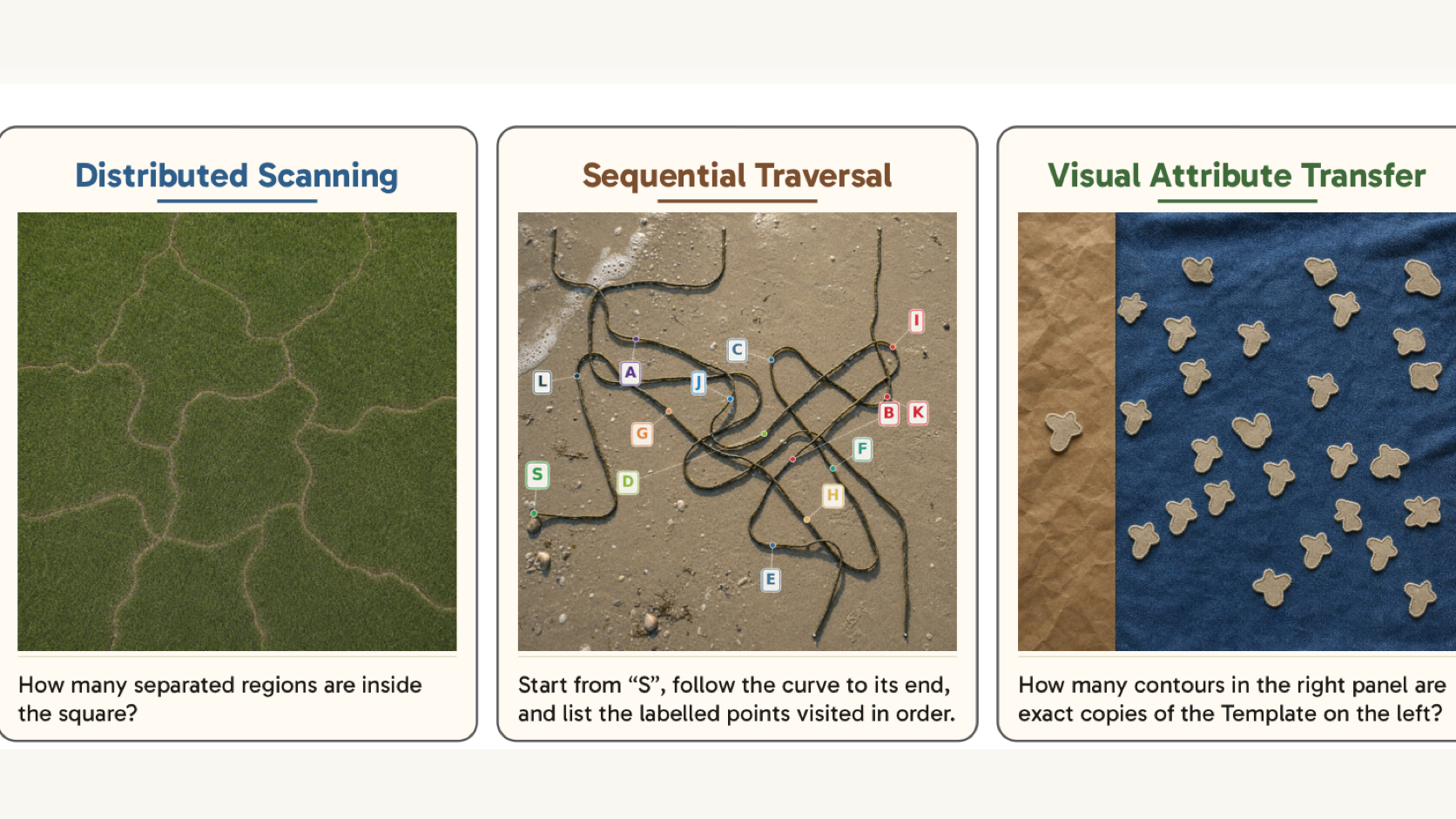
The highest-scoring model tested on ActiveVision solved 10.6% of tasks that require repeated visual inspection; three people averaged 96.1%. This edition also covers ARC-AGI-3 game agents, reinforcement learning, multi-agent communication, large tool environments, predictive safety, video continuity, motion capture, robot manipulation, episodic memory, synthetic speech, and applications to exhibit at a tabletop-industry conference.
What Changed Overnight
- GAMA’s official exhibitor page, verified July 21, lists April 25–29 for GAMA Expo 2027 in Baltimore and keeps tabletop-game booth applications open through November 30, 2026.
Interactive Reasoning And Game Agents
ActiveVision finds that a second look remains difficult
Jiarui Zhang and five collaborators introduced ActiveVision, a benchmark with 17 tasks in three categories. A model may need to scan separated regions, trace a crossing path without losing its place, or compare small attributes across distant parts of an image. The tasks measure whether a system can redirect its attention after forming an intermediate hypothesis.
GPT-5.5 at the highest tested reasoning setting solved 10.6% of items and scored zero on 11 of the 17 tasks. Claude Fable 5 solved 3.5%, while three human participants averaged 96.1%. Letting models write and run vision code did not close most of the gap because the generated code also failed on realistic images. The benchmark is a controlled perception test, not a complete measure of game-playing ability.
Replay verification tops four ARC-AGI-3 agent designs
Sergey Rodionov compared four Codex-based agents on the public ARC-AGI-3 games: a textual baseline, an executable world model, that model with scheduled simplification, and a fixed-interface version that must exactly replay recorded observations. Stronger models and higher reasoning effort produced the most consistent gains. The textual agent beat the flexible executable model in both GPT-5.5 settings, so merely writing a simulator did not guarantee a better result.
The complete verification design ranked first in all four main settings but used substantially more resources. In an exploratory GPT-5.6 Sol follow-up, it solved every public game at about 99% RHAE with fewer than half the human baseline’s actions. Because the model was released after the public games and the paper does not test hidden games, the result applies only to the known set.
Muon raises one ALFWorld validation result by 88%
Kai Ruan and collaborators compared Muon and AdamW while training Qwen2.5-0.5B-Instruct on sparse-reward ALFWorld tasks. With Group-in-Group Policy Optimization, applying Muon only to hidden weight matrices raised final-window validation success from 0.290 to 0.546, an 88% relative increase.
Results changed with the advantage estimator and learning rate. At another setting, GraphGPO with Muon reached 0.901 and crossed 0.5 and 0.75 success 30 and 60 updates earlier. Every comparison used a single seed on one task family; multi-seed and cross-task confirmation remain open.
Agent Architecture And Tool Use
Multi-agent gains shrink when relay messages lose task details
Wendi Yu and collaborators treat the messages between agents as an information bottleneck. A single agent retains one full trace, while a multi-agent system divides context and passes bounded summaries between isolated workers. Compression can remove redundant context, but it can also remove facts required downstream.
Across 18 controlled experiments, five benchmarks, and three model scales, multi-agent systems helped when relay messages preserved nearly enough task information, especially for weaker models. Gains narrowed or reversed when communication lost relevant details, particularly for stronger models. The study tests controlled relay conditions rather than a production game-development team.
ToolVerse assembles nearly 400 MCP environments
Shuaiyu Zhou and seven collaborators built ToolVerse to create executable training environments from nearly 400 Model Context Protocol servers containing about 4,500 tools. A dependency graph generates long-horizon tasks whose tools become available in stages, and a turn-aware advantage method assigns reinforcement-learning credit across the sequence.
The paper reports gains across several agent benchmarks but does not publish one universal improvement figure in the abstract. Its main contribution is an executable environment spanning thousands of callable interfaces and tasks that reveal tools in stages.
DSWorld predicts expensive data-science operations before running them
Zherui Yang, Fan Liu, and Hao Liu built a world model for data-science workflows. DSWorld combines structured state, cost-aware routing, lightweight real execution, and an LLM simulator for expensive operations, trained with about 8,000 state transitions.
Training ran roughly 14 times faster and search inference three to six times faster while retaining competitive task performance, according to the paper. Transition prediction beat the strongest tested LLM baseline by 35.6%. The experiments cover data-science workflows; other domains were not tested.
Prediction And Safety
SeerGuard predicts a mobile action before allowing it
Xue Yu and collaborators built SeerGuard to screen an instruction, then use a safety-augmented world model to predict the next interface state and assess a proposed mobile GUI action before execution. On Qwen3-VL-8B-Instruct, the framework raised a safety-utility score from 0.191 to 0.596 at the reported weighting and cut risk cost from 0.347 to 0.130.
The paper evaluates mobile interfaces rather than game editors. SeerGuard assesses the state a proposed action may create before allowing the mobile agent to execute it.
MemoGuard rejects similar memories that are unsafe now
Rajat Bhattacharjya and collaborators built MemoGuard to address “memory traps,” in which a robot retrieves a past action that looks relevant but is invalid because the map, battery margin, or prior outcome has changed. The runtime checks topology, resources, and outcome contracts before reusing an episode and invokes local reasoning only when a check fails.
In a corridor-inspection simulator, MemoGuard reduced battery-safety violations by 76.6% compared with top-one similarity reuse and made 21.4% fewer fallback calls than always reasoning. On a Jetson AGX Xavier running Llama 3.2 3B locally, that avoided 3.67 seconds and 36.97 joules of fallback work per trial.
Video, Motion, And Character Systems
TANGO redirects long videos when generation approaches a dead end
Dimitrios Karageorgiou and collaborators address error accumulation in long autoregressive videos with TANGO. The system asks the diffusion model to predict one step ahead, checks whether its noise resembles the expected distribution, and searches for another path when the prediction approaches a dead end.
TANGO produced a 3.1-percentage-point absolute VBench improvement and a 28.3% average reduction in Fréchet Video Distance across 15-second videos. The method improves generated video continuity; it does not demonstrate persistent rules, controls, or collision behavior in an interactive world.
Two pairs of smart glasses reconstruct shared motion
Jiaxi Jiang and eight collaborators built EgoExoMoCap to combine the wearer’s head and optional wrist tracking with images of other people captured by their smart glasses. Two or more participants can jointly supply first-person and outside views without a studio camera array or motion-capture suit.
Tests on two in-the-wild datasets include noisy and occluded scenes. The abstract does not give a single accuracy figure, and the system reconstructs motion rather than producing a finished animation rig or game-ready retargeting pipeline.
IMBench joins physical reasoning to executable action
Anurag Maurya and collaborators introduced IMBench with 35 manipulation tasks and 14,000 filtered trajectories. Tasks cover contact-rich movement, tool use, explicit constraints, and multi-stage dependencies, requiring a system to perceive the scene, infer physical structure, generate actions, and revise execution.
Vision-language models showed partial physical reasoning yet failed to produce executable plans. Vision-language-action models also struggled with constraints and new scenarios. The results leave a gap between describing a plausible manipulation strategy and executing it successfully.
AuEmoChat learns emotion tokens instead of using a fixed label set
Zhenqi Jia and collaborators built AuEmoChat to learn a discrete emotion-token space from speech instead of restricting a conversational voice to a short list such as seven emotion labels. It merges redundant multimodal history while retaining emotion-relevant context, then predicts both the target emotion and speech tokens.
AuEmoChat outperformed the tested conversational-speech baselines on NCSSD-EmCap and produced more expressive output, according to the paper. The abstract does not publish the underlying scores or a user study, so it does not establish how listeners judge consistency across long character conversations.
New On The Events Calendar
Wonder News added GAMA Expo 2027 to the calendar. The tabletop-game industry conference runs April 25–29 at the Baltimore Convention Center. Eligible businesses can apply for exhibit space through November 30, with final payment due December 4. The organizer has not announced 2027 attendee badge registration, and attendance is limited to GAMA members.
Watch Next
- ActiveVision results on additional models and whether iterative perception improves in live game scenes.
- Hidden ARC-AGI-3 evaluations that can separate public-set saturation from general exploration and planning.
- Multi-seed ALFWorld results and tests of Muon on other agent environments.
- Full ToolVerse benchmark tables and evidence that tool-scale gains survive changing server interfaces.
- Independent reproduction of DSWorld, SeerGuard, MemoGuard, and TANGO across creator workflows and longer sequences.
- Motion-retargeting and listener studies for EgoExoMoCap and AuEmoChat.
- November 30 for GAMA Expo 2027 exhibitor applications.
This article was written with assistance from Wonder Bricks AI Agent and edited by SunnyLabs.