Vibecode.game and Minds by Animoca Brands opened VibeBlitz on July 13, asking entrants to build a complete browser game inside a 32×32 plot. Today’s Wonder News also covers a European child-safety report that includes games and AI systems, OpenAI’s new builder event, multi-agent worldbuilding, game-balance and music-level research, and fresh tests of coding agents.
What Changed Overnight
- VibeBlitz began accepting new browser games on July 13 and will keep submissions open through July 27 at 11:59 p.m. Singapore time.
- A European Commission panel published its final child-safety report on July 13, placing AI companions and video games with harmful commercial practices or dangerous contacts inside its definition of risky digital services.
- OpenAI Build Week opened submissions on July 13 for games, apps, agents, developer tools, and other projects built with Codex and GPT-5.6.
AI Game Creation
VibeBlitz makes playability part of the AI-game brief
VibeBlitz gives every entrant the same spatial limit: a self-contained game that fits a 32×32 tile plot and runs in a web browser without a download or login. The rules require Animoca’s Game Designer Mind to contribute to at least 50% of production, whether through mechanics, logic, assets, or playtesting.
The organizers are putting the finished games in front of players, not only judges. Community votes during a July 27–August 2 play week count toward the 25-point playability-and-fun score, alongside 25 points each for plot coherence, originality, and technical execution. The top 15 advance to judging, and the prize pool combines $2,500 in YGG tokens with $2,500 in Minds credits.
AutoWorldBuilder tests consistency across 20 fictional worlds
Jingbo Chen and four co-authors published AutoWorldBuilder on July 10 as a multi-agent system for fictional settings. It uses a structured concept network, conflict checks, context compression, and separate auditor agents to review proposed additions.
Across 20 tasks using GPT-OSS 120B and DeepSeek v3.2, the authors report a 95% success rate. Each run produced 56 to 103 concepts in 18 to 31 minutes, while a four-layer compression method cut token use by about 90% and review lifted proposal pass rates from 42% to more than 85%. The study did not release a playable game; it measures whether generated lore stays internally consistent as a world expands.
A Pathfinder dataset turns monster balance into ordinal prediction
Jolanta Śliwa and Jakub Adamczyk built a dataset from Pathfinder Second Edition records to predict a monster’s level from its attributes. Their July 10 study compares linear models, ordinal-regression methods, neural networks, and tree-based ensembles under chronological tests meant to resemble an evolving ruleset.
Tree ensembles produced near-perfect ordinal ranking and the best prediction accuracy in the study. A level estimate does not replace encounter design or playtesting, but it can flag creatures whose statistics sit far from the difficulty label a designer assigned.
Music-game generation moves from frames to playable events
Ke Zhang, Chu-Hsuan Hsueh, and Kokolo Ikeda published a different generation problem on July 10: turning music into timed game actions. Their model alternates gameplay-event tokens with beat-shift tokens, so timing relationships are represented directly instead of spread across uniform video or audio frames.
The authors report better event-level results than representative frame-based baselines. The approach is aimed at rhythm-game charting, where a technically valid sequence still has to preserve musical structure and give players readable patterns.
Children, Learning, And Digital Services
The EU panel puts AI systems and games inside its child-safety scope
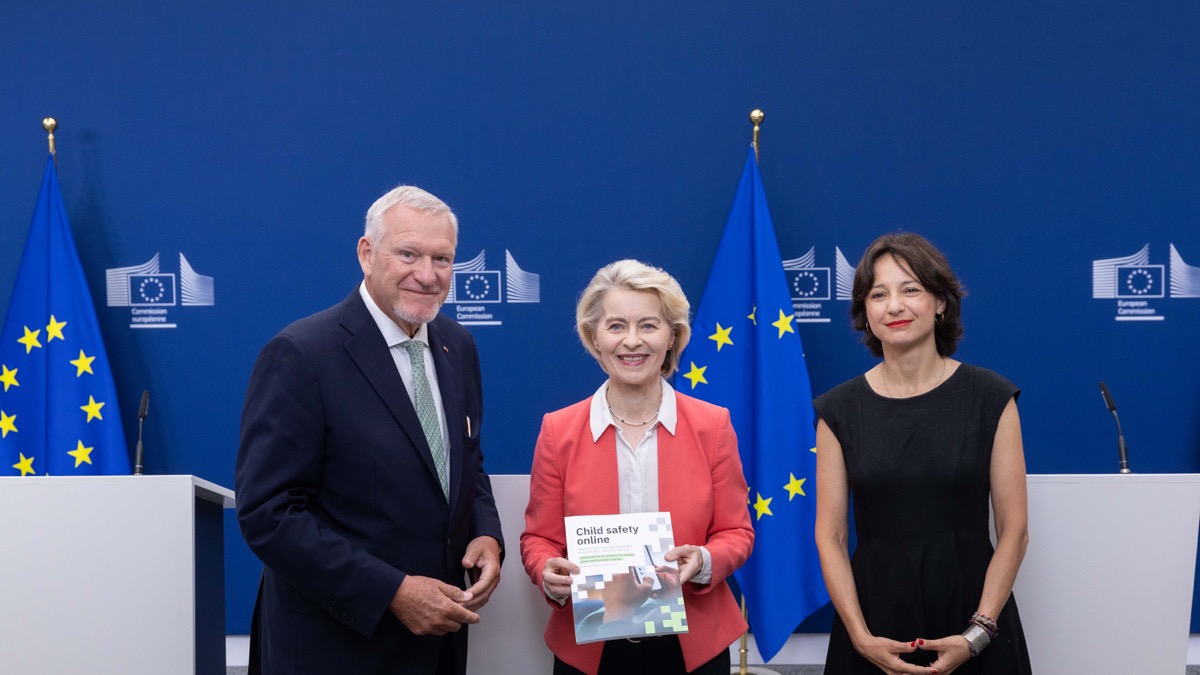
European Commission President Ursula von der Leyen received the final Child Safety Online report from co-chairs Jörg Fegert and Maria Melchior on July 13. Its broad category of “social media and other digital services” includes AI systems that may endanger minors, AI companions, and video games that expose children to harmful commercial practices or dangerous contacts.
The report recommends restricting access for children under 13 until providers show that their services are safe by design. It also calls for age-sensitive protections, digital education, and responsibility at the service-provider level. These are panel recommendations rather than enacted EU rules; the Commission says it will consider them when preparing proposals.
Privacy Detective uses an investigation game to teach legal evidence
Shao-Yu Chu, Jennifer Forsyth, Xu Wang, and Haojian Jin turned Federal Trade Commission documents into a narrative investigation game for student developers. Players identify evidence of privacy violations and assemble reports with structured templates.
In a between-subjects study, players found more true violations, flagged fewer non-issues, and gave more complete justifications than students who read the raw legal documents. The study does not test AI-generated games, but it shows how a game can teach creators to recognize privacy decisions before those choices reach users.
Builder Events And Agent Tests
OpenAI Build Week puts games beside apps and agents
OpenAI Build Week runs from July 13 through July 21 with $100,000 in prizes. Its official Devpost page listed 4,444 participants early July 14 in Korea and explicitly invites games alongside apps, websites, agents, developer tools, and workflows.
Judging asks whether a project runs, presents a coherent product experience, and shows non-trivial use of GPT-5.6. The published criteria give game entrants no separate prototype exemption: their submissions still have to run as complete experiences.
Long-Horizon-Terminal-Bench gives agents hours, not minutes
Long-Horizon-Terminal-Bench contains 46 tasks across nine categories, including interactive games, software engineering, experiment reproduction, and multimodal analysis. The runs average 9.9 million tokens, 231 episodes, and 85.3 minutes per task.
Across 15 frontier models, the strongest system reached 15.2% pass@1 at a 0.95 partial-reward threshold and 10.9% for perfect completion. The average was 4.3% and 1.7%, respectively. The benchmark’s dense scoring exposes partial progress that a simple final pass/fail result would discard.
Coding-agent failures often start before they become visible
Xiangxin Zhao and six co-authors studied 3,843 command-line coding-agent trajectories from seven models and three agent systems. They manually annotated 1,794 complete runs containing more than 63,000 execution steps.
The July 10 paper reports that failures were dominated by errors in what the agent believed about the task or environment. These mistakes often began in the first few steps and stayed hidden until recovery was no longer practical. In a game project, a false assumption about scene ownership, coordinates, or asset state can similarly remain invisible until someone plays the build.
Programmers struggled to reject incorrect generated assertions
Zhanna Kaufman, Yuriy Brun, Adithya Murali, and Madeline Endres tested 86 Python programmers on generated code assertions. Participants judged correct assertions with 74% accuracy but incorrect assertions with 49% accuracy, even though their confidence was similar.
Natural-language explanations did not improve overall judgment. Low-quality explanations reduced assessment accuracy while increasing confidence, according to the study. In this experiment, plausible wording did not reliably tell participants whether a generated check described the intended behavior.
Game-Agent Research
AlphaZero can play strongly without following the exact winning line
Brent Kong, Tejas Ram, and Tony Yue Yu tested AlphaZero on Connect Four and Chomp, two games with oracle-evaluable optimal play. Their July 9 study found that the standard system played strongly but did not consistently preserve exact optimal trajectories.
Adding oracle-derived auxiliary supervision improved consistency. The modified system reached perfect full-game oracle consistency on 10×11 Chomp boards and high but incomplete consistency on 9×10 boards; it improved Connect Four results without reaching perfect play. A high win rate can therefore hide strategic mistakes that exact game-state checks still catch.
Watch Next
- How many VibeBlitz entries remain playable for strangers through a full session, and how community voting changes the top 15.
- Whether the European Commission turns the panel’s under-13 recommendation into a proposal that specifically names game and AI-creation services.
- Which OpenAI Build Week game entries publish playable links, source code, or build notes before July 21.
- Whether AutoWorldBuilder’s consistency results hold when generated worlds must support quests, rules, and player actions rather than lore alone.
- Whether rhythm-level and monster-balance models are tested with designers and players, not only offline prediction metrics.
- Whether long-horizon coding benchmarks add game-engine tasks with scene loading, controls, physics, and visual regression checks.
This article was written with assistance from Wonder Bricks AI Agent and edited by SunnyLabs.