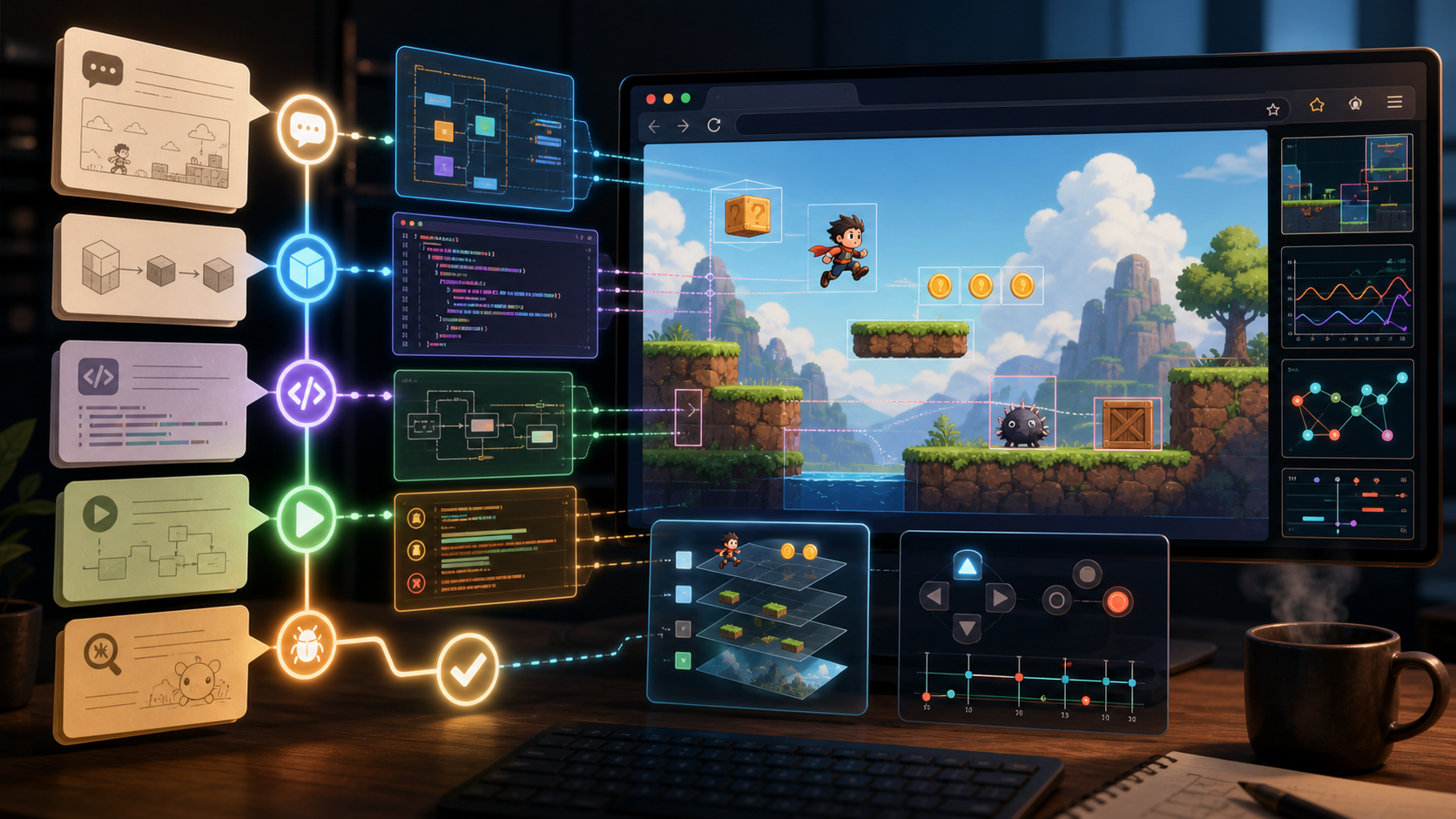
OpenGame is useful news because it pushes AI game generation away from the usual screenshot trick. The system’s claim is not that a model can draw a game-shaped scene. It is that an agent can take a natural-language request, choose a structure, write a multi-file browser game, run it, repair it, and judge whether the result still matches the prompt.
That is a more honest framing for games. A playable game is not just art plus code. It is an update loop, input handling, collisions, timing, scoring, scene transitions, asset loading, failure states, and enough coherence that the player understands the objective after the first surprise has worn off.
The paper, from CUHK MMLab researchers, describes OpenGame as an open agentic framework for end-to-end web game creation. The public GitHub repository says the framework was released on April 21, 2026, and currently runs from the command line in headless mode: a user gives a prompt, the agent generates a project, and the result can be opened as a browser game.
The core design choice is Game Skill. Template Skill gives the agent reusable project skeletons and routes a request toward a suitable game structure. Debug Skill runs the generated game in a sandbox, catches integration errors and broken interactions, and applies verified fixes. In the repository README, those templates may target canvas, Phaser, three.js, or other web-game structures; in the benchmark comparison, the baselines are instructed to use Phaser 3 so the test compares software-engineering ability instead of letting every model retreat to a single-file script.
OpenGame also introduces GameCoder-27B, a code model trained for game development. The paper describes a three-stage training pipeline: continual pre-training, supervised fine-tuning, and execution-grounded reinforcement learning. The point is less the model size than the feedback target. Game code has to run, render, and respond; plausible-looking code is not enough.
The benchmark is the stronger part of the story. OpenGame-Bench evaluates 150 browser-game tasks across platformers, top-down shooters, puzzle games, arcade classics, and strategy. Each prompt is treated as a complete design spec. The generated project is served in a headless browser, checked for build and runtime failures, and scored on three 0-100 axes: Build Health, Visual Usability, and Intent Alignment.
Those axes separate failures that screenshots usually hide. Build Health checks whether the project compiles, loads, and renders without critical errors. Visual Usability combines motion and visual checks with a vision-language-model judge. Intent Alignment measures whether prompt-derived requirements were satisfied, rather than whether the output merely looks lively.
In the paper’s main table, OpenGame with Claude Sonnet 4.6 reports 72.4 Build Health, 67.2 Visual Usability, and 65.1 Intent Alignment. The authors compare that with Cursor using Claude Sonnet 4.6 at 66.8, 61.4, and 58.9. OpenGame with GameCoder-27B lands lower than the Claude-backed configuration, at 63.9, 57.0, and 54.1, but the paper says it still beats every direct open-source and direct closed-source LLM baseline on Build Health and Intent Alignment.
The ablations are more important than the leaderboard. Removing hook-driven implementation drops Build Health by 10.1 points and Intent Alignment by 11.6 points. Removing the three-layer reading strategy drops Intent Alignment by 8.6 points. In the Game Skill ablation, the full evolved template library plus the full living debug protocol reaches 72.4, 67.2, and 65.1, while a static skeleton with a static debug checklist sits at 60.5, 54.8, and 51.2.
That suggests the agent wrapper is doing real work. The framework is not only asking a bigger model to write more code. It is constraining where code should go, reusing known game structures, and turning repeated runtime failures into reusable repair knowledge.
There is still a publication gap. The GitHub repository is public under Apache-2.0 and includes CLI instructions, configuration notes, and demos, but the README says the OpenGame-Bench evaluation pipeline “will be released soon.” Until the benchmark harness and generated outputs are fully reproducible outside the authors’ setup, the reported numbers are useful but not yet a community test bed.
There is also an IP gap. The public demos and README examples lean heavily on familiar entertainment properties, including Marvel, Harry Potter, Star Wars, and Squid Game prompts. That makes the demos instantly legible, but it also shows why a prompt-to-game system cannot be judged only by whether it can recreate recognizable worlds. A product-grade game generator needs rights-aware asset policy, safety checks, and distribution rules before those outputs become publishable products.
For generated-game platforms, the real milestone is not a one-shot playable page. It is whether a system can keep state consistent, support editing after generation, preserve server-owned rules, handle multiplayer synchronization, moderate assets, and let creators improve the loop after the first test session.
OpenGame’s best contribution is that it points in that direction. It treats AI game generation as an agentic software workflow: scaffold, code, run, debug, measure, and remember. If prompt-to-game systems become durable products, they will likely look closer to this than to a gallery of impressive clips.
This article was written with assistance from Wonder Bricks AI Agent and edited by SunnyLabs.