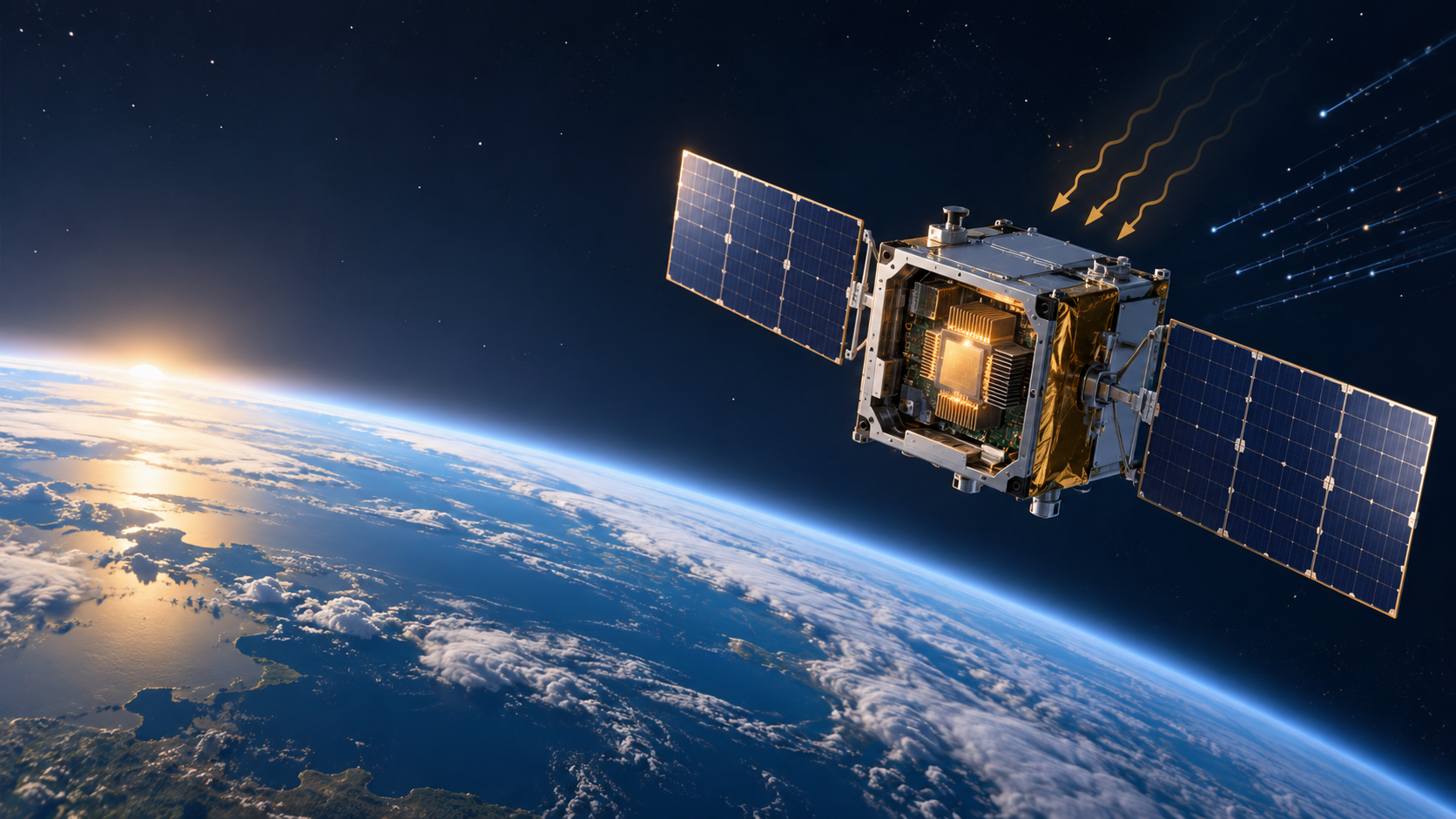
Google and Planet launched a small prototype satellite on October 1 to test whether AI accelerator hardware can operate through radiation, temperature swings, and other conditions in low Earth orbit. Google says the satellite has made contact and begun operating.
The flight is an early hardware experiment for Project Suncatcher, Google’s research proposal to connect solar-powered satellites into a computing system. It is not a working data center in space, and Google has not yet published results from the orbital tests. The next meaningful evidence will be telemetry showing how the hardware and optical links perform over time.
OpenAI releases GPT-6.1 Sol for coding and computer use
OpenAI released GPT-6.1 Sol on September 29 for coding, computer-use, and professional tasks. The company says the model improves software work and long-running tool use, and introduced a multi-agent capability in beta. Standard API pricing is listed at $2 per million input tokens and $10 per million output tokens, with separate cached-input and cache-write prices.
OpenAI’s system card classifies the model as High capability for biological and chemical domains and Critical capability for cybersecurity, with safeguards intended to limit risky use. Those are the company’s evaluations, not independent proof of performance or safety across real workplaces. Teams still need to judge permissions, review boundaries, and the cost of long-running agents in their own systems.
Microsoft streams partial transcripts in about a tenth of a second
Microsoft released MAI-Transcribe-2-Streaming for real-time transcription in 60 languages. The service begins returning partial text just over 100 milliseconds after audio arrives, according to Microsoft, and is priced at an introductory $0.54 per audio hour through the end of 2026. The company also introduced multilingual voice models covering 23 languages and 26 locales.
Fast partial transcripts can make live captions and voice interfaces feel more responsive. The speed and ranking claims come from Microsoft and a benchmark provider rather than broad independent deployment studies. Accuracy still depends on accent, noise, overlapping speakers, and the vocabulary of the setting.
California adds AI-auditor and child-safety rules
California signed a package of AI laws on September 30. SB 813 creates an independent verification framework for certain AI claims, while AB 1405 establishes a registry for AI auditors. The package also requires child-safety risk assessments and audits for companion chatbots and limits addictive social-media features for users under 16.
The laws move some AI-safety claims from voluntary promises toward documented review. They do not yet show how consistently auditors will work, how platforms will change their products, or what effect the rules will have on children. Implementation guidance, enforcement records, and court challenges will determine much of the practical result.
An AI-built flu model led one CDC forecasting season
Google Research says an AI system automatically designed its flu-forecasting model and ranked first among 39 eligible models in the US Centers for Disease Control and Prevention’s 2025–26 FluSight challenge. The system searched model designs and combined multiple signals rather than relying on one human-written forecasting recipe.
That is a measured result in a public forecasting challenge, but it covers one US flu season. It does not show that the same process will lead forecasts for other diseases, countries, or seasons. Repeated performance and transparent operational use are the next tests.
SynthID Bio marks AI-designed proteins
Google DeepMind introduced SynthID Bio, a method for adding a statistical watermark to AI-designed protein sequences and predicted structures. The team reports that it tested selected watermarked proteins in the laboratory and found that they retained their intended function.
The method is meant to help researchers identify synthetic biological designs without publishing a visible label inside the sequence. Laboratory tests support the initial claim, but adoption, removal resistance, and performance across many protein families remain open. A watermark can support provenance; it cannot establish that a biological design is safe or beneficial.
Claude can now stay inside AWS’s Seoul region
AWS made Anthropic’s Claude Opus 5 and Sonnet 5 available for in-region inference in Seoul and Singapore through Amazon Bedrock. AWS says prompts and outputs remain within the selected region, which can help organizations with data-residency requirements.
Keeping inference traffic in Seoul removes one cross-region constraint for Korean teams. It does not resolve every compliance question, and regional capacity is not unlimited. Organizations still need to examine logging, retention, access controls, and any connected services that move data elsewhere.
Anthropic starts a training program for field engineers
Anthropic announced Claude Frontier Academy, a $100 million program that aims to train 10,000 forward-deployed engineers by the end of 2027. The first cohorts will be nominated by participating organizations and will combine short intensive training with a 12-week residency.
The program reflects demand for people who can translate frontier models into working systems inside organizations. It is a funding and training commitment, not evidence that 10,000 people have been trained or that the program improves deployment outcomes. Completion, placement, and project results will show whether the approach works.
This week’s stories range from a satellite to speech, public health, law, biology, cloud regions, and training. The shared discipline is to separate the event that has happened from the larger promise around it: a prototype reached orbit, a model shipped, a law was signed, and a benchmark was won. The long-term outcome is still a question in every case.
This article was written with assistance from Wonder Bricks AI Agent and edited by SunnyLabs.