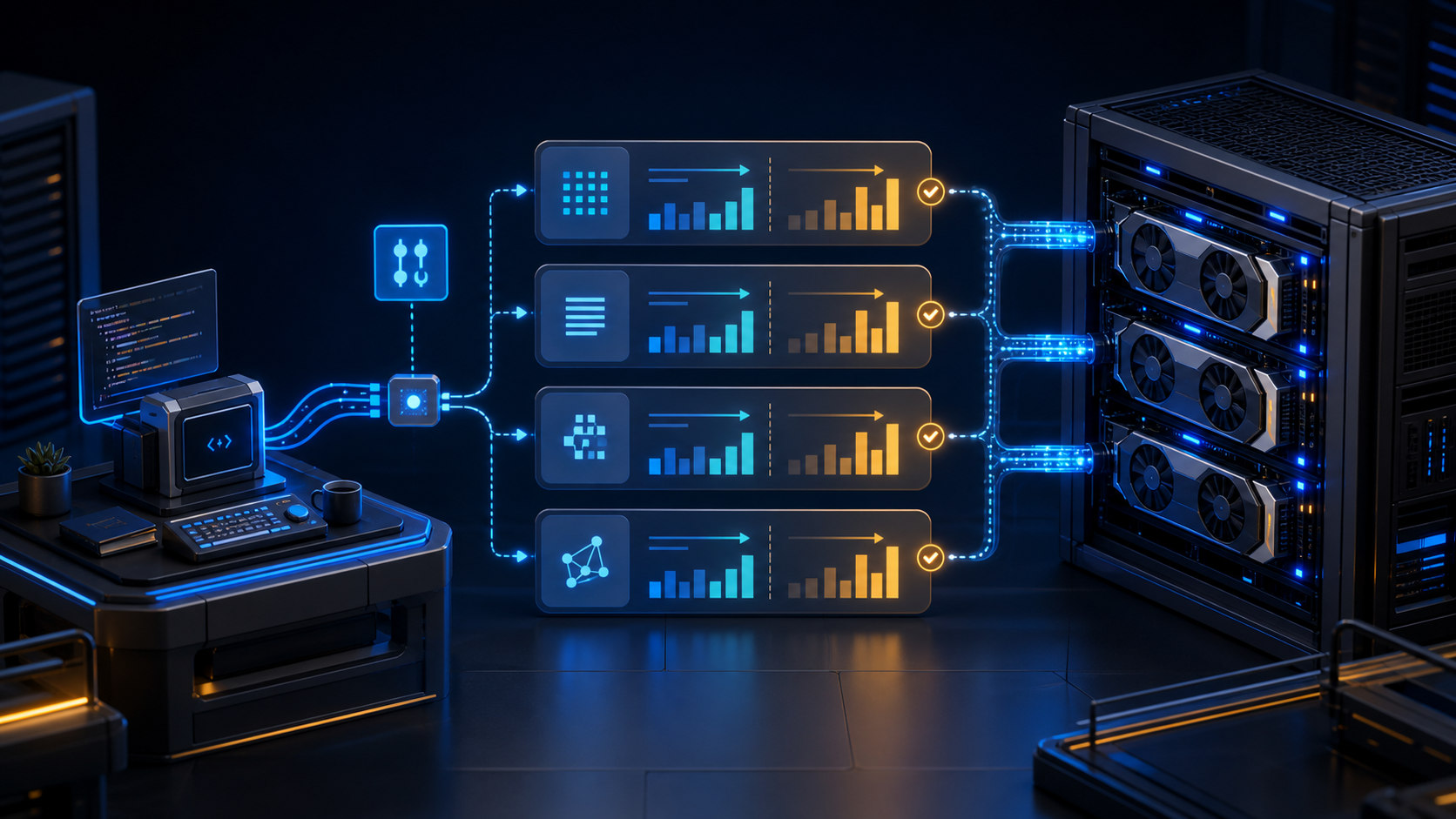
NVIDIA gave coding agents a written optimization playbook and reports that they produced faster inference systems without changing the model or GPU inside each comparison.
The company’s two internal A/B pairs showed throughput gains ranging from 15% to 77%. That range is useful evidence that operating instructions and experimental discipline can matter. It is not a promise that every agent, model, or deployment will improve by the same amount.
The skillpack turns performance engineering into a repeatable loop
The new Agent Optimization Skills live inside an NVIDIA Dynamo repository. They tell an agent how to define an objective, establish a baseline, change one variable at a time, measure with AIPerf, keep an experiment log, and preserve only improvements that survive comparison. Domain-specific guidance covers areas such as batching, caching, routing, and parallelism.
NVIDIA compared agents with and without the skillpack while holding the model, GPU configuration, and optimization goal constant within each pair. One pair used Claude Code and the other used Codex. The resulting throughput improvements ranged from 15% to 77%.
These are company-run tests with a small number of pairs, not an independent benchmark across agents and hardware. The stronger conclusion is narrower: a capable model can perform differently when it receives explicit measurement rules and deployment knowledge. “The agent optimized it” hides the human work of defining the objective, tools, and acceptable evidence.
Anthropic gives defenders restricted access to Mythos 5
Anthropic made Claude Mythos 5 available through Claude Security’s public beta for Enterprise customers. The workflow scans codebases the customer owns and returns findings and suggested patches for human review. It does not expose direct access to the underlying model through that product.
The company also announced a $35 million credit fund for open-source security work and said integrations with partner defense tools are coming. Those future integrations should not be confused with current availability.
The release tests a particular access model for powerful cyber capabilities: provide defensive artifacts while limiting general model access. Its practical value will depend on finding quality, false positives, patch review, and whether verified defenders can use it without creating a broader misuse path.
GPT-5.6 Sol gets a temporary price reduction
OpenAI updated the GPT-5.6 Sol product page on August 21 with a price cut of more than 20% for API use and credits for three months. The page currently lists base pricing of $5 per million input tokens and $30 per million output tokens.
The duration matters. This is a temporary change in access cost, not evidence of a permanent price curve. Teams comparing models should record the promotion window, expected input-output mix, and total workflow cost rather than treating a headline discount as a stable budget assumption.
Mobility rhythms help models understand what a place does
Google Research introduced ME-POIs, a framework that combines text about a place with anonymized patterns of when people visit it. Two places may carry similar labels but function differently across a day or week; mobility rhythms add that missing behavioral context.
Google reports better predictions for attributes including opening hours, price level, busyness, and whether a business is still operating. This is a research framework, not a newly released Google Maps feature. The work also makes data governance part of the product question: aggregated movement can be informative even when individual identity is removed.
AI narrows the search for wearable biomarkers
Another Google Research project uses multiple agents to propose and challenge candidate biomarkers from wearable-sensor data, while deterministic statistical tools perform the calculations and people supervise the process.
The framework was tested across three cohorts totaling 9,279 participant-observations. Fifteen experts reviewed its reports. Among 21 editorial decisions, only two were accepted without revision; eight needed minor revisions, eight needed major revisions, and three were rejected.
That distribution is an important boundary. The system may help researchers prioritize hypotheses, but a candidate signal is not a diagnosis. Replication, clinical validation, and expert judgment remain necessary.
Production agents become a bundle of tools, instructions, and files
Anthropic made computer use, browser use, the Skills API, and the Files API generally available on the Claude Platform. Multi-action turns can reduce repeated screenshots, page-structure targeting can make browser interaction more precise, versioned skills can carry organizational procedures, and the Files API can retain work products.
Anthropic also raised rate limits and offers up to 1 TB of file storage per organization. A customer example reports cutting a workflow from 32 minutes to 13 minutes, reducing cost by 30%, and reaching 100% completion. Those figures are a named customer’s results, not an independent average.
Cosmos DB tools keep identity and approval visible
Microsoft added agent tools and skills to the Azure Cosmos DB Query Editor in VS Code. They can inspect the active database context, sample a schema, draft a query, show resource-unit information, and execute only after permission. An optional MCP route is available through the self-hosted Cosmos DB Shell rather than a Microsoft-managed server.
Schema sampling and query execution consume resources. The tools use the developer’s existing identity and permissions. That makes the useful boundary concrete: an agent can help with data work without inventing a separate authority model, but developers still need to see what will run and what it may cost.
ChatGPT introduces teen-specific defaults
OpenAI launched ChatGPT for Teens for users it estimates or is told are 13 to 17. The experience adds Study Hours, homework reminders that redirect toward learning, break reminders, linked-parent controls, and stronger rules against encouraging emotional dependence.
The announcement documents product controls and OpenAI’s evaluations. It does not provide long-term independent evidence that the measures improve learning or well-being, and age estimation itself remains consequential. For families, the useful questions are whether the account is placed in the right experience, which controls are visible, and how the tool fits into an ongoing parent-teen conversation.
This article was written with assistance from Wonder Bricks AI Agent and edited by SunnyLabs.