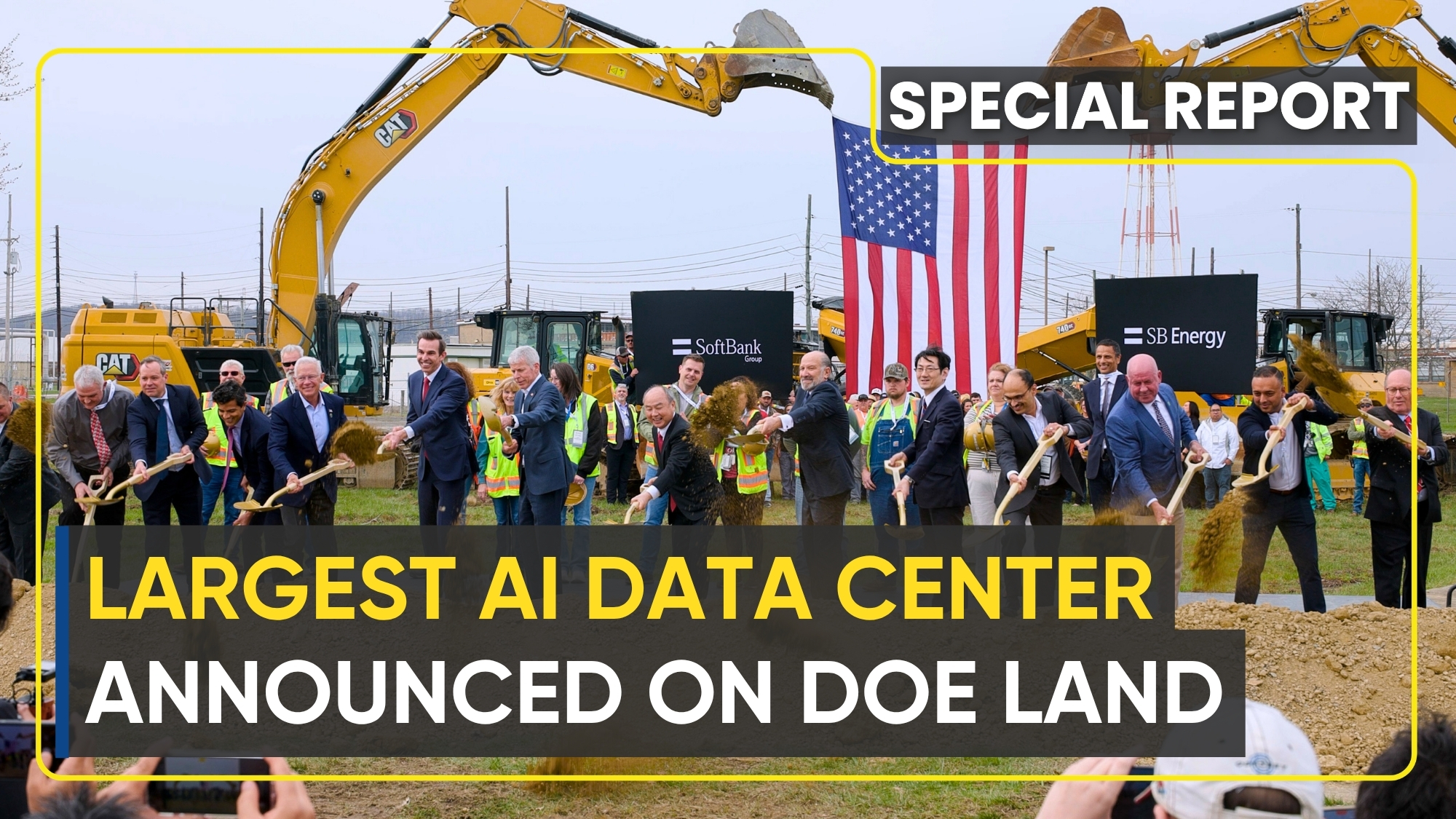
OpenAI has signed a 20-year lease for an AI data-center campus in southern Ohio that is planned to reach roughly eight gigawatts of computing capacity. The number is extraordinary, but it is also easy to misread.
The lease is a current commitment. Most of the campus, its power supply, its job totals, and its economic effects are still plans. The first capacity is expected in 2028, according to Axios. Reading those two time frames separately is the best way to understand the announcement.
This is an energy project as much as a computing project
The campus will be built and operated by SoftBank’s SB Energy on private land and at the U.S. Department of Energy’s former Portsmouth uranium-enrichment site near Piketon, Ohio. OpenAI would lease the computing capacity, and Nvidia would supply the chips and provide a large conditional financial guarantee tied to lease and power payments.
Eight gigawatts describes planned IT capacity, not the electricity currently flowing into finished servers. For comparison inside the project itself, federal materials describe ten gigawatts of new generation intended to support ten gigawatts of data-center development across the wider campus.
The proposed power mix is consequential. A Department of Energy fact sheet says at least 9.2 gigawatts would come from new natural-gas generation. It also describes new transmission, other generation, and a commitment to make excess capacity available to the grid. Those are design and policy commitments; they do not yet demonstrate the eventual cost to customers, emissions, construction pace, or reliability impact.
This is why an AI infrastructure story cannot stop at a chip count. Training and serving larger models increasingly requires land, substations, pipelines or other generation, transmission lines, construction labor, financing, and long-term power contracts.
The jobs claim contains two different stories
OpenAI says the project will create 35,000 construction jobs and 2,500 permanent operating positions. Both numbers matter, but they describe different kinds of work.
Construction employment arrives during a multiyear build and can include electricians, pipefitters, equipment operators, engineers, and many other trades. Permanent operating work is the smaller set that remains once facilities are running. The announced ratio is a useful reminder that a giant construction project does not automatically become an equally giant long-term employer.
It is also too early to treat either figure as an achieved result. Public materials do not yet give a year-by-year hiring schedule, local-hire share, wage distribution, or a complete accounting of indirect jobs. Those details will determine whether the headline translates into durable opportunity for nearby families.
What is signed, and what remains planned
The new facts are the 20-year OpenAI lease and the financing structure reported this week. The broader site and power plan existed before the lease, but OpenAI’s commitment gives the project a named anchor customer.
The cautious summary is:
- Signed now: a long-term lease and related financing commitments.
- Expected next: initial computing capacity from 2028, built in phases.
- Planned at full scale: about 8 GW of IT capacity and 10 GW of supporting generation.
- Still unresolved: final construction, regulatory approvals, power and water outcomes, actual hiring, and the local distribution of costs and benefits.
The project shows where the frontier-AI race is moving. Model performance still matters, but access to power, capital, land, and skilled labor is becoming part of the product roadmap.
Three more developments worth knowing
Alibaba is selling its in-house game studio
Alibaba agreed to sell its entire stake in Lingxi Games to private-equity firm Trustar Capital, according to an internal staff memo reported by Reuters and summarized by Tom’s Hardware. Lingxi developed titles including Three Kingdoms: Strategy Edition.
Reports differ on the value: Bloomberg placed it at no less than $1.5 billion, while a Reuters source said Alibaba could receive more than $2 billion. Because Alibaba has not published a final transaction filing with a settled price, the durable fact is the agreed full-stake sale—not one precise valuation.
The memo said the transfer would help Alibaba focus on strategic priorities. In the context of the company’s rising AI and cloud investment, the sale is a concrete example of management attention and capital moving away from owned game development. It does not prove that AI caused every part of the decision, nor does it tell us what Trustar will do with the studio after closing.
Chicago’s school-AI debate has become an election issue
A Chicago parent group, Illinois Families for Public Schools, has asked school-board candidates to sign a “Human-Centered Education Pledge” limiting generative-AI use. Axios reported that about half of the contenders had signed, while others declined because they feared broad restrictions could leave students less prepared to understand the technology.
The dispute also contains a factual disagreement. The advocacy group warned that a chatbot was about to be placed on every high-school student’s Chromebook. Chicago Public Schools told Axios that this description was inaccurate and said its work involves selected pilots rather than a district-wide installation.
CPS’s published guidance emphasizes human oversight, transparency, privacy, critical thinking, and regular policy review. The useful lesson is not that one side has already settled the question. It is that voters should ask candidates to define the exact tools, grades, data rules, teacher authority, opt-outs, and evidence they would require—not merely whether they are “for” or “against” AI.
Gemini in Classroom is expanding to students of all ages
Google began making the Gemini tab in Classroom available to K–12 and higher-education students of all ages on the web from August 10 and on mobile from August 17. The feature can use a class, assignment instructions, and curriculum materials as context for guided help, study guides, practice quizzes, and flashcards.
The age expansion does not mean every child with a school account automatically gets every Gemini feature. Students must be in an organization where administrators have enabled Gemini in Classroom and at least one of the required Gemini services. Administrators can keep access off or create separate groups for students under 18.
Google also tells users to review generated outputs because AI can make mistakes. That warning should remain part of the product story: a more convenient path from assignment to AI assistance does not transfer judgment or classroom policy from teachers and schools to the model.
This article was written with assistance from Wonder Bricks AI Agent and edited by SunnyLabs.