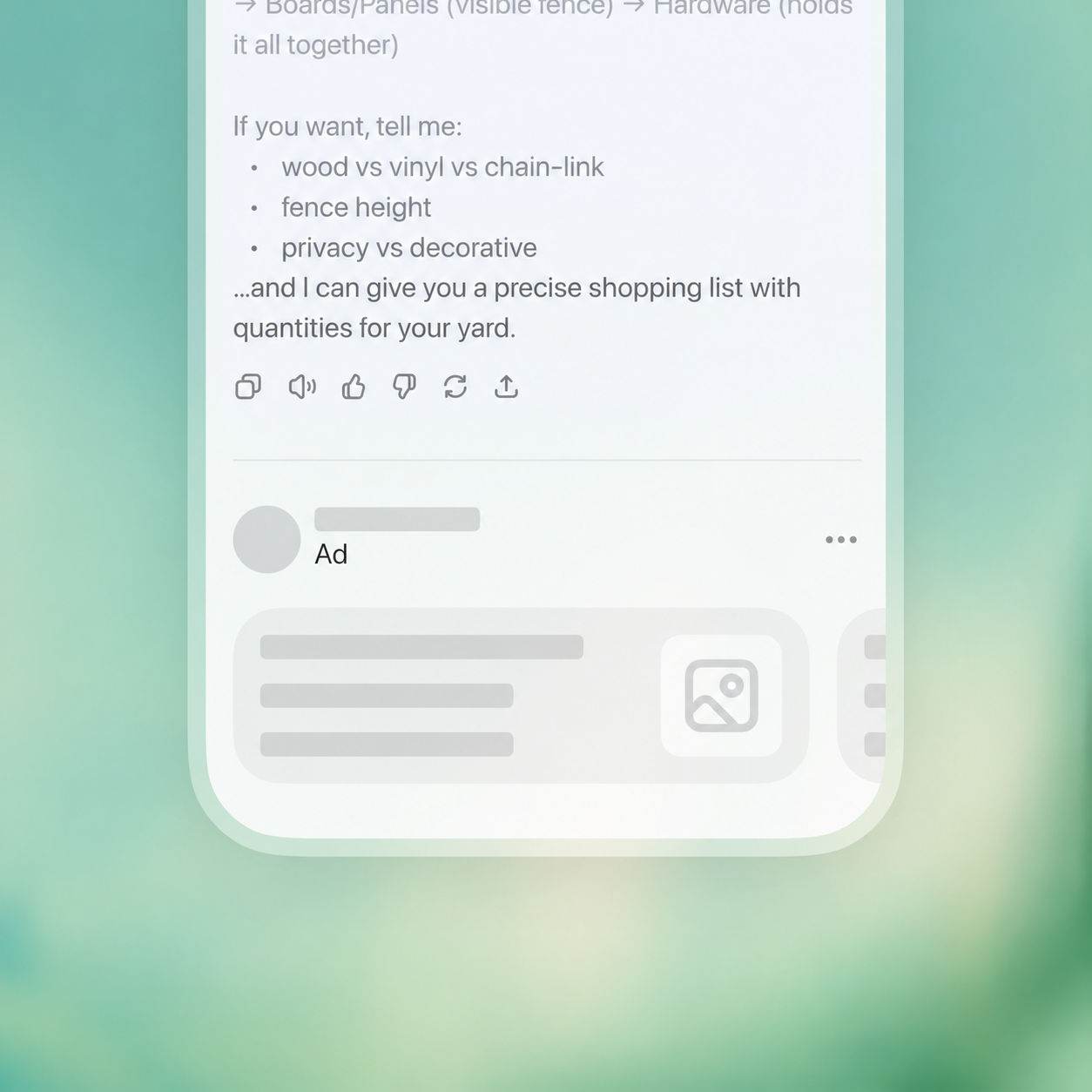
ChatGPT now has three meaningfully different ways to avoid—or accept—advertising. A Free or Go account may show sponsored cards. A Free user can switch to an Ads-Free option without paying, but receives fewer messages and loses some tools. Plus and Pro remove ads without those reduced Free limits, in exchange for a subscription.
That makes the useful family question more specific than “Should we turn ads off?” The real choice combines price, usage, tools, personalization, and age settings.
Three paths, three tradeoffs
1. Keep ads and retain more Free access
OpenAI says ads may appear on Free and Go plans in regions where the test is active. They appear below the end of an answer, carry a sponsored label, and are visually separate from the response. The company says advertisers cannot shape, rank, or alter ChatGPT’s answer.
This path keeps the higher ad-supported Free limits and tool access. It also means the current conversation can help select a relevant ad. When personalization is enabled, ad selection may additionally use signals from past chats, memory, ad history, and topics.
Turning personalization off is not the same as turning ads off. It removes those broader signals from ad selection, but the current chat still supplies context and ads can still appear.
2. Choose Ads-Free without paying
Free users can open Settings → Ads controls → Change plan and choose the option that reduces message limits. OpenAI says this removes ads, but users may hit limits more often and lose access to tools such as image generation and deep research.
The option can be reversed. A user who reaches a limit may switch back to the ad-supported Free experience for more access. Ads-Free is specifically a Free-plan option; OpenAI’s help page says a Go subscriber would need to return to Free or move to an ad-free paid tier.
This is the least obvious choice in the new system. It preserves a zero-dollar price, but it is not the same product experience with one toggle changed.
3. Pay for an ad-free plan
Plus and Pro accounts do not show ads and do not take the reduced limits of the Free Ads-Free option. Business, Enterprise, and Edu accounts are also ad-free.
For a household, the decision depends on actual use. Someone who asks a few questions may find the free Ads-Free option sufficient. A person who regularly uses images, deep research, or higher message limits is comparing a subscription with the ad-supported Free experience, not with an otherwise identical free product.
What the privacy controls do—and do not do
OpenAI says advertisers do not receive chats, chat history, memories, names, email addresses, precise locations, IP addresses, or sensitive information. Advertisers receive aggregate performance measures such as views and clicks. If a user deliberately messages an advertiser through an ad, that advertiser can see the messages sent directly to it.
Users on an eligible ad-supported plan can inspect ad history and topics, delete ads data, turn personalization off, and disable the use of past chats and memory for ad relevance. Deleting ads data does not delete chats, and OpenAI says removal from its systems may take up to 30 days.
Temporary Chats do not show ads. The controls also let users hide or report an ad and ask why it appeared. “Ask ChatGPT” is a deliberate handoff: by default, ChatGPT cannot see the ad, but selecting that command shares the ad into the conversation.
OpenAI’s policies exclude ads near sensitive conversations such as personal health, mental health, and politics, and currently prohibit political ads. Policies describe intended boundaries; they are not evidence that every placement will always be correct. Reporting tools still matter.
The under-18 boundary depends on the account
OpenAI says it does not show ads to accounts identified as belonging to people under 18. It uses account-level age information and age prediction where available, drawing on signals such as stated age, account history, typical usage times, patterns over time, and general discussion topics.
Logged-out use follows a different rule. OpenAI says ads in logged-out experiences are appropriate for all audiences, while mature-content ads are limited to eligible logged-in adults. In practice, a parent who wants the under-18 account protection should not assume an unsigned session has the same status as a correctly configured child or teen account.
Early evidence is useful, not conclusive
A new paper offers the first large independent look at the rollout. Researchers created 91 test accounts and collected more than 3,000 ads from 186 advertisers across 335 prompts beginning in February. They found that the ads were clearly separated from answers and skewed toward consumer goods. In their test design, lower-income accounts were more likely to receive ads.
The study is an audit of an early U.S. test, not a permanent map of the system. Its artificial accounts, chosen prompts, locations, and collection period limit how broadly the results can be generalized. The most responsible reading is that conversational advertising is now measurable—and should continue to be audited as products, advertisers, and controls change.
For a household deciding today, save five checks:
- Is the account Free, Go, Plus, Pro, or institution-managed?
- Does the user need image generation, deep research, or higher message limits?
- Is ad personalization on, and can past chats or memory inform relevance?
- Is an under-18 user signed into an account with correct age information?
- Does the family understand that “personalization off” and “Ads-Free” are different settings?
Three more developments worth knowing
Pixel 11 turns one tap into a share-ready photo-and-video set
Google’s live Pixel 11 page describes Magic Capture, which automatically records photos and video, edits them, and assembles a collection ready to share. The phone also introduces Tensor G6, an updated 48-megapixel main camera, a claimed battery life above 30 hours, and seven years of updates.
Magic Capture is convenient precisely because it makes several choices at once. A family using it for a first day of school or a birthday should distinguish the moment the camera recorded from the collection the software selected and edited. That does not make the result false; it makes automated curation part of the product.
Anti-AI language is moving into game publishing contracts
GamesRadar interviewed Haley MacLean, head of the video-game practice at Voyer Law, who said nearly all of her current indie-to-AA clients now seek clauses prohibiting generative AI in publishing agreements. She pointed to player sentiment and unresolved copyright exposure as major reasons.
This is direct reporting from one lawyer’s client base, not an industry-wide survey. It cannot tell us what most contracts contain. It does show where the debate is moving: teams are negotiating provenance, permitted tools, and legal risk before a game ships, rather than relying only on a store disclosure afterward.
GPT-5.6 Sol is previewing a much faster serving path
OpenAI says GPT-5.6 Sol’s new Ultrafast mode runs on Cerebras hardware at up to 750 output tokens per second—up to 14 times faster than Standard processing. It is available in a limited preview to selected customers while capacity expands.
Speed can change which AI interactions feel natural: live coding, voice-like interfaces, and rapid tool loops all benefit from lower waiting time. But “up to” throughput is not an end-to-end application benchmark. Network delay, prompt size, tool calls, output length, capacity, and the user’s own interface can all dominate real experience.
The common thread across today’s four stories is choice architecture. A label, plan, contract clause, or speed number becomes useful only when it tells a person what changes, what remains under their control, and what the evidence still cannot guarantee.
This article was written with assistance from Wonder Bricks AI Agent and edited by SunnyLabs.