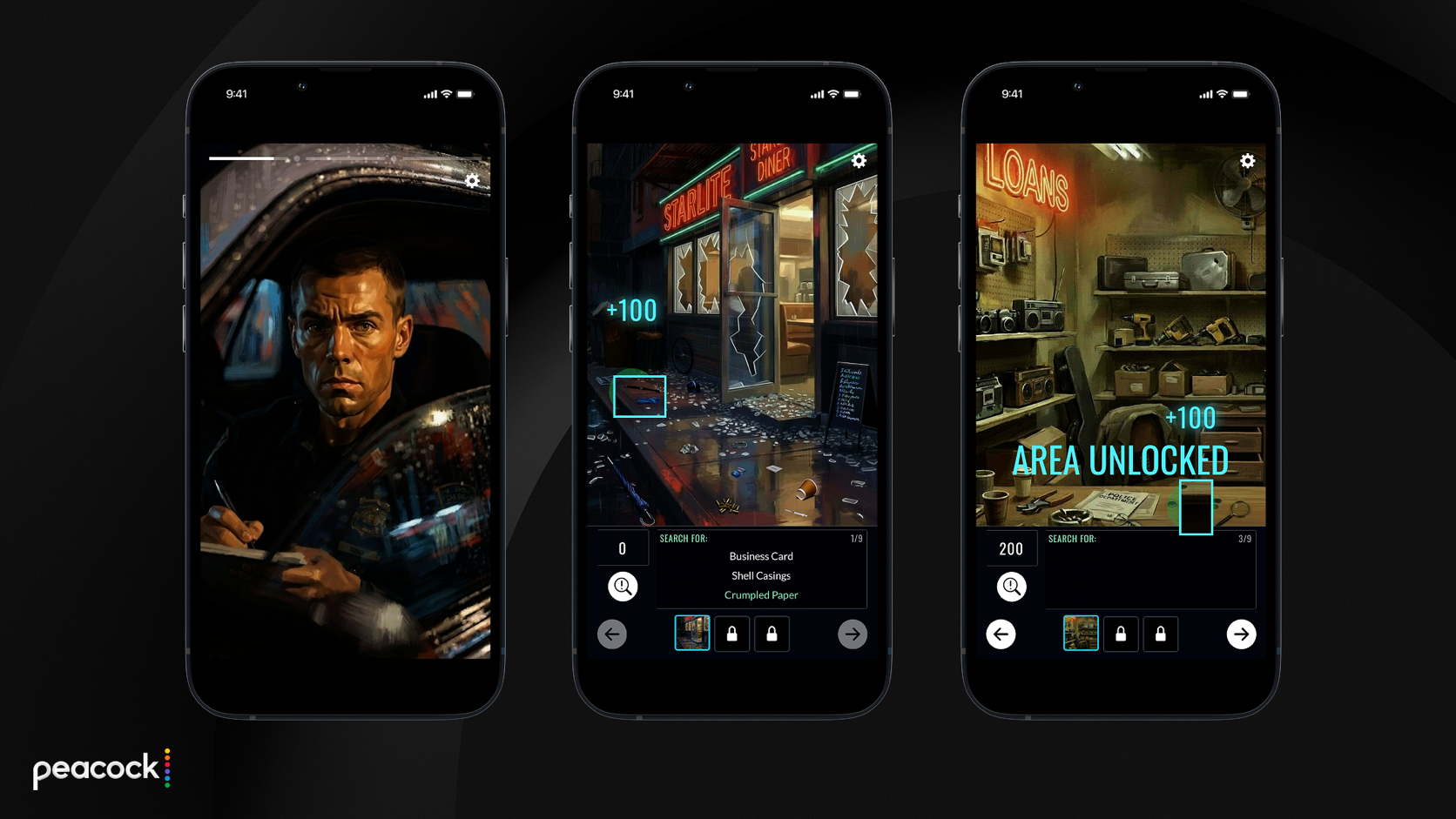
Peacock has put a game where viewers normally expect another episode. Public Eye, launched August 10 inside the streaming service’s mobile app, is a 10-part detective story in which players search animated crime scenes for clues and follow one conspiracy across the full season.
NBCUniversal says Wolf Games combined generative-AI visuals with human storytelling and a hidden-object game loop. That distinction matters. The launch is not merely a stream of generated video. It asks whether AI-made scenes can support a story people actively inspect, solve, and return to.
A streaming app becomes the game store
Ten episodes, one case, and clues under your fingers
Players take the role of Officer Logan Dine, who is secretly investigating his uncle’s murder in Caldera City. Each episode advances the story, then gives the player animated scenes to search. Objects and documents become clues, and the case expands into a conspiracy inside the police department.
The format joins two mobile habits that have mostly lived apart: short, serialized drama and casual puzzle games. Peacock does not send players to a separate download or console. Watching and playing sit inside the same app, account, and session.
NBCUniversal presents the AI-generated visuals as one production layer, paired with Wolf Games’ writing and game design. The company has not said which images, animation steps, or production decisions were generated, reviewed, or revised by people. It also has not released an independent quality evaluation. The safe conclusion is narrower: generative AI helped produce the visual material, while the published product still depends on a human-authored mystery, a clue system, and episode structure.
Peacock already knows some viewers will play
The company says 40% of Peacock mobile users engaged with a game in June. It also says players of Law & Order: Clue Hunter, another Wolf Games title, spend more than six minutes a day in that game on average, and that some Wheel of Fortune TODAY players became first-time viewers of the television show.
Those are company-reported figures, not an independent measure of game quality or long-term retention. Peacock has not published Public Eye’s completion rate, repeat-play rate, or how many people finish all 10 episodes. The unanswered question is whether a serialized mystery creates a durable reason to return, or whether the novelty fades once the first generated scene has been searched.
For parents and creators, the distribution change may be more important than the rendering technique. AI-made games are moving out of research pages and specialist creation tools. They are appearing inside apps that families already open for something else.
Three more developments worth knowing
Grok 4.6 is built to stay with longer jobs
SpaceXAI released Grok 4.6 on August 12 with an explicit focus on long-running agents and more ambitious interactive and visual work. The company describes tasks that span research, large codebases, application building, and polished work artifacts rather than one prompt and one reply.
Grok 4.6 is available in Cursor and Grok Build. SpaceXAI is offering twice the included usage in those products for the first week. The launch page also reports benchmark comparisons with other frontier models, but those results come from the maker and use a mix of published system cards and benchmark leaderboards.
The practical change is easier to state than the benchmark table. Frontier models are becoming tools for work that continues across many steps. That makes review, interruption, tool access, and the point at which a person takes over more consequential than a single polished answer.
ONE Store gave AI-made games their own shelf
ONE Store opened a dedicated AI Games section on August 7 through a partnership with the AI game platform Verse8. GameMeca reports that the section launched with 20 titles, including Ragnarok Breaker and Heros Unite, and lets users play without downloading a separate app for each game.
The store began a launch promotion on August 11. ONE Store describes the section as the first dedicated AI-game area in an app market and says it wants to build a standing distribution path for individual creators. Those first-in-market and future-scale claims come from the company; they should not be read as proof that the 20 games have found an audience or can retain players.
Still, a real distribution shelf changes the question. AI game tools no longer need to prove only that someone can make a small game. The games must now compete for a click, explain what is worth playing, load reliably, and give people a reason to return.
Google’s 353,000 learners produced more than 6,000 projects
Google and Kaggle say more than 353,000 people joined their five-day AI Agents: Intensive Vibe Coding course. The program combined expert sessions, technical papers, notebooks, community debugging, and a capstone. Participants submitted more than 6,000 projects, from historical transcription tools to space-weather research systems.
Enrollment is not completion, and a submitted capstone does not prove lasting skill or product quality. Google has not published a representative learning-gain study for the course. The project count nevertheless says more than registrations alone: thousands of participants moved from watching lessons to making something that could be reviewed.
The course materials remain available through Kaggle Learn. For families and educators, the interesting design choice is not the phrase “vibe coding.” It is the short loop from a natural-language idea to a working artifact, followed by debugging, documentation, and a public capstone.
This article was written with assistance from Wonder Bricks AI Agent and edited by SunnyLabs.