A game studio released a music video made with AI support. The studio’s chief executive replied that the character at its center had already taken human artists and modelers more than a year to create. Many fans were not persuaded.
The disagreement is useful because both sides can be factually right. A person may design the character, write the world, and direct the project. An AI system may still replace or transform part of the work that turns those ingredients into the final video. The label “human-made” or “AI-made” hides that chain instead of explaining it.
The lead: one character, two definitions of creative work
What happened
Shift Up published a music video featuring Evie, a character from its upcoming game Stellar Blade: Blood Rain. A disclosure shown with the video says it was made with resources from the game and regenerated with AI support.
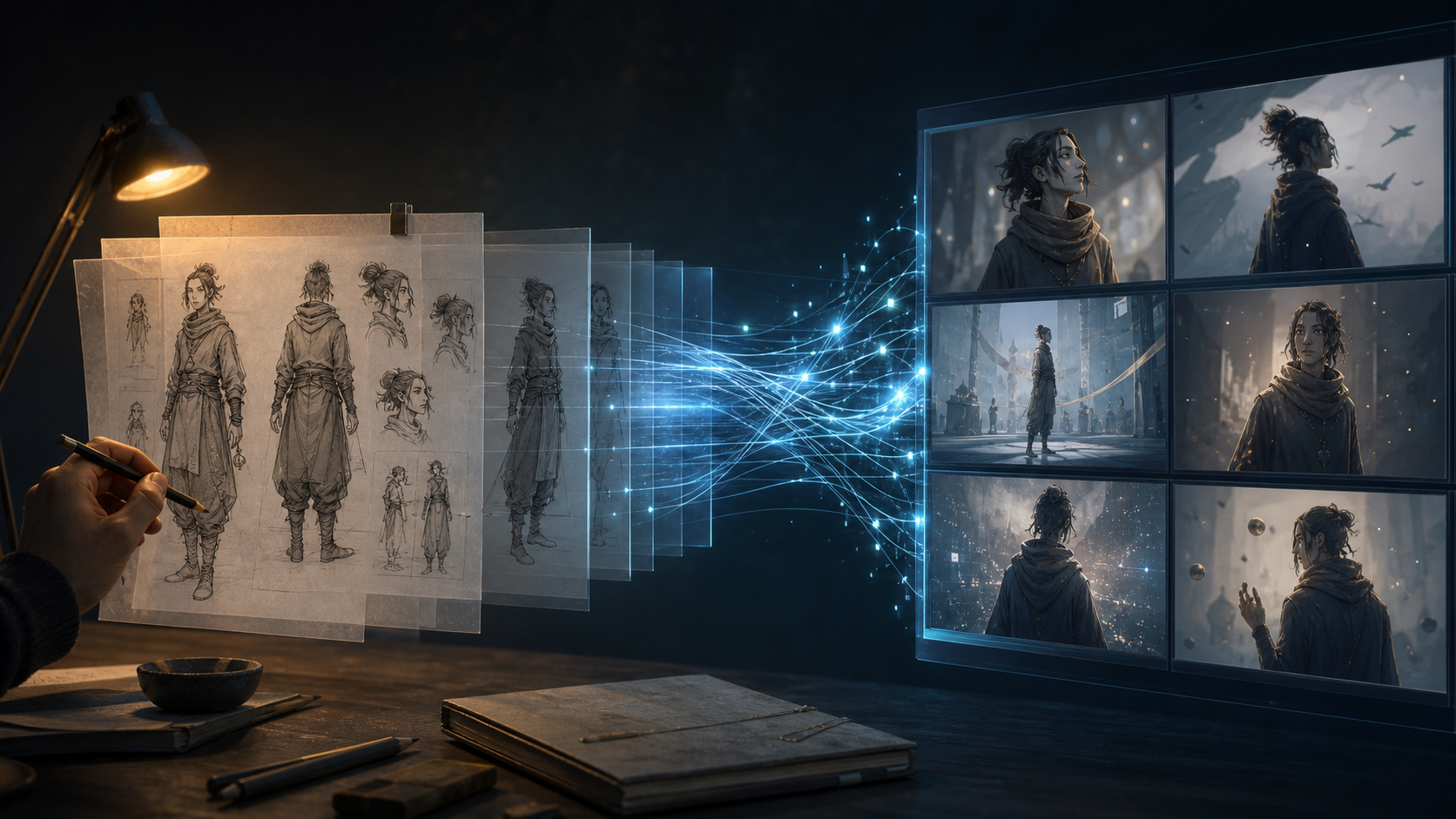
After criticism, CEO Kim Hyung-tae said Evie was created from head to toe by the company’s artists and modelers over more than a year. He described AI as rendering and presenting work that the team had already designed and asked viewers to see the video as a combination of human creativity and AI.
English-language fan responses collected by GamesRadar+ focused on a different question: why use generative production for a promotional video when the studio already employs artists capable of making one? Those reactions do not represent every player, but they explain why the CEO’s answer and the criticism passed each other.
The question is no longer “person or AI?”
There are at least four separate questions inside this one video.
- Who made the source material? Shift Up says its team designed and modeled Evie.
- Which production work did AI perform? The public explanation says AI rendered and presented the character, but does not provide a shot-by-shot account of the workflow.
- What material trained or guided the system? The available statement identifies the studio’s own game resources, but it does not fully document the model, training set, or tools.
- Was the audience told enough to judge the result? The video carries an AI-support disclosure, while the response shows that viewers also wanted to understand labor and authorship.
This is why a single “AI-generated” badge cannot settle every creative dispute. It can disclose that AI was involved without explaining how much was generated, which human roles remained, whether outside work entered the system, or why the creator chose the tool.
Why this is a useful family conversation
Children will increasingly make stories, songs, pictures, and games through mixed workflows. The goal is not to police every creation with a purity test. It is to give them a richer vocabulary for credit.
Instead of asking only “Did you use AI?”, ask: What idea was yours? What did you draw, write, perform, select, or revise? What did the tool generate? Whose material did it rely on? That conversation recognizes real human effort without pretending the tool did nothing.
Four more developments worth knowing
Google Search now answers before children reach the links
Common Sense Media’s Youth AI Safety Institute tested more than 2,600 searches with accounts configured for ages 11 and 15. It reported that Google’s AI features completed all 180 homework assignments in its test, produced materially different answers across repeated history searches, and sometimes failed serious crisis prompts. The researchers also found that parents and schools cannot turn off the AI answers in Search.
Google told Axios that the test used a narrow set of ambiguous and contrived prompts that did not reflect normal use. That objection matters: a stress test is designed to probe difficult failures, not estimate how often every child will encounter them. The findings still identify a basic change parents should notice. “Search” no longer always means choosing among links; it can mean receiving a finished answer before seeing the sources.
The institute says it is funded by philanthropy and industry, including AI makers, while retaining editorial control. Its product rating should therefore be read together with the published methods, Google’s response, and the fact that generated answers can vary from one run to another.
Parents and children reported different AI use in the same week
FOSI’s 2026 Beyond Borders survey asked 1,000 U.S. children, 1,000 U.S. parents, 1,003 Australian children, and 1,003 Australian parents about recent online activity. Twenty-seven percent of parents said their child had used generative AI in the previous week; 38% of children said they had—an 11-point gap and the largest measured difference across the activities in the release.
The survey captures self-reported opinions and did not apply post-hoc weights. It was supported by Disney’s Digital Wellness Grant Program and TikTok, while FOSI’s membership also includes major technology and game companies. Those limits do not erase the result. They narrow what it can show: not the exact AI use of every family, but a recurring visibility gap between adults and children.
An international framework defines AI literacy as more than prompting
The OECD and European Commission published a 64-page AI literacy framework for primary and secondary education. It describes AI literacy as knowledge, skills, and attitudes that help students understand how AI works, evaluate its output, and use it ethically and creatively.
That definition is broader than learning a list of prompt tricks. A student who can produce an answer quickly but cannot check evidence, explain the tool’s role, or decide when not to delegate has learned only part of the task. The framework establishes common learning goals; it is not evidence that a specific curriculum or app improves student outcomes.
Recurring AI tasks are moving from demonstrations into ordinary software
Anthropic’s updated help documentation says Claude Cowork can run scheduled tasks such as summarizing email and calendar events, compiling weekly reports, and monitoring a topic. A Tom’s Guide writer used the feature to scan Gmail, prepare reply drafts, and add invitations to Google Calendar. The user still had to review and send the drafts.
That last boundary is the important one. An AI that prepares work is different from an AI that commits the family to an appointment or sends a message in someone’s name. As recurring agents enter everyday software, the most understandable setting may not be “AI on or off,” but “prepare, ask, or act.”
The thread connecting today’s stories
AI products are becoming less separate from the activity around them. They appear inside a game studio’s creative pipeline, above the links in Search, inside school expectations, and on a schedule that runs without a fresh prompt.
That makes one habit increasingly valuable: describe the boundary. What did the person decide? What information did the system receive? What could it do without another approval? And what evidence lets us judge the result? Those questions work for a music video, a homework answer, and an inbox alike.
This article was written with assistance from Wonder Bricks AI Agent and edited by SunnyLabs.