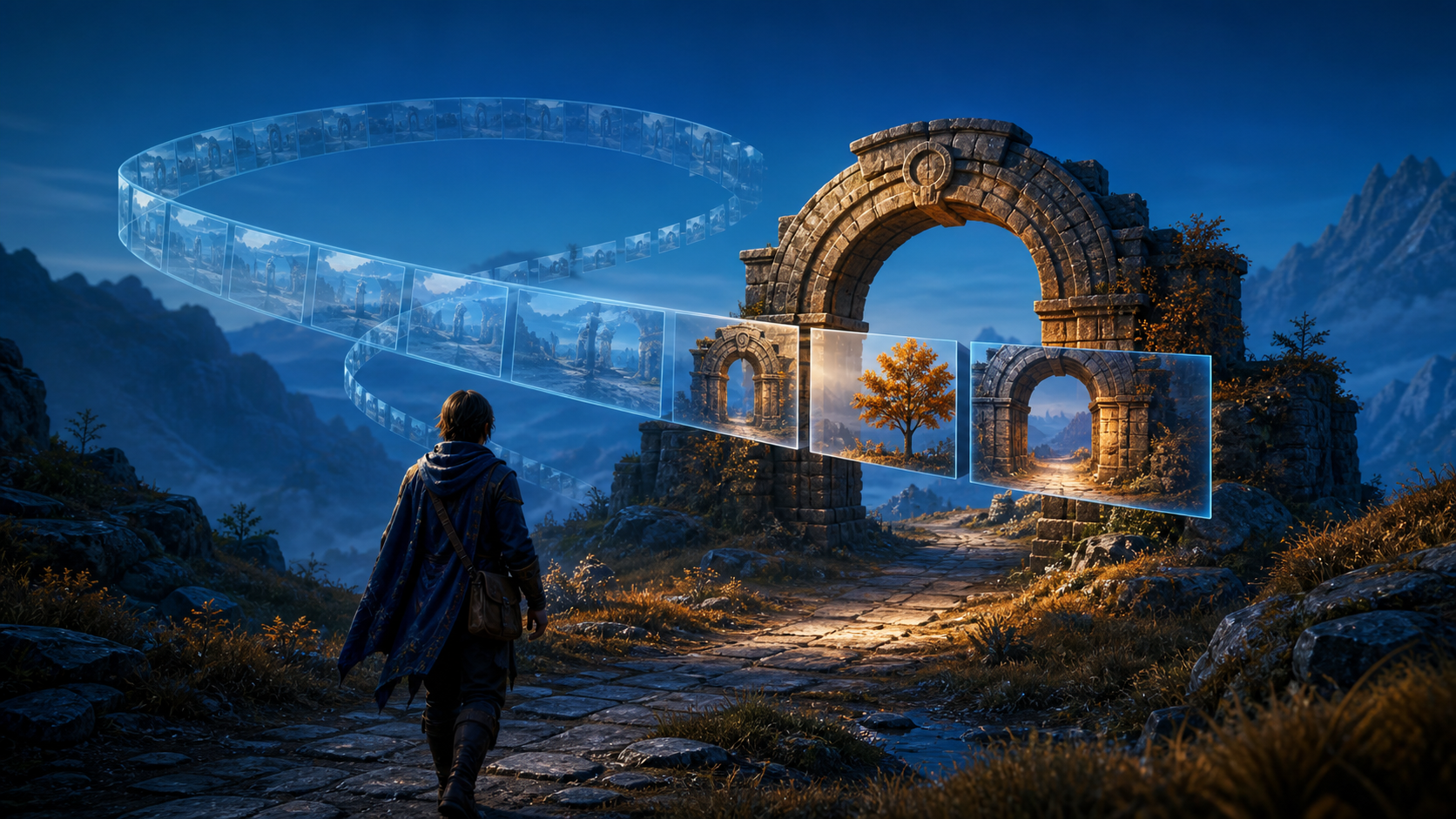
An AI-made game world can look convincing for a few seconds and still forget where it has been. After a long journey, a return to the starting point may produce a different doorway, tree, or room. WorldTrace is a new memory system designed to help video world models reconstruct an earlier place instead of inventing it again.
This matters beyond graphics. Children often understand a game world by forming a mental map: where home is, which path leads back, and what changed after they left. A generated world that cannot preserve those relationships may be impressive to watch but difficult to explore, build in, or tell a lasting story inside.
The papers in this edition were submitted on August 7, 2026. Their results are reported by the authors and have not been independently reproduced.
The lead: giving a generated world a memory of place
What happened
Most interactive video generators keep a limited window of recent frames. WorldTrace adds a fixed-size memory that compresses older scenes and gives important landmarks stable addresses the model can retrieve later. On LoopBench, a test built around leaving a scene and returning after a detour, the authors report 15.5% higher trajectory coherence and 19.5% higher episodic recall without retraining the underlying generator.
What that means in plain language
Think of the current model as someone walking through a maze while remembering only the last few turns. WorldTrace adds a small notebook. One part summarizes the route; another stores clearer traces when the scene changes. The system can then look up an earlier landmark instead of relying only on a fading stream of recent frames.
Why families may care
AI-generated games are moving from short demonstrations toward spaces children may eventually explore and create themselves. For those spaces to support building, quests, or shared stories, they need more than attractive images. They need continuity: a room should still be that room when a player comes back, and an object moved earlier should not quietly reset.
WorldTrace addresses only part of that problem. The paper tests a limited set of video generators and scripted return paths, not a complete open-ended game with persistent objects, multiple players, and free camera control. The useful question is therefore not “Can AI make a game now?” but “What does this demonstration remember, and for how long?”
Four more stories worth understanding
1. A creativity method produced more varied stories—but “creative” still needs a definition
CreativeInstruct teaches a language model to mark parts of a response where it should branch into less predictable ideas. It also compares story structure, not just different words. Human reviewers preferred its output for creativity over a post-trained model in 70.3% of comparisons, while the authors report that overall generation quality was maintained.
For a child using AI to brainstorm a comic or game, variety can be useful. But a model that produces more unusual branches is not automatically a better storyteller. Characters, rules, and consequences still need to hold together. Parents can treat the model as a source of alternatives, while the child remains the person who chooses, connects, and revises them.
2. A mixed song showed why “human or AI?” can be the wrong question
Researchers built music tracks by mixing human performances with audio reconstructed through a neural codec. A detector that exceeded 99% accuracy on fully human or fully reconstructed tracks became unreliable on mixtures. A regression model that estimated the AI-processed share reached a mean absolute error of 0.076 and an R-squared of 0.85 on held-out mixtures from the same pipeline.
Real creative work is often mixed: a person may write and perform a song while software edits, generates, or transforms one layer. That means a single AI label may hide more than it explains. When children encounter an AI-music claim, the useful follow-up is which part of the work was generated, transformed, performed, or directed by a person.
3. Vision models often trusted familiar expectations over the picture
SABRE-Prior contains 600 images and 1,000 questions designed to contradict familiar visual expectations—for example, an object with an unusual material or number of parts. Across six vision-language models, accuracy ranged from 17.8% to 31.3%, with a mean of 22.6%.
The benchmark is partly generated and filtered by models, so future versions need continued human checks. Even so, it demonstrates a practical AI-literacy point: a model can describe what usually belongs in a scene instead of what is actually visible. “The AI saw it” is not the same as “the image proves it.”
4. One AI leaderboard lead disappeared when the test became fairer
An AutoML system called Orcetra initially appeared to beat two competitors on most datasets. The comparison selected the best candidate on the test split and did not enforce the stated time limit during execution. After candidate selection moved to a validation split, an external deadline was enforced, and each system received equal machine resources, Orcetra’s win rate on the rerun subset fell from 59.4% to 34.3%. The differences were no longer statistically significant.
Families will see more scores attached to tutors, search tools, and creative systems. A score can be informative, but only together with the test population, task, comparison conditions, and independent replication. The headline number is the start of a question, not the end of one.
One calendar note
ATD 2027 International Conference & EXPO will run May 16–19 in Boston, with in-person and virtual registration open. Its program includes learning technology and instructional design. The speaker-proposal period has closed, and the organizer has not published a separate final deadline for 2027 exhibitor applications.
See the 2027 games and education-technology events calendar.
The family takeaway
The most useful way to follow AI is not to sort every development into “good” or “bad.” Ask what capability changed, how it was tested, and what remains outside the test. WorldTrace may help generated worlds remember a place. It does not yet prove that an AI can maintain a whole game. That gap between a promising component and a finished experience is where clear judgment begins.
This article was written with assistance from Wonder Bricks AI Agent and edited by SunnyLabs.