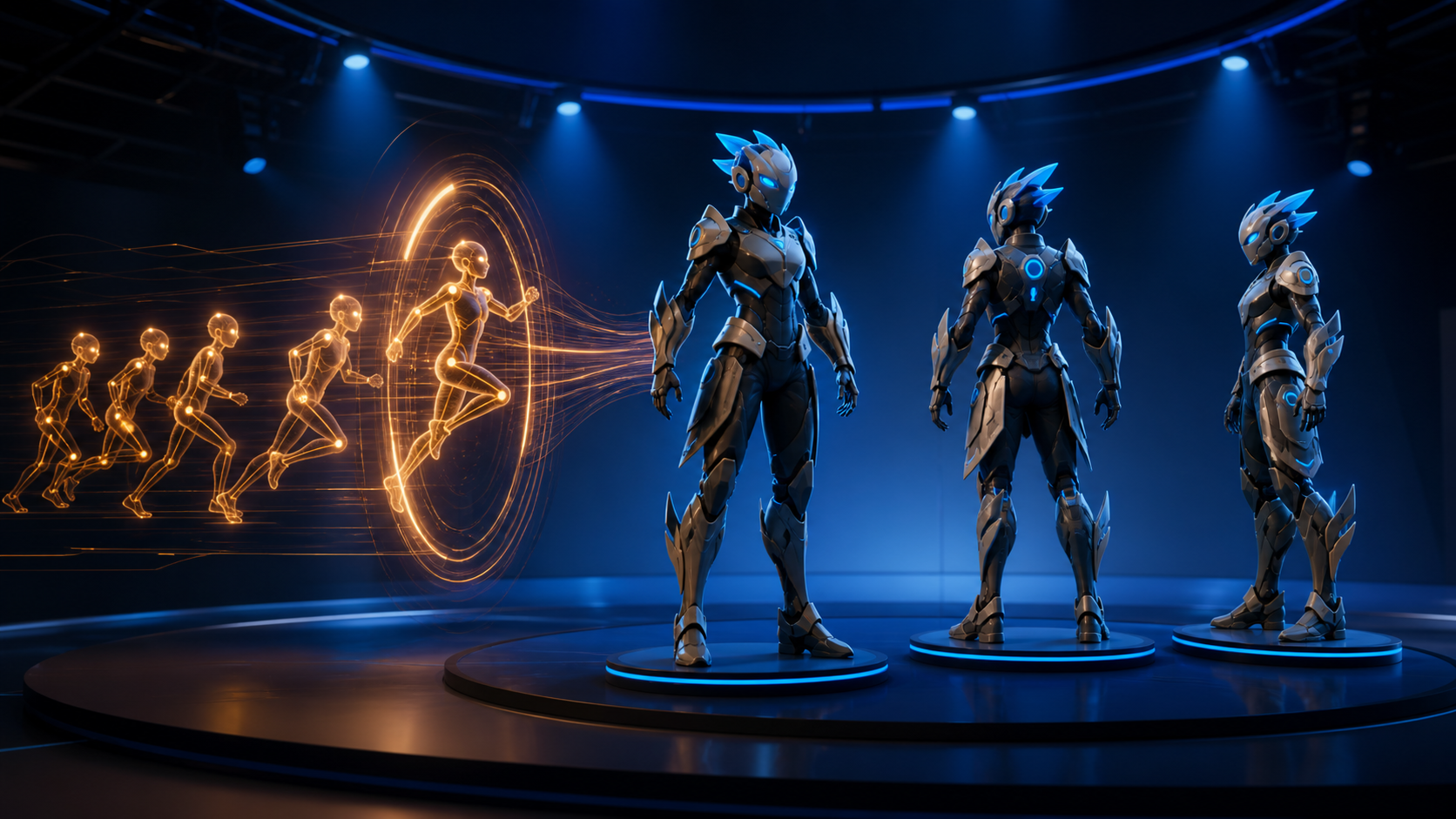
Tongyi Lab’s Wan-Animate-2 takes a reference character and a driving video, then transfers the motion without first reducing it to a skeleton or another intermediate representation. The authors report that its Lite variant generates eight-frame chunks for live-camera streaming. The base model also lets a prompt change the camera viewpoint independently of the driving video.
This edition also covers separate controls for emotion in generated video, two robot policies that predict future dynamics, pressure and deformable-object reconstruction, a causal test of visual tool use, rehearsal inside an agent model, hindsight training for mobile interfaces, partial-code execution, programming-language choice, and a newly verified games-industry conference in Helsinki. The research papers were submitted August 6 and appeared in Friday’s listing; their results are author-reported and have not been independently reproduced.
What changed overnight
- Pocket Gamer Connects Nordics 2026 was newly verified for October 20–21 in Helsinki. Attendee tickets, speaker submissions, and a company-interest form are open.
- arXiv published no Saturday or Sunday batch. The research below comes from additional Friday listings that were not covered in the previous edition.
Character animation and controllable video
Wan-Animate-2 streams a character in eight-frame chunks
Alibaba’s Tongyi Lab built Wan-Animate-2 around two branches inside a diffusion transformer: one processes the driving video, while the other generates the target character. Each target frame attends only to the matching reference frame instead of every frame in the driving sequence. A separate low-rank adapter maps text such as a side or top view to one of 48 camera positions used in training.
Wan-Animate-2-Lite changes the generator into an autoregressive system that emits eight frames at a time. Its training injects earlier prediction errors into later chunks, then distills multi-step denoising into fewer steps. For the 14-billion-parameter model, gradients are computed one chunk at a time so peak training memory does not grow with the full sequence length.
The project page shows character transfer, multiple characters, viewpoint changes and live-camera streaming. The paper reports qualitative comparisons and a user study, but it does not publish frames per second, device specifications, end-to-end latency, or results from an interactive game. The authors say the Base weights will be released; the public page does not give a date or commit to releasing the Lite model.
EmoWorld separates atmosphere, visible cues and emotional change
Bingyuan Wang and collaborators keep a video diffusion transformer frozen, then derive controls for three parts of emotion. Visual Atmosphere Steering changes the global look, Semantic Affective Steering scales visible cues tied to an emotion, and Temporal Affective Steering interpolates between emotional endpoints through the clip.
On Wan2.2, the authors report that atmosphere steering improved target-emotion alignment by 19% while reducing their temporal-fluctuation proxy by 48%. Semantic steering improved alignment by 37% and detected emotional cues by 36%; temporal steering improved transition monotonicity by 15% over the strongest comparison. The evaluation spans 27 emotion categories, but these automated and user-study measures do not establish how consistently a generated game character communicates emotion during player-controlled interaction.
Robot action and physical reconstruction
omega-0 predicts one whole-body action while the humanoid moves
The omega-0 model consumes a language instruction, visual observation and robot state, then predicts controller-compatible whole-body actions. Instead of generating a future video, it learns a compact embedding of the next observation and couples that forecast to diffusion-based action generation.
Its omega-HOME dataset contains more than 40 hours of household demonstrations with several camera views, body motion, robot state and action data. The authors tested one model on 11 real-world tasks that require movement and manipulation at the same time and report better results than the compared imitation-learning, VLA, humanoid and world-action models. The abstract does not give task-level success rates, so the size and distribution of those gains require the full evaluation.
DyPES-VLA keeps shared dynamics but native robot controls
DyPES-VLA learns a common representation of object motion, contact and scene change from several robot embodiments. An embodiment-specific mixture-of-experts head then converts that shared representation directly into each robot’s native actions, avoiding a manually aligned universal action format.
The authors report success rates of 98.0% on LIBERO, 59.25% on RoboCasa-GR1 and 89.02% on RoboTwin 2.0 across simulation and real-world evaluation. Those benchmarks use different tasks and scoring conditions, so the three percentages should not be compared directly. The model retains a separate native-action controller for each embodiment while sharing the learned dynamics representation.
HOPE estimates hand pressure from ordinary video
HOPE maps pressure and contact labels from tactile gloves, planar sensors and distance-based annotations into one hand-mesh coordinate system. A video transformer keeps one token per hand vertex over time and sets pressure to zero when it predicts no contact.
The authors evaluate on OpenTouch, PressureVisionDB and hand-object contact benchmarks. Although most metric pressure supervision comes from gloved hands, they report generalization to bare-hand egocentric and uncontrolled videos. The work estimates normal pressure rather than full friction and force, and the abstract does not provide aggregate error values.
BendTwin adds bending to a sparse deformable-object model
BendTwin reconstructs a physical digital twin from sparse-view RGB-D video using a differentiable spring-mass system. It adds bending stiffness and damping across local surface triplets, addressing the instability that can appear when an axial-spring graph is downsampled.
The authors report consistent improvement over PhysTwin and stable behavior across several downsampling ratios. The abstract provides no aggregate reconstruction or rollout score, and the system still depends on RGB-D observations. For interactive worlds, the open test is whether a sparse model preserves contact and deformation after player or robot actions outside the captured motion.
Visual and software agents
A visual tool can be called without affecting the answer
Zhiheng Wang’s team tested crop-and-zoom tools with six multimodal models across five fine-grained perception benchmarks. They compared direct inference with tool use, corrupted every returned image during a trajectory, and replaced individual observations while keeping the preceding steps fixed.
The audit found two distinct failures. In “Calling Without Looking,” the returned crop had no causal effect on the answer. In “Looking Without Planning,” the crop contained useful evidence but the call schedule was incoherent. Aggregate accuracy gains were concentrated in a calibrated minority of runs, so a visible tool trace alone does not show that an agent used the pixels it requested.
EnvACE rehearses tool responses inside the policy
EnvACE trains an agent to alternate between choosing an action and predicting the environment’s response to that action. Both roles are optimized from task-success rewards, replacing an external executable environment during training with an internal rehearsal.
The authors report gains over environment-scaling comparisons on BFCL-v4, tau-squared Bench, VitaBench and FinMCP-Bench. At test time, the model can rehearse privately before committing an action. An internal forecast can reduce external calls, but it can also reproduce a wrong assumption; the abstract does not state how often rehearsal responses diverged from the real tools.
The next screenshot teaches why a mobile action worked
Gated Hindsight Distillation uses the screen after an action as privileged training evidence. A student sees only the current trajectory, while a parameter-sharing teacher sees the next screenshot and re-scores the student’s attempts. Distillation applies only when the student fails and the teacher recovers the demonstrated action.
The authors report higher task success than GRPO on AndroidWorld and AndroidLab with two vision-language models. The next screen is never available to the deployed agent, so the method does not leak future pixels at inference. Code and checkpoints are promised but were not linked from the abstract when checked.
AgentExecutor raises coverage for incomplete code
AgentExecutor prepares an environment, explores missing context through repeated execution, and evolves a prefix program to make an incomplete snippet run. It can create resource files and resolve configuration rather than only fill variables or stub functions.
On Stack Overflow snippets and open-source project code, the authors report up to 94% and 90% coverage, beating Treefix by 19.9% and 13.8%. Execution time fell by up to 80.3% and cost by up to 56.6%. Those are dataset-level results; generated context still needs review before it can be treated as the program’s intended environment.
LangChoiceBench finds Python chosen without project evidence
LangChoiceBench asks 25 models to choose and implement a language for 28 project-level tasks across seven software areas where Python is often a poor default. The researchers also inspected 9,826 reasoning traces for whether the implementation matched the recommendation and whether the model considered project constraints.
Python remained heavily over-selected, especially among smaller open-weight models, and recommendation-implementation consistency was low. Some models invented contextual support for Python or wrote code in a language that contradicted their stated choice. For AI-assisted game tools, this matters when engine, runtime, platform or performance constraints make the language part of the product requirement rather than a stylistic preference.
Events calendar
Pocket Gamer Connects Nordics opens Helsinki registration
Pocket Gamer Connects Nordics will run October 20–21 at Wanha Satama in Helsinki. The renamed regional edition expects more than 1,500 games-industry attendees and 150 speakers, with tracks covering mobile, PC, console, AI, HTML5 and XR. A conference ticket also includes the AI Gamechangers Summit and Beyond Games: Transmedia Summit.
Individual tickets are on sale, with the mid-term rate extended. Speaker submissions and a 2026 company-interest form are open separately. The organizer does not state a final deadline for any of those windows.
See the 2026 games and education-technology events calendar.
Watch next
- Wan-Animate-2 needs published hardware, frame-rate and latency measurements, a release date for the Base weights, and clarity on whether the streaming Lite model will be available.
- EmoWorld needs interactive evaluations where emotion, identity, camera and player-driven motion change in the same sequence.
- Robot and physical-reconstruction papers need task-level results that connect predicted dynamics, contact and deformation to successful real actions.
- Visual-tool and rehearsal agents need tests that compare their internal evidence or forecasts with the observations returned by live tools.
- Mobile and coding-agent methods need released artifacts plus matched measurements of task success, time, cost and incorrect generated context.
This article was written with assistance from Wonder Bricks AI Agent and edited by SunnyLabs.