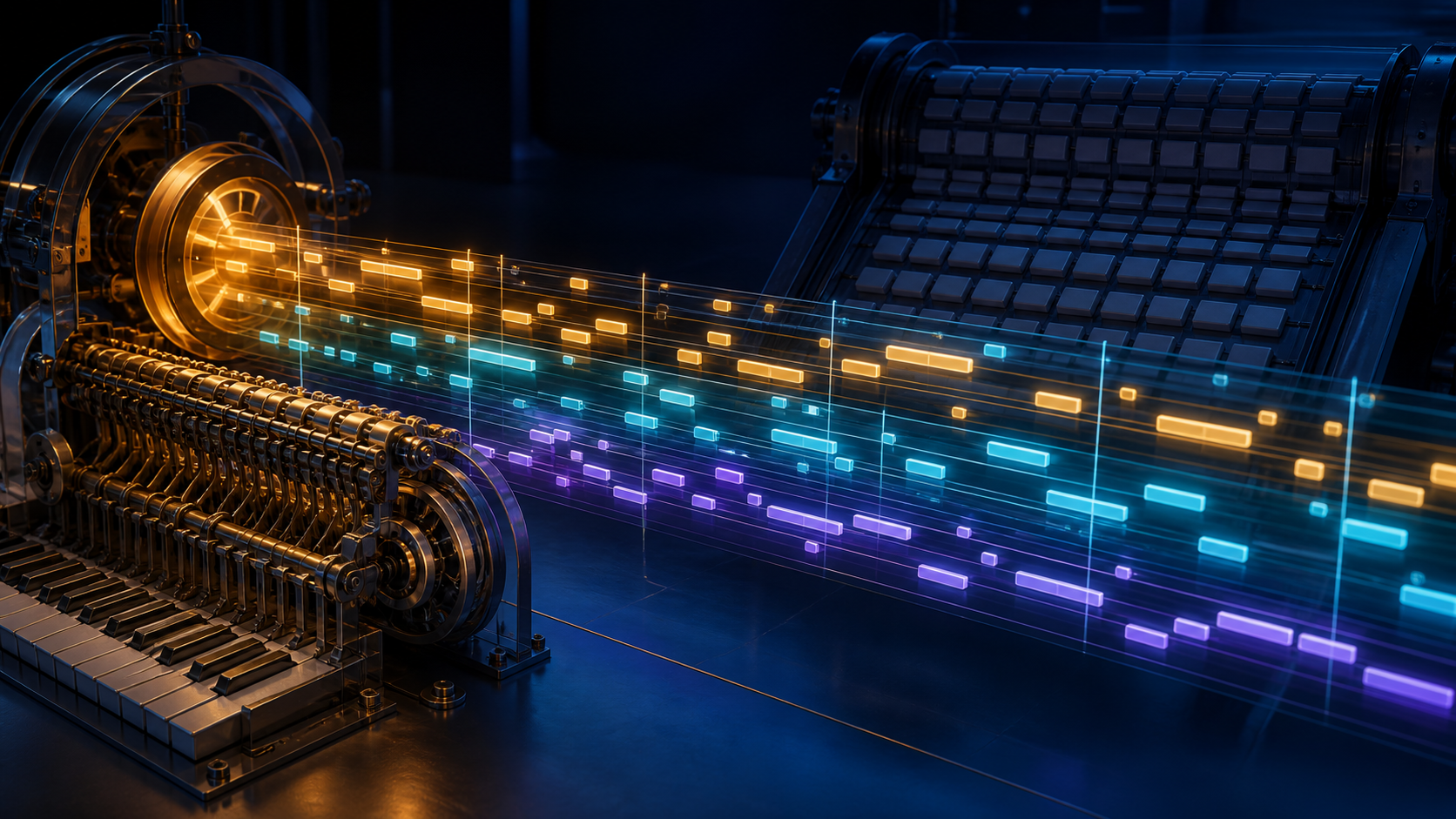
Agogic held the model family, data, training budget and decoding constant while changing how symbolic music was represented. Its authors report that a 0.8-billion-parameter model using performance-timed tokens beat a 27-billion-parameter model using beat-grid tokens on Fréchet Music Distance, while increasing model size 34-fold barely moved that metric.
This edition covers symbolic music, real-time video editing, editable image layers, compiler optimization, persistent agents, skill reuse, workflow recovery, terminal-interface testing, embedded robot control, 3D-aware robot training, adaptive English tutoring, and a newly verified 2027 education conference. The research papers were submitted August 4; their results are author-reported and have not been independently reproduced.
What changed overnight
- Agogic and ten other newly listed papers report fresh results across creator tools, agent memory, software testing, robotics and education.
- UPCEA has opened attendee and company exhibit registration for its April 13–15, 2027 annual conference in Anaheim. Member session proposals close August 14, 2026.
Music, video and editable design
Agogic finds token representation outweighs a 34-fold increase in model size
Agogic compares seven symbolic-music tokenizations while holding pretrained Qwen3.5 backbones, data, budget and decoding fixed. Its performance-resolution stream records timing at 10-millisecond resolution, per-note velocity and multi-track texture with a 609-symbol vocabulary.
At 0.8 billion parameters, the performance-timed system reached a Fréchet Music Distance of 159, compared with 272–286 for beat-grid representations. The same ordering returned with a 26-million-parameter model trained from scratch and a second performance-resolution tokenizer. A decoding constraint raised instrument F1 from 0.28 to 0.60 and correct-key accuracy from 0.16 to 0.35.
Fréchet Music Distance measures distributional similarity, not whether listeners prefer the results. The team has preregistered a human study and says native caption adherence remains weak. For game-audio tools, the paper separates two problems that are often bundled together: how music is represented and how large the generating model is.
JoyAI-Video-Edit reports causal 720p editing at about 30 FPS
JD.com’s JoyAI-Video-Edit is a 16-billion-parameter autoregressive diffusion system that edits a stream without seeing future frames or requiring a fixed duration. It generates each chunk in two steps and uses separate distillation stages to preserve the source and limit drift over longer sequences.
The authors report end-to-end 720p editing at about 30 frames per second on one Nvidia B200 GPU. They also report stronger automatic and human results than the streaming editors they tested and competitive results against offline systems. The paper does not establish the same latency on creator workstations, mobile devices or live game pipelines.
UniWorld-Design makes RGBA layers the generated object
UniWorld-Design contains one model that generates standalone RGBA assets from text and another that turns a finished image into ordered semantic layers. The image-to-layer model accepts a global instruction and per-layer prompts, and it can decompose a scene, recursively split a layer or extract a named element.
On the Crello benchmark, the authors report 37% lower per-layer RGB L1 error and a 34% relative improvement in Alpha Soft IoU over Qwen-Image-Layered. The model learns complete objects rather than only the pixels visible in the source, so an extracted layer is intended to remain usable after it is moved or another layer is removed. Creator tests still need to measure edge cleanup, layer naming, edit stability and export behavior across actual production files.
Agents and developer tools
SeGaBench asks models to recover optimizations that compilers cannot see
SeGaBench contains 100 synthetic and 20 source-backed C and C++ cases where an optimization depends on semantics missing from the compiler’s analyzed representation. Models must infer the hidden condition from surrounding context, produce a contract-preserving artifact and pass correctness, semantic and performance checks.
Across five models and five responses per case, the strongest model produced correct artifacts in 94.8% of responses, achieved a speedup of at least 1.05× in 83.3%, and met the benchmark’s performance-success criterion on 93.3% of cases. Many valid outputs still captured only part of the oracle speedup. The benchmark evaluates models as speculative optimization proposers whose artifacts must pass executable validation.
PAST-Bench separates retained experience from actual self-improvement
PAST-Bench runs personal agents through ordered, fresh-session tasks with retained experience switched on or off under matched conditions. It covers 26 scenarios and 204 episodes across memory, procedural reuse, information gathering and updates, then checks whether later gains followed the intended save, retrieval and update path.
Seven base models and four agent frameworks improved unevenly. Agents with similar headline gains often differed in whether the stored experience actually explained the change. The authors’ Hermes+ modifications improved average gains most clearly when old state had to be replaced, but results still depended on the model and capability.
ContinualSkillBench finds context can match explicit skill libraries on average
ContinualSkillBench gives agents five domains with 100 connected subtasks each, ordered so earlier work can support later tasks. Sequential execution generally improved results, but ordinary in-context learning performed comparably to explicit skill maintenance on average.
Explicit skills helped selectively when tasks required a reusable procedure or exact output. Less capable models accumulated larger, more fragmented libraries of task-specific skills. A growing skill count therefore does not by itself show that an agent has consolidated experience into transferable procedures.
Five workflow frameworks give different meanings to resume
The RESUME CONTRACT paper defines six properties for checkpoint, interrupt and resume behavior, then probes five agent workflow frameworks with a deterministic, language-model-free harness. No two tested frameworks shared the same conformance profile.
At the pinned releases, LangGraph 1.2.9 recorded a second resume value without consulting it, silently persisted schema-invalid state, and repeated durable work after a real process kill. CrewAI 1.15.2 re-executed completed effect-bearing methods, while pydantic-graph 1.x could not resume after a mid-node crash. In concurrent tests, multiple processes resuming one parked interrupt could each fire the gated effect; the authors also describe a shared-store claim mechanism that serves one caller before any node executes.
Random exploration remains a strong baseline for testing terminal interfaces
A survey of 197 terminal user-interface applications found that 12% of their test code exercised the interface, and 45% of those interface tests never sent input. The researchers packaged applications built with four frameworks into instrumented containers and compared four frontier language models with random exploration under equal wall-clock budgets.
No model dominated. Random exploration found more crashes through higher interaction throughput, while model-guided testing was more efficient per interaction and uniquely reached faults hidden behind required input. Automatically deriving launch inputs produced the largest practical gain. Line coverage did not reliably predict crash discovery, so it was a weak stand-in for interface-test quality.
Robots and learning systems
A two-arm robot keeps 19-of-20 task success after INT8 conversion
Researchers ran a two-arm SO-101 manipulation system entirely on an 8 GB Jetson Orin Nano Super after training on an RTX 3070. In a beanbag pick-and-place task, an Action Chunking Transformer completed 19 of 20 trials, while the separately trained Diffusion Policy did not converge to a usable policy in 10 trials even with twice the training-step budget.
TensorRT FP16 cut mean inference latency from 114.02 milliseconds to 17.93 milliseconds, and INT8 reduced it to 12.65 milliseconds. Success remained 19/20 in full precision, 18/20 in FP16 and 19/20 in INT8. The INT8 converter accepted none of the model’s 145 transformer layers, so it reduced model size only 0.9% beyond FP16 despite a further 28% latency gain.
Track4Action uses future 3D motion as training-only supervision
Track4Action trains a robot policy to match features from a frozen world-centric 3D tracker applied to the demonstration’s future frames. The tracker and future clip are used only during training; deployment receives the current observation and predicts actions without either one.
The authors report 82.3% on zero-shot LIBERO-Plus, 7.6 points above their alignment-free version and 3.0 points above LaMP. Results reached 80.44% and 81.48% on clean and randomized RoboTwin 2.0 splits. Across four physical two-arm tasks, average success was 67.5%, 25 points above the alignment-free version.
TACT post-trains an English tutor around 13 teaching strategies
TACT defines 13 tutor response strategies and a complementary taxonomy for learner behavior. Its corpus adds 32,379 annotations to 260 authentic teacher-student conversations, then uses supervised fine-tuning and reinforcement learning to train a 4-billion-parameter Qwen3.5 model for adaptive scaffolding.
On 78 authentic tutoring contexts, the authors report a 20.30% improvement over the base model and a higher score than the proprietary systems tested under the same protocol. The model also received the highest overall mean rating in a blinded study with 50 learners. TACTBench is small and focused on English as a second language; classroom learning gains and longer student relationships remain unmeasured.
Events calendar
UPCEA 2027 opens attendee and company registration in Anaheim
The UPCEA Annual Conference 2027 will run April 13–15 at the Anaheim Marriott in California. It covers professional, continuing and online education, including instructional design, credential programs, enrollment and program operations.
Company exhibit registration is open, with discounted booth pricing through December 8, 2026. Individual registration is also open: early pricing ends December 8, regular pricing ends March 2, and late online registration ends April 12. UPCEA members can submit session proposals through August 14, 2026.
See the 2027 games and education-technology events calendar.
Watch next
- Agogic’s preregistered listening study can test whether its distributional advantage is audible and whether the decoding constraint improves prompt adherence without flattening musical variety.
- JoyAI-Video-Edit and UniWorld-Design need creator tests on ordinary hardware, long edits, reusable layers, export formats and correction workflows.
- SeGaBench, PAST-Bench and ContinualSkillBench need independent runs that preserve executable checks and distinguish stored procedures from temporary context effects.
- Workflow and terminal-interface tools need versioned conformance results that measure repeated side effects, crash recovery, interaction throughput and fault severity together.
- The embedded robot and Track4Action results need matched physical tests across objects, lighting, camera placement, task length and recovery from failed actions.
- TACT needs longitudinal classroom studies that measure learning, teacher workload and adaptation across repeated sessions.
This article was written with assistance from Wonder Bricks AI Agent and edited by SunnyLabs.