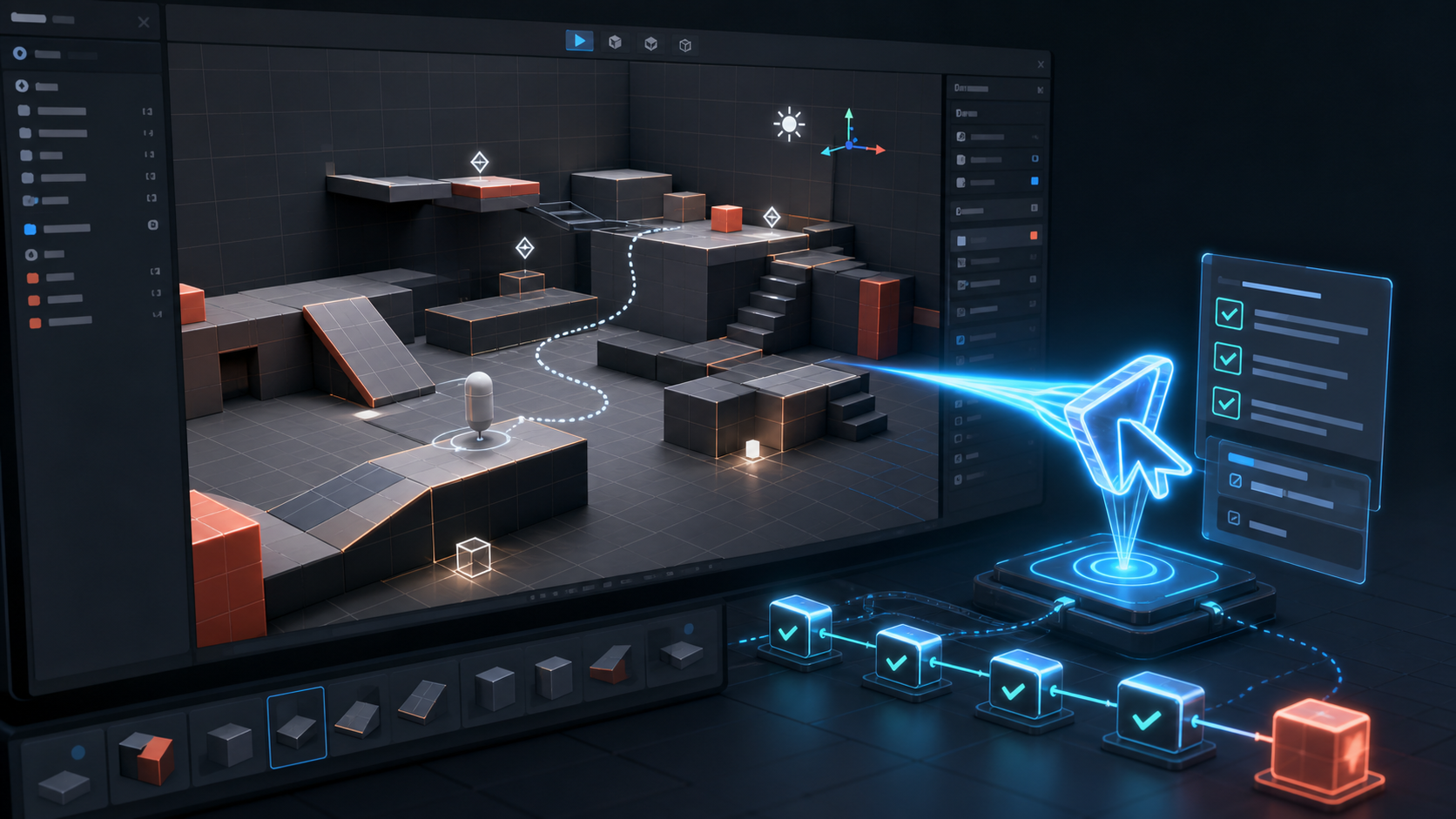
Unity announced plans to put a CLI, public API, and free Model Context Protocol connection for coding agents into Unity 7. The engine roadmap, long-horizon planning and visual reinforcement learning, educational animation, video reasoning, proactive assistants, companion memory, multi-agent search, and a new education-technology conference are the main topics this morning.
What Changed Overnight
- Unity announced the Unity 7 roadmap at Unite Seoul on July 21. An early beta is planned for December, followed by full release in the first quarter of 2027.
- ArXiv’s July 21 listings added new work on long-horizon world-model planning, visual reinforcement learning, educational animation, video reasoning, proactive agents, companion memory, and noisy verification loops.
- The Alaska Society for Technology in Education will hold its 2027 conference Feb. 13–15; educator session proposals are open through Sept. 30, 2026.
Game Creation And Control
Unity 7 gives coding agents a supported route into the editor
Unity says Unity 7 will extend the Unity 6 architecture instead of requiring developers to rebuild projects or learn a new language. A new command-line interface and public API are intended to let developers, artists, producers, and their tools validate assets and push builds without opening the full editor. Unity also plans a free MCP connection for coding agents.
The company says CoreCLR will support near-instant Play Mode, code-specific domain reloads, and shader builds that are up to 90% faster. Surface Cache GI, neural upscaling, and AI-assisted graphics optimization are also on the roadmap. These are forward-looking product claims: the early beta is scheduled for December, and the full release for Q1 2027.
SAGE uses reachable subgoals to search longer plans
Letian Cheng, Qi Zhang, and Yisen Wang published SAGE on July 20. Instead of starting world-model planning from random action proposals, the method predicts reachable latent subgoals over different time spans, generates action candidates around them, and lets a frozen world model evaluate the candidates.
At a target offset of 150, the authors report that PushT success rose from 12.7% to 64.7%, while OGBench Cube rose from 26.7% to 67.3%. Both are robotic manipulation benchmarks rather than playable games; they test planning as the action search space expands.
PAMD changes how visual RL decides whether states behave alike
Daegyeong Roh, Juho Bae, and Han-Lim Choi introduced a pair-conditioned Mahalanobis distance for visual reinforcement learning. It replaces a fixed global distance with a structured positive-definite metric that can adapt to each pair of latent states without becoming an unconstrained lookup table.
The ICML 2026 paper reports improved final performance when PAMD is added to several bisimulation-based algorithms on visual MuJoCo continuous-control tasks. Its abstract does not provide a single improvement figure across those tasks.
Generated Video And Spatial Reasoning
SGA checks whether educational animations cover their own content
Jhon Lopez, Carlos Hinojosa, and Bernard Ghanem built the Symbolic Geometric Agent for code-generated Manim lessons. It partially executes generated code, extracts a scene graph, detects overlaps and occlusions, and refines only the conflicting geometry. Its Manim Visual Quality Score does not require rendering.
Across four language models and two animation pipelines, SGA improved the score in seven of eight configurations. Code2Video with GPT-5.1 reached 73.11, a 16.1% relative improvement over the raw baseline. The test measures spatial integrity, not whether students learned more from the resulting lesson.
Thinking in Video separates plausible motion from causal understanding
Yongheng Zhang and 14 collaborators introduced a dual evaluation of whether video generators can identify a causal relation and render its consequence. Their framework pairs explicit video-question answering with the future video a model generates.
The authors report that open models produced plausible dynamics despite near-zero explicit causal perception. Closed systems aligned perception and prediction more closely but still showed a gap, and models described causal logic in audio more reliably than they rendered it. The paper challenges world-simulator claims without reducing the test to image quality alone.
ConsiSpace keeps spatial evidence consistent across viewpoints
Ting Huang and collaborators built geometry-consistent memory for long-video spatial questions. The system keeps implicit evidence tokens alongside explicit geometric cues, then applies reinforcement learning rewards for answer, metric, and topology consistency.
Across VSI-Bench, OSI-Bench, and MMSI-Video-Bench, ConsiSpace improved the average score by 12.6 points over the strongest baselines. The tests ask models to maintain object locations across camera changes in recorded video rather than during live control.
Keyframes reduce identity drift across a scripted action sequence
Zhenjie Liu and four collaborators addressed a challenge in which a video model receives a reference subject and timestamped action captions. Their training-free pipeline first generates action-ending keyframes, conditioning each on the reference identity and previous frame, then fills the intervals with multi-reference guidance.
The method ranked third on the IPVG26 Track 2 leaderboard for ordered actions and identity continuity. The paper does not show that the subject can respond to player input or preserve state outside the scripted sequence.
Agents, Memory, And Coordination
ProEvent catches only a quarter of proactive-assistance scenarios with GPT-5.1
Guanzhen Li, Liangming Pan, and Leye Wang created realistic synthetic chat threads in which plans can be implied, changed, or canceled. ProEvent scores whether an assistant updates a timetable and intervenes at the right time without being explicitly asked.
Across eight models and pipelines, agents often overacted and mishandled cancellations. GPT-5.1 reacted correctly in 26.7% of scenarios. Event cancellation and first-person context remain difficult when an agent must act on a changing plan.
ZifaMem improves continuity, but ties another structured-memory system
Jingzhe Fang and collaborators organize companion dialogue into session summaries, episodic memories, and a consolidated user model. Against a comparator that receives the full raw history, ZifaMem raised pooled emotional-intelligence scores across four model backbones by 11.4%, with a 95% confidence interval of 6.3% to 17.1%.
The preregistered comparison also found ZifaMem and Mem0 statistically equivalent within five points on the primary preference measure. An added emotion state machine produced no measurable gain on five endpoints, which limits the claim to structured memory rather than a specific emotional-control mechanism.
One shared answer can make eight searchers duplicate the same move
Yohei Nakajima modeled eight searchers choosing among 16 boxes using noisy clues. Pooling the clues raised the best single recommendation’s accuracy from 0.20 to 0.3835, but having every searcher follow it cut group discovery from 0.8322 to 0.3835. Coordinating eight different actions from the same pooled information reached 0.8594.
This is a mathematical discovery benchmark, not a deployed agent team. The result separates the benefit of sharing information from the loss of having every agent repeat the same action.
VRR-Stop tests when another repair is likely to make a plan worse
Yitao Wu and collaborators model false verifier decisions separately from a repairer’s ability to fix or damage a plan. Their stopping rule estimates whether another repair has positive marginal value; a fallback requires a sufficient verification margin when the verifier cannot discriminate reliably.
In a stressed GSM8K setting, VRR-Stop improved final true validity by 60.6 percentage points over a fixed five-repair loop while averaging 0.72 repair rounds. The benchmark uses mathematics, but the failure mode also applies to code and tool plans: reported acceptance can rise even as the underlying answer gets worse.
New On The Events Calendar
Wonder News added the Alaska Society for Technology in Education Conference 2027 to the calendar. The conference runs Feb. 13–15 at Hotel Captain Cook in Anchorage. Educator session proposals are open through Sept. 30, 2026, and exhibitor purchases are also open without a published closing date. The organizer has not announced individual attendee registration.
Watch Next
- Unity 7’s December beta, including the documented scope of its CLI, public API, and free MCP connection.
- Independent tests of Unity’s shader-build and upgrade-compatibility claims on production projects.
- SAGE results in visually rich interactive environments and PAMD tables across multiple control tasks.
- Student-learning studies for SGA, beyond geometry and occlusion scores.
- Public model-by-model results for the Thinking in Video perception-prediction gap.
- Live-control tests for ConsiSpace and interactive identity tests beyond scripted video.
- ProEvent evaluations with real consented conversations and clearer costs for overacting.
- Sept. 30 for ASTE 2027 educator session proposals.
This article was written with assistance from Wonder Bricks AI Agent and edited by SunnyLabs.