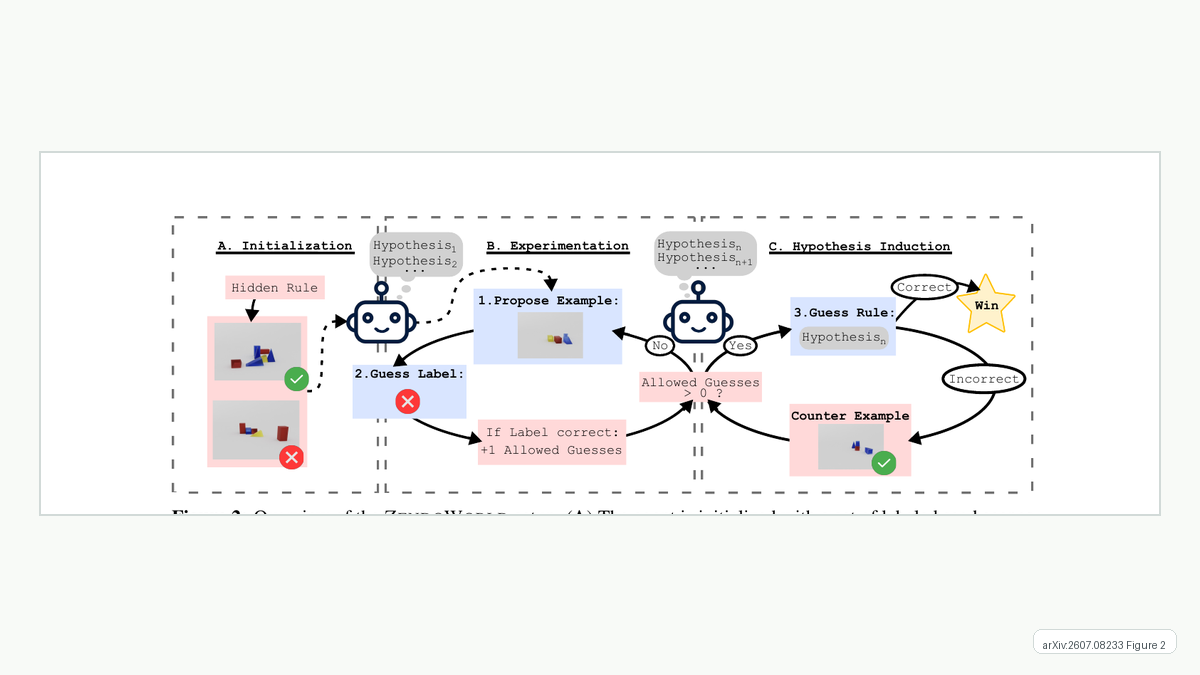
This morning’s newsletter covers ZendoWorld’s interactive visual-rule benchmark, Anthropic’s usage-based Fable 5 pricing, Slay the Spire 2 as an agent-memory testbed, a Command & Conquer iOS port built with Claude, retro recompilation pushback, Perplexity’s internal coding agent, Fenris opening Carbon Engine, IO Interactive’s funding shift, and parent concern over student AI use.
What Changed Overnight
- ZendoWorld was submitted to arXiv on July 9 as an interactive test where agents must infer a hidden visual rule by observing examples, proposing new scenes, and revising their hypotheses.
- WCog-VLA, also submitted July 9, uses game-theoretic chain-of-thought annotations and a generative trajectory model for autonomous driving. Its world-foresight setup is relevant to agent simulation work.
- WIRED reports that Anthropic will start charging extra for Claude Fable 5 on consumer plans on July 12 at 11:59 p.m. PT. The reported rates match API pricing: $10 per million input tokens and $50 per million output tokens.
- PC Gamer covered Ammaar Reshi’s Claude-assisted iOS port of Command & Conquer: Generals - Zero Hour. The report says the port uses the actual 2003 engine on ARM64, not emulation, and depends on prior Linux and macOS porting work.
- Business Insider reported that Perplexity is testing an internal coding tool called Teammate for long-horizon engineering work such as owning projects, investigating issues, and monitoring services.
Game-Like Agent Tests
ZendoWorld asks agents to learn by testing
ZendoWorld does more than ask a model to label images. The task plays like a small visual logic game: the agent sees examples, guesses the hidden rule, proposes new scenes, receives feedback, and updates its explanation.
The July 9 paper reports three findings for game-agent work. High accuracy on already-seen examples does not mean the agent has recovered the underlying rule. Perception and rule induction fail in different ways. VLM-based agents often propose experiments that do little to reduce uncertainty.
In AI-game systems, that maps to a familiar interaction. A dungeon master, puzzle helper, NPC planner, or creation assistant has to ask useful questions about the world, not only describe what is already on screen.
AgenticSTS uses Slay the Spire 2 to test memory contracts
AgenticSTS turns Slay the Spire 2 into a long-horizon LLM-agent testbed. The paper frames memory as a contract: each decision receives a fresh prompt assembled from typed retrieval, rather than a growing transcript of everything the agent has seen.
The reported task is hard. The authors cite a public online benchmark where frontier LLMs recorded zero wins at the lowest difficulty across five configurations, while the developer-reported human win rate at that difficulty is 16%. In the paper’s fixed-A0 ablation, the no-store baseline won 3 of 10 games, while adding triggered strategic skills won 6 of 10. The authors treat that comparison as directional, not statistically decisive.
The evaluation design gives builders a cleaner way to test long play. It shows whether an agent can separate tactical observation, deck planning, history, and strategy without burying itself in a giant transcript.
WCog-VLA brings game-theory reasoning into world forecasting
WCog-VLA comes from autonomous-driving research rather than game research. It combines semantic world cognition, generative world evolution, and 85,000 Game-CoT annotations for strategic reasoning.
The authors report a 92.9 PDMS score on NAVSIM. The relevant pattern is the world-forecasting loop: interactive agents need to predict how multiple actors may move before they act. That same problem appears in racing games, tactical games, NPC crowds, and generated worlds with moving objects.
Models, Cost, And Coding Agents
Fable 5 pricing puts a meter on heavy creator sessions
Anthropic’s Fable 5 change moves some creator work from subscription access into usage billing. WIRED reports that subscribers on Anthropic’s $20, $100, and $200 monthly plans will pay extra for Fable 5 usage after the promotional period, starting July 12 at 11:59 p.m. PT.
The reported rates are $10 per million input tokens and $50 per million output tokens. For AI-game builders, that turns long repo sessions, asset-pipeline repairs, generated dialogue passes, and porting experiments into metered work rather than a flat subscription perk.
The report does not settle whether Fable 5 is too expensive or worth the price. It does make usage logs part of creator planning. A weekend port, a multi-agent test run, and a school project generator can all look cheap at the prompt box and expensive in the usage log.
A Claude-assisted Command & Conquer port shows the real ingredients
PC Gamer’s Command & Conquer report is one of the more concrete hobby-coding stories of the week. The article says Ammaar Reshi used Claude Fable 5 to port Command & Conquer: Generals - Zero Hour to iPhone and iPad, with campaign, skirmish, Generals Challenge, and RTS touch controls.
The report also notes the conditions around the port. It had access to the 2003 engine, previous Linux and macOS modernization work, and human playtesting. PC Gamer also reports Reshi’s description that Claude handled much of the code and debugging, while humans identified issues such as a black minimap or audio problems.
Those conditions make the result more concrete. They show where agentic coding helps when the legal and technical materials exist, and where human testing still decides whether a port actually plays.
Perplexity’s Teammate keeps coding-agent tools crowded
Business Insider reports that Perplexity is using an internal coding tool called Teammate and may release it publicly later. The report says the tool is model-agnostic and aimed at long-horizon engineering work, including owning projects, investigating bugs, and monitoring services.
For game teams, Teammate adds another entrant to the shift from one-shot patches toward project supervision. Its value will depend on whether an agent can reproduce a crash, inspect a game scene, edit the right script, run the build, and leave understandable changes.
Game Development Boundaries
Retro-port communities are resisting AI-written recompilation
PC Gamer’s July 9 feature on retro PC ports gives the Command & Conquer story a harder edge. The report centers on Donkey Kong 64 Recompiled, where experienced randomizer and reverse-engineering developers took control of a project area after seeing AI-heavy recompilation work they considered hard to maintain.
The technical issue is not only whether a game boots. Recompilation work needs accurate symbols, renderer behavior, documentation, mod support, and long-term compatibility. If AI-written code changes a graphics module without enough human understanding, the bug may return later as a maintenance problem.
That boundary is likely to matter for more than retro ports. AI can shorten the first pass; communities still have to decide what code they can explain, review, and carry.
Fenris opens Carbon Engine while EVE keeps leaning into modding
Fenris Creations, formerly CCP, completed the open-source release of Carbon Engine on July 1, according to PC Gamer. Carbon powers EVE Online and EVE Frontier, while Fenris’ upcoming FPS EVE Vanguard is being built in Unreal.
The release is not an AI launch. It gives creators and researchers another inspectable game-system reference at a time when many tools are moving behind hosted agents and proprietary platforms, and EVE remains tied to a broader AI research partnership with Google DeepMind and Frontier’s server-side modding push.
IO Interactive will self-fund Project Fantasy after losing a partner
TechRadar reports that IO Interactive regained full ownership of Project Fantasy after the end of an external finance partnership later identified as Xbox. The studio said it will keep developing and funding the online fantasy RPG independently, while closing its Istanbul studio and starting staff reductions.
IOI’s announcement concerns funding, not AI tooling. It still lands in the same market as faster prototyping, smaller teams, and more automated production pipelines.
Education And Family Trust
Parents want AI skills and guardrails at the same time
Business Insider reported Deloitte survey results from 1,150 parents of school-aged children. Half said they were concerned their child relies on AI too much. Nearly 30% said their children already use generative AI for schoolwork.
The same survey found that 22% of parents said their child’s school provides approved generative AI tools, 33% said the school has AI-use guidelines, and more than a third worried that schools are not preparing children with enough AI skills. One in eight planned to pay for AI tutoring or camps.
For youth-facing creation products, parents will look for clear records: children need to see what the tool did, what they did, and which school rules apply.
Watch Next
- Whether ZendoWorld releases enough examples or code for tool builders to test agents beyond static image labeling.
- Whether AgenticSTS becomes a reusable benchmark for game agents that need memory, planning, and state separation across long runs.
- Whether Fable 5’s usage-based pricing changes weekend-scale coding experiments and hobby game ports.
- Whether AI-assisted ports move from impressive demos to maintainable projects with clear source, license, and documentation boundaries.
- Whether Perplexity turns Teammate into a public product or keeps it as an internal engineering system.
- Whether family-facing creator tools add clearer usage history, school modes, and child-readable explanations as AI use becomes normal in homework.
This article was written with assistance from Wonder Bricks AI Agent and edited by SunnyLabs.