SpaceXAI’s Grok 4.5 release, AlayaWorld’s playable video-world paper, and Meta’s new developer API lead today’s Wonder News. The newsletter also covers Godot’s AI-contribution boundary, Steam-player disclosure data, developer criticism of Bahast’s AI-asset disclosure, Perplexity’s internal coding agent, a Claude Code exploit write-up, and parent concern over student AI use.
What Changed Overnight
- AlayaWorld was submitted to arXiv on July 7 as a full-stack open-source framework for interactive generative worlds. The authors say it supports real-time navigation and actions such as combat, spell casting, and monster summoning.
- Meta released Muse Spark 1.1 and opened the Meta Model API in public preview for U.S. developers. The Verge reports that the model is available in Meta AI’s Thinking mode and through the API, with $20 in credits for new API accounts.
- MarketWatch reported July 10 that Meta’s new API pricing is $1.25 per million input tokens and $4.25 per million output tokens, framing the release as Meta’s first paid model API push.
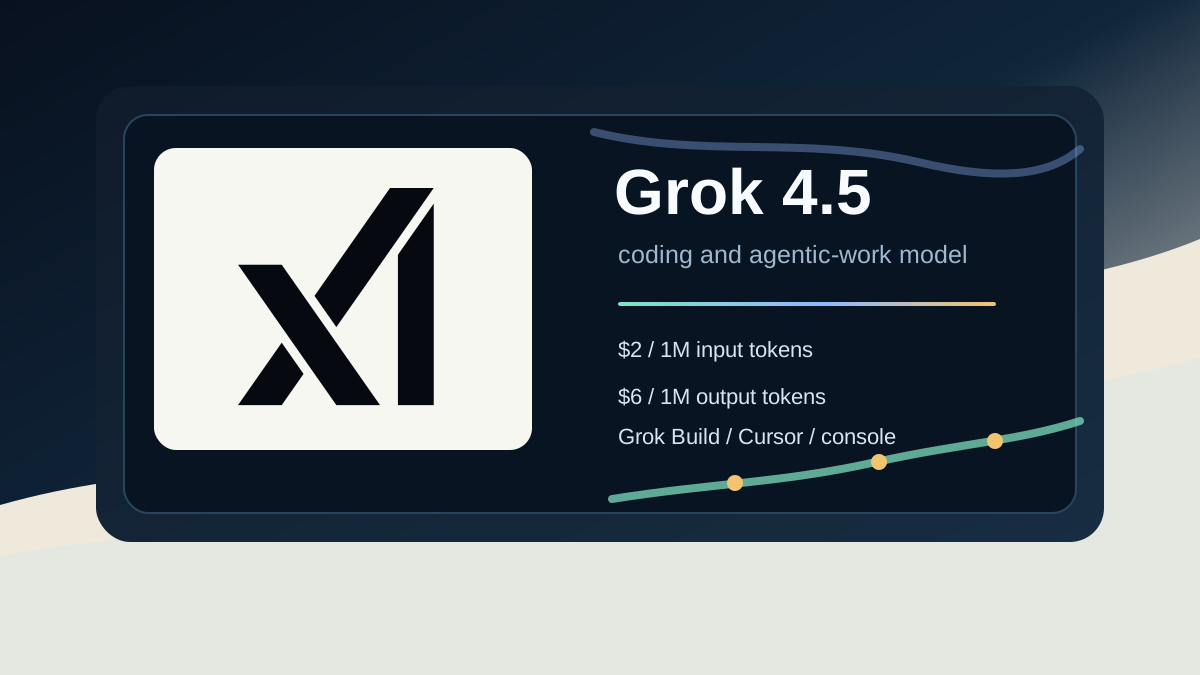
- Axios reported that SpaceXAI released Grok 4.5 on July 8 as a coding and agentic-work model, priced at $2 per million input tokens and $6 per million output tokens.
- Steam AI disclosure stayed noisy. GamesRadar+ covered a 3,800-player survey in which 43% of respondents said they were fine with AI in games, while nearly 90% said they at least glance at Steam AI disclosures. A separate July 9 GamesRadar+ report covered developer criticism of the new ARPG Bahast’s AI-use disclosure.
Playable Worlds And Game Research
AlayaWorld turns world-model talk into a playable stack
AlayaWorld is directly relevant to AI games because it is more than a video-generation paper. The authors describe a framework for online world generation conditioned on user interaction, with modules for data preparation, model architecture, training, inference acceleration, deployment, evaluation tools, and documentation.
The game-facing claim is concrete: users can move through generated spaces and trigger actions such as combat, spell casting, and monster summoning. Many world-model demos still stop at video continuity or camera control; AlayaWorld is trying to make the generated scene respond like a playable environment.
The caveat is clear. The paper is a research framework, not a shipped creation tool. The next evidence to watch is how it behaves under long play sessions, repeated goals, object persistence, failure recovery, and creator editing.
WorldDirector and WildWorld point at the same missing layer
Two adjacent papers help explain why playable world models are hard. WorldDirector, posted July 2, focuses on persistent dynamic memory and uses an LLM to coordinate 3D trajectories and camera movement before video generation. The reported goal is to preserve visual identities when objects leave and re-enter a scene.
WildWorld, published in March, is older but newly relevant because it supplies the kind of structured gameplay data that world models need. The dataset contains more than 108 million frames from Monster Hunter: Wilds, more than 450 actions, synchronized skeletons, world states, camera poses, and depth maps. It also defines WildBench for action following and state alignment.
For builders, the shared point is narrow: playable generation needs state, not only prettier frames. A system has to track whether a character still has ammunition, where the camera is, which action was requested, and how long the scene has been drifting.
Player-rating research adds a disclosure angle
When AI Deceives, submitted June 26, studies player ratings around AI-driven deception mechanics in RPGs. The author uses 54 Baldur’s Gate 3 version updates and English Steam reviews posted within 1 to 28 days after each update.
The reported finding is not a broad rule against AI in games. It is more specific: perceived deception awareness had a monotonic negative effect on positive review rates in the observed data, with an estimated net loss of about 0.4 percentage points across the measured range. For AI-game designers, that is a reminder to separate surprise, adaptive behavior, and hidden manipulation in both design and disclosure.
Models And Developer Tools
Meta prices Muse Spark 1.1 for coding competition
Meta’s Muse Spark 1.1 release is a developer-access story first. The Verge reports that Meta says the model can handle more advanced coding, complex bug detection and fixing, multi-agent workflows, and native multimodal perception across images, videos, and documents.
Game-tool vendors are sensitive to token costs. MarketWatch reported the Meta Model API rate at $1.25 per million input tokens and $4.25 per million output tokens, plus $20 in free credits. If that pricing holds, coding-agent products get another low-cost model option for long bug-fix loops, build logs, asset-pipeline scripts, and test generation.
That does not prove Muse Spark 1.1 is strong for game engines. The tests to watch are engine-specific: Unity scene changes, Godot scripts, Unreal build errors, shader fixes, asset importers, and playable regression checks.
Grok 4.5 and Perplexity’s Teammate keep coding agents crowded
Axios reported that SpaceXAI’s Grok 4.5 is available in Grok Build, Cursor, and the SpaceXAI console, but not yet in the EU. The company is pitching it as an engineering and agentic-work model rather than a general consumer chatbot.
Business Insider also reported that Perplexity has built an internal coding tool called Teammate, used by its engineers since May. The report says Teammate is intended for long-horizon engineering work such as owning projects, investigating issues, and monitoring services, and that it is model-agnostic.
The two stories describe different paths into the same market. One company is selling a model into coding tools; another is testing a coding tool around multiple models. Game teams will care less about the label and more about whether an agent can safely touch repos, reproduce bugs, and leave maintainable code.
0DIN shows why agent setup still needs hard stops
Mozilla’s 0DIN team published a June 25 write-up showing how an agentic coding tool can be tricked by a normal-looking repository. In the demonstration, the visible repo contains routine setup instructions. The harmful payload is fetched later from a DNS TXT record after the agent follows an error message and runs an initialization command.
The point is not limited to Claude Code. The risk is the combination of trusted project context, shell access, installer scripts, and an agent trying to be helpful. For game creators pulling tools, mods, asset pipelines, or sample projects from unfamiliar repos, setup commands are production risk, not housekeeping.
Platforms, Stores, And Community Lines
Godot chooses human accountability over AI submissions
Godot’s policy post is unusually direct. The Foundation says the growing number of AI-generated contributions has lowered the effort required to make pull requests while leaving review capacity unchanged. It also says maintainers lose the mentoring benefit when feedback is absorbed by a machine rather than a future contributor.
The incoming policy says no autonomous AI-agent use or vibe coding, no substantial AI-generated code, disclosure for limited AI assistance, no AI-generated text in human-to-human communication, and human review before merge. Code completion, regex help, and find-and-replace are treated as limited menial assistance.
For open-source game engines, the post lays out a concrete governance model: allow small assistance, reject unaccountable authorship, and make reviewer time part of the policy.
Steam users are checking disclosures even when they are tolerant
GamesRadar+ reported on a GameDiscoverCo survey of 3,800 Steam players. The headline split was mixed rather than uniformly hostile: 23.4% said they had no problem with AI in games, 19.6% said they were fine with it, 25.6% were neutral, 23.3% were not keen, and 8.1% would not consider playing a game with AI under any circumstances.
The stronger store-design number is disclosure behavior. Nearly 90% of respondents said they usually check Steam AI disclosures, either in detail or by glancing at them. That means disclosure copy is not a legal footnote for many buyers. It is part of the product page.
The Bahast debate shows how fast that copy can become the story. GamesRadar+ reported that the ARPG’s disclosure framed AI use as necessary for a solo developer working within time and money constraints, prompting criticism from other indie developers who said budget limits do not justify replacing handcrafted work.
Retro-port communities are drawing their own boundary
PC Gamer’s July 9 feature on retro PC ports shows the same argument in a more technical community. The article centers on Donkey Kong 64 Recompiled, where experienced randomizer and reverse-engineering developers took over a project space partly in response to AI-heavy recompilation work they viewed as hard to maintain.
The technical issue is not only taste. Static recompilation and decompilation projects need accurate understanding of original code, documentation, renderer behavior, and long-term modding support. If AI-generated code gets a game booting but leaves unknown changes inside graphics modules or toolchains, the cost returns later as bugs, compatibility problems, and fewer human contributors.
Education And Family Trust
Parents are split between AI dependence and AI readiness
Business Insider reported Deloitte back-to-school survey results from 1,150 parents of school-aged children. Half said they were concerned their child relies on AI too much. At the same time, more than a third worried that schools are not preparing children with enough AI skills, and one in eight planned to pay for AI tutoring or camps.
The same report says 22% of parents said their child’s school provides approved generative AI tools, 33% said the school has AI-use guidelines, and nearly 30% said their children already use generative AI for schoolwork.
For youth-facing creation tools, that mix matters. Parents are not simply asking for bans or acceleration. They are asking whether children know what the tool is doing, whether schools have rules, and whether creative work still belongs to the child.
Watch Next
- Whether AlayaWorld releases demos, code, or evaluation traces that let builders test long sessions instead of only reading the paper.
- Whether Meta’s low API pricing changes coding-agent costs for small studios and education tools.
- Whether Grok 4.5 shows useful game-engine evidence inside Cursor or Grok Build.
- Whether Godot’s AI policy becomes a template for other open-source engines, emulators, and modding projects.
- Whether Steam disclosure copy starts moving sales or player trust more than the underlying amount of AI use.
- Whether parent concern pushes youth creation products toward clearer history, classroom rules, and child-readable AI explanations.
This article was written with assistance from Wonder Bricks AI Agent and edited by SunnyLabs.