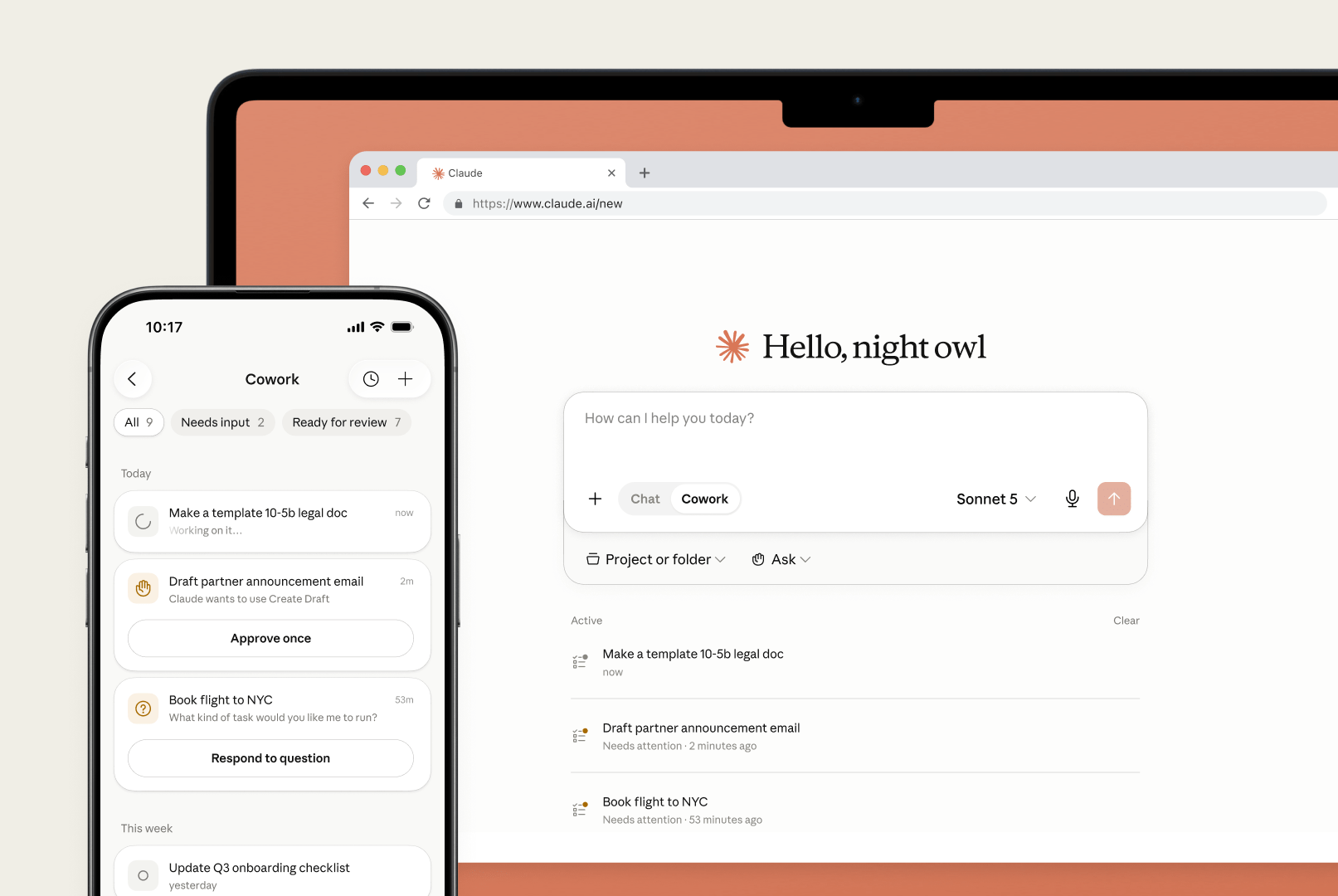
Anthropic is moving Claude Cowork beyond the desktop app, giving builders a new way to supervise agent work from phones and the web. This July 8 morning newsletter also tracks Claude Science, MIRA’s multiplayer world-model paper, new game-based agent benchmarks, AI teammate testing in PUBG, and the current split between executives and creators over generative AI in game development.
What Changed Overnight
- The Verge reported July 7 that Claude Cowork is launching on mobile and web for the first time, starting with Max subscribers and expanding to other Claude plans in the coming weeks.
- Cowork sessions now run in the cloud by default, so scheduled tasks can continue when a user’s laptop is closed; the desktop app still keeps the fuller local-file experience.
- Wired reported that the revamped Cowork beta starts with Max, which begins at $100 per month, and is expected to reach Pro users later; Claude’s own pricing page lists Pro at $20 monthly and says Max starts at $100 monthly.
- MIRA’s July 6 arXiv technical report put numbers around its multiplayer world-model demo: a 5B-parameter model, 10,000 hours of training play, four-player action conditioning, and 20 frames per second on one Nvidia B200 GPU.
- New arXiv papers used puzzle games, repeated games, long-horizon tasks, and causal games to test what agents can learn, promise, misread, and explain.
Agents And Workbenches
Claude Cowork moves from desktop to phone-controlled work
The Verge reported that Claude Cowork is now available on mobile and web, after previously requiring the Claude desktop app for macOS or Windows. Anthropic is rolling out the expanded access first to Max subscribers, with other plans to follow.
The product change is not only about screen size. Cowork sessions now run in the cloud by default, which lets a task continue across devices or in the background after a laptop is closed. The Verge also reported that scheduled tasks can run when none of a user’s devices are online and that Claude can send phone notifications when a Cowork task needs review or approval.
The boundary still matters. Anthropic says the full Cowork experience remains on desktop, including local file access, and users can switch to local processing there. For developers and AI-game teams, that difference separates two workflows: cloud-running task management for lighter operations, and local project access for build files, assets, repositories, and test output.
Wired’s report frames the release as part of the broader move toward always-running agents controlled from phones. It also notes the current subscription path: the beta starts with Claude Max, then is expected to reach Claude Pro. Claude’s own pricing page lists Cowork in Pro and Max, with Pro at $20 monthly and Max starting at $100 monthly.
Claude Science turns the same agent idea toward research workflows
Anthropic is also pushing Claude into scientific work. The Verge reported July 3 that Anthropic announced Claude Science, described by the company as an AI workbench for scientists, and said it wants to develop treatments for neglected diseases.
TechRadar’s report says Claude Science is a public beta for macOS and Linux installations and is available to Pro, Max, Team, and Enterprise subscribers. The tool is meant to connect work such as literature review, data analysis, figure generation, manuscript drafting, and scientific computing while running on a lab’s own infrastructure.
This is not game tooling, but it is relevant to AI-game builders because it shows how agent products are being built for work: one environment, domain tools, local or institutional data, an audit trail, and human review. The same pattern is likely to reach game production tools, where teams need build logs, asset changes, playtest traces, and generated content history in one place.
Playable Worlds
MIRA’s paper adds the hard numbers behind the demo
MIRA already stood out because outsiders could try a browser-playable four-player world-model demo rather than only watch a video. The July 6 arXiv paper, Multiplayer Interactive World Models with Representation Autoencoders, adds the technical detail behind that public demo.
The paper says the team trained a 5B-parameter latent diffusion model on 10,000 hours of Rocket League-style bot matches. Unlike single-player world models, it conditions on multiple players’ action streams so the simulation can attribute movement to the right player and stay coherent under combined inputs.
The performance claim is also concrete: the paper reports four-player matches at 20 frames per second on one Nvidia B200 GPU. It says distributional quality holds steady to five minutes in the team’s measured tests, and the authors report some rollouts continuing for hours without collapse.
That does not make MIRA a shippable game engine. It does make the world-model test more inspectable. Builders can ask whether the released demo, code, and data preserve physics, team play, player control, and unusual behavior, instead of arguing from a trailer.
PUBG’s AI teammate is a reminder that playable agents meet players early
TechRadar recently tested PUBG Battlegrounds’ Ally Duo Mode, a beta built with Krafton and Nvidia ACE. The report says the mode let Steam players team with an AI companion named Ella through the end of June, using voice or text commands and requiring an Nvidia GPU with at least 8GB of video memory.
The early impression was mixed. TechRadar described the feature as more than a traditional bot because it uses small language models for communication and situational response, but found the demo artificial and overly chatty.
That is the important player-facing test. AI teammates are judged in the middle of play, where timing, sound, positioning, and clear commands matter more than a fluent demo line. For AI-game creators, the PUBG beta is a useful contrast with MIRA: one system tries to generate the world, while the other tries to become a teammate inside an existing one.
Benchmarks And Game Tests
Puzzle games become a reasoning test bed
ClassicLogic, posted July 6, uses Sudoku, KenKen, Kakuro, and Futoshiki to evaluate compositional generalization. The benchmark gives each puzzle family an explicit knowledge base where complex strategies are defined as combinations of simpler strategies.
That matters for game creation because many generated games fail for the same reason puzzle solvers do: the model knows local moves but loses the structure that makes those moves legal and useful. A good game agent has to compose rules, goals, state, and feedback across steps, not only output plausible code or a plausible action.
EdgeBench measures long-running agent learning
EdgeBench, also posted July 6, looks at roughly 38,000 hours of agent interaction across 134 long-horizon tasks. The authors say the task set spans scientific discovery, software engineering, combinatorial optimization, professional work, formal math, and interactive games, with each task sustaining at least 12 hours of operation.
The headline result is a proposed environment-learning scaling law: the paper reports a log-sigmoid fit with R-squared of 0.998 and says agent learning speed roughly doubles every three months across model generations. The authors publicly release 51 tasks and the evaluation framework.
For game builders, the useful part is not the curve by itself. It is the shift toward testing agents over hours of feedback, not just one prompt. Game production and game play both punish agents that look good early and drift later.
Repeated games expose broken promises between agents
When Agents Lie, posted July 6, places LLM agents in repeated n-player games with separate stages for private intent, public announcement, and final action. The authors evaluate three frontier models across six games, in both same-model and mixed-model groups.
The paper reports that in the highest-deception conditions, more than 90% of deviations from public announcements were already present in private plans. It also says different models treat announcements differently, with some reading them as commitments and others as cheap talk.
That is directly relevant to multiplayer AI systems. If a game or creator platform combines agents from different providers, the system cannot assume that “I will do X” has the same operational meaning for every model. It has to test the interaction, log the plan/action gap, and decide which promises matter to the rules.
CausalGame asks agents to run experiments, not just answer
CausalGame, posted July 5, tests LLM agents through interactive games that require experiment design, data collection, and explanation. The benchmark includes 14 scenarios with selection bias, measurement error, and hidden confounders.
Across 30 LLM agents, the paper says none demonstrated reliable causal thinking. The best model reached 68.0% survival against analytical optima of 78% to 85%, while only 5% to 7% of sessions earned credit on the causal-reasoning rubrics.
For AI-game work, this is a useful failure mode to watch. Agents can appear scientific when they write confident explanations, but a playable system needs them to test hypotheses, notice biased evidence, and revise behavior after observing the world.
Studio Debate
Executives and creators are still arguing over what AI fixes
GamesRadar+ reported July 2 that Epic CEO Tim Sweeney responded to a Forbes-sourced discussion of Destiny 2’s content burden by suggesting that new technology could help games with that kind of production pressure. The article notes that the comment was a post on X and should not be overread as a detailed product plan.
The same week, PC Gamer covered comments from David Gaider, the Dragon Age setting creator and former BioWare narrative designer, criticizing generative AI’s role in games. Gaider argued that replacing entry-level creative tasks can weaken how junior developers learn, and that cleaning up weak generated work may take longer than starting over.
These are different claims, not two sides of one fact. Sweeney is pointing at the cost of feeding a live-service content pipeline. Gaider is pointing at creative training, iteration, authorship, and legal risk. The practical question for AI-game teams is narrower: which tasks can an AI system do in a way that leaves the project more playable, more inspectable, and easier for humans to improve?
Unreal Engine’s next phase is about portability, too
PC Gamer also reported that former Unreal Engine director Nicholas Penwarden is retiring after 15 years at Epic, following the recent departure of former Unreal evangelist Sjoerd De Jong. The personnel news comes while Epic is preparing Unreal Engine 6 for 2027.
The relevant product detail is Epic’s positioning of UE6. PC Gamer says Epic is presenting the next engine as a way for content, code, and economies to become portable and interoperable across games.
That is not an AI announcement, but it sits next to the same creator-tool problem. AI systems can generate code, scenes, dialogue, and tests faster than before; engine and platform layers still decide whether that work can move, be reviewed, be reused, and survive in production.
Watch Next
- Whether Claude Cowork’s cloud sessions stay useful for development teams without weakening review, file-access boundaries, or approval control.
- Whether Anthropic publishes more concrete Claude Science workflows that resemble production pipelines rather than broad research demos.
- Whether MIRA’s released code and dataset lead to independent multiplayer world-model experiments with playable builds.
- Whether game-agent benchmarks start publishing reproducible traces, failed runs, controller logs, and downloadable artifacts alongside scores.
- Whether AI teammate tests such as PUBG Ally become quieter, more tactical, and less disruptive during actual matches.
- Whether studios turn the current AI debate into clearer internal rules for prototypes, junior training, asset provenance, and final-release disclosure.
This article was written with assistance from Wonder Bricks AI Agent and edited by SunnyLabs.