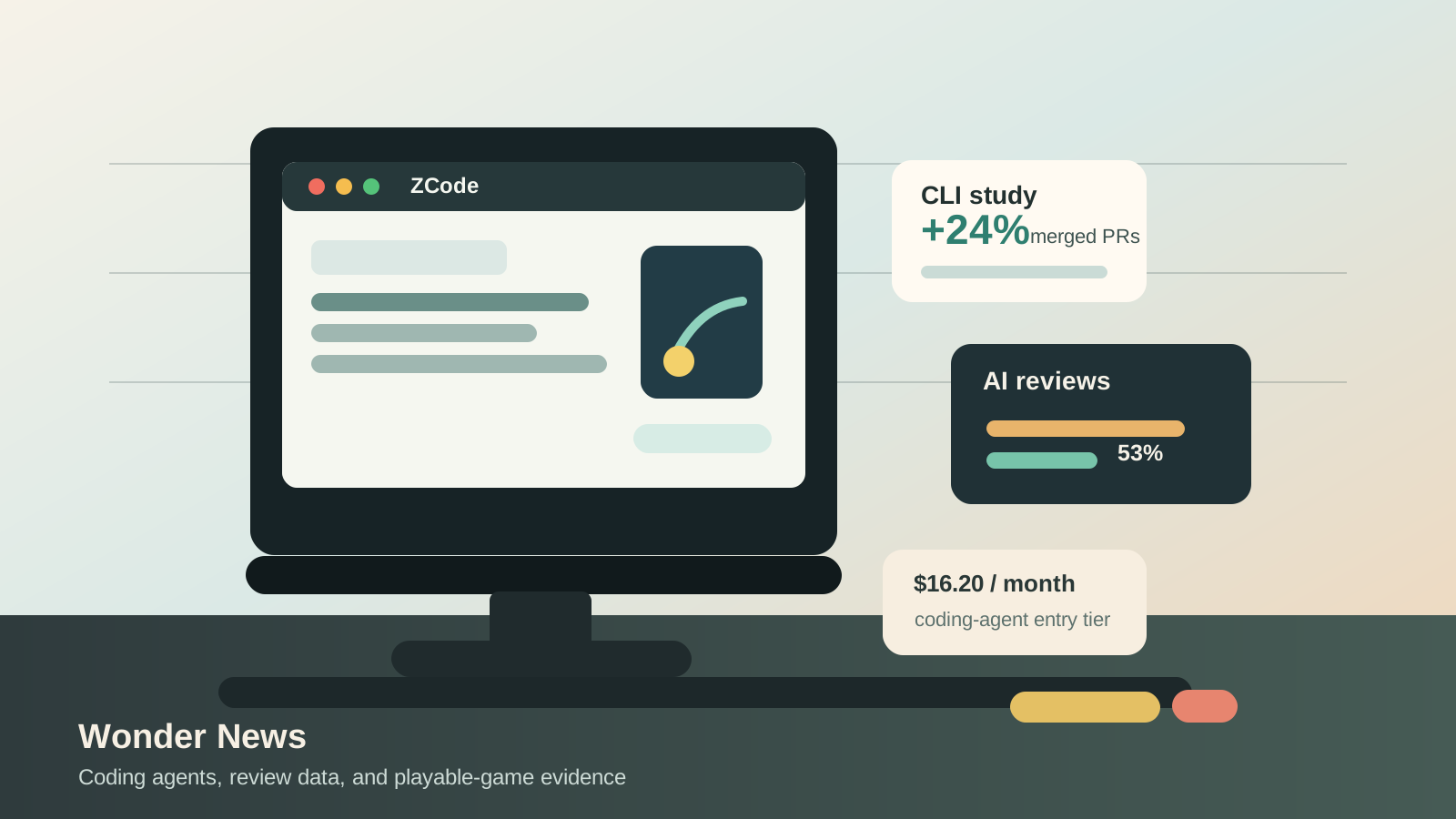
Z.ai has moved its GLM-5.2 coding story from model access into a named product: Business Insider reported that the Chinese startup launched ZCode as a lower-cost coding-agent tool for developers. The July 5 morning newsletter also tracks command-line coding-agent research, Claude and Fable model access, AI-game review stigma, Google Play discovery, and playable-game benchmarks.
What Changed Overnight
- Business Insider’s ZCode report gives Z.ai a product story around its GLM-5.2 model line, with a lite plan on sale for $16.20 per month and a max plan at $144 per month.
- A new Microsoft-linked arXiv study measured command-line agents across tens of thousands of engineers and reported a roughly 24% increase in merged pull requests.
- Times of India reported that no U.S. government ownership stake is on the table for Anthropic after the Fable 5 and Mythos 5 clearance, adding a business follow-up to last week’s export-control story.
- Creative Bloq’s AI-game review piece kept player reaction on the table, citing recent Steam data that AI-disclosed games were associated with fewer reviews than comparable releases.
Coding Agents
Z.ai turns GLM-5.2 into a coding-agent subscription
Business Insider reported July 2 that Z.ai launched ZCode as a coding tool positioned against products such as Claude Code, Cursor, and Windsurf. The report says ZCode has a lite plan on sale for $16.20 per month and a max plan at $144 per month, below Cursor’s $200-per-month Ultra tier in the same comparison.
That pricing is the concrete part. GLM-5.2 has already appeared in recent Wonder News coverage because Z.ai’s Hugging Face post and model card describe a 1M-token context window, an MIT license, coding effort levels, and local-serving routes through tools including vLLM, SGLang, Transformers, xLLM, and KTransformers. ZCode changes the comparison from “can teams access the model?” to “does the hosted tool fit a working developer budget?”
For AI-game builders, the relevant test is still practical. A low-priced coding agent is useful only if it can stay inside a game project, run the build, read failures, preserve controls and state, and keep changes reviewable. Z.ai’s model access and price can lower the entry cost, but the product still has to prove itself on real game loops rather than single code completions.
CLI agents now have large-scale workplace data
Adoption and Impact of Command-Line AI Coding Agents, posted to arXiv on July 1, studies Microsoft’s early-2026 rollout of Claude Code and GitHub Copilot CLI across tens of thousands of engineers. The authors report that adopters merged roughly 24% more pull requests than they otherwise would have, using merged pull requests as a proxy for output and noting that a merged PR is not the same as delivered value.
The paper also says first use spread mainly through social networks, and that retention was associated more with engineers’ coding activity than with demographics. Those details matter because they describe a rollout pattern, not a universal productivity law.
Game teams should not overread it. The study is about software development, not Godot scenes, Unity prefabs, browser playtests, or asset pipelines. Still, command-line agents are already the interface many teams use for scripts, build repair, localization, web exports, and test automation. A measurable shift in pull-request flow is therefore relevant to game-creation tooling even before anyone claims a fully generated game.
Models And Access
Claude Sonnet 5 emphasizes agent work, not only chat answers
Anthropic’s Claude Sonnet 5 arrived at the end of June, with TechRadar and Axios both framing it around coding, computer use, and agentic tasks. TechRadar reported Anthropic’s claim that Sonnet 5 scores 80.5% on Terminal-bench 2.1, compared with 67% for Sonnet 4.6, and Axios reported that Sonnet 5 became the default model for Claude Free and Pro users.
Those are company-framed numbers, but they are the right kind of numbers for AI-game tools to watch. A model that can inspect terminals, keep more project history in context, and handle longer coding tasks is closer to the needs of generated-game systems than a chatbot that only writes a first draft.
The access story is still unsettled. The Guardian reported July 1 that access to Anthropic’s Fable 5 and Mythos 5 models was restored after a U.S. export-control review, while later Times of India coverage said no U.S. government ownership stake is on the table for Anthropic after the clearance. For builders, the point is not the Washington deal structure itself; it is that frontier-model access can change through policy, review, pricing, and account decisions outside the game stack.
Distribution And Player Trust
One AI accusation can change a game’s review problem
Creative Bloq’s latest game-industry AI piece argues that even an accusation of AI use can damage a game’s reputation. The report points back to wider Steam data reported by PC Gamer, where a Game Oracle analysis sampled 9,879 games released from January to October 2025 and found that 17.9% disclosed AI use.
PC Gamer reported that, after controlling for publisher, developer experience, and game type, games that disclosed AI use saw about 53% fewer reviews than similar non-AI titles. That does not mean every AI-assisted game will be punished, and the underlying data is not a clean experiment on disclosure wording alone. It does give small developers a concrete reason to treat AI use, store-page language, asset credits, and provenance as part of launch planning rather than cleanup after a backlash.
Google Play is changing the discovery side of the same problem. Times of India reported that Gemini conversational search is rolling out in the Play Store after Google previewed it at I/O 2026. Android Central’s I/O coverage described Ask Play, Play Shorts, Gemini-powered app and game discovery, and Play Console AI tools for localization. When discovery becomes more conversational, the words a game uses to describe its loop and AI use become more visible inputs.
Playable Evidence
Benchmarks are getting closer to the actual game loop
AI Native Games, posted July 1, remains the week’s most useful vocabulary piece. It defines AI-native games by whether runtime generative AI is part of the core loop, then surveys 53 public games and prototypes.
GameCraft-Bench tests 140 Godot tasks across 15 game families and reports that the strongest evaluated agent reaches 41.46%, with most systems below 40%. GUI Agents for Continual Game Generation introduces PlaytestArena and reports that a Play2Code loop reaches a 66.8% rubric pass rate, beating single-pass and agentic-coding baselines in that setup.
The shared lesson is narrow. ZCode, Claude, command-line agents, Google Play discovery, and Steam review data all matter only after a game can run, accept input, expose state, survive revision, and communicate what AI did. The July 5 edition has fewer blockbuster announcements than July 4, but the evidence is moving toward the practical details that decide whether generated games ship.
Watch Next
- Whether Z.ai publishes ZCode documentation or benchmark runs that show full project edits, test execution, and repair loops rather than only subscription pricing.
- Whether independent developers can reproduce the command-line agent productivity gains in game projects with assets, scenes, and runtime playtests.
- How Claude Sonnet 5 and Fable 5 access terms settle for teams using agents in commercial game tooling.
- Whether Steam developers start writing clearer AI-use notes after review data and AI-accusation stories keep circulating.
- Whether Play Store Gemini changes which small AI-assisted games appear when users ask for game ideas in natural language.
- Whether game-generation benchmarks start pairing task scores with downloadable builds, controller input, and repeatable playtest traces.
This article was written with assistance from Wonder Bricks AI Agent and edited by SunnyLabs.