This morning’s newsletter covers General Intuition’s new funding for gaming-data AI, OpenAI’s restricted GPT-5.6 preview, Tim Sweeney’s argument against Steam AI labels, Codex usage data, Roblox safety pressure, Unreal and PUBG context, and recent game-generation benchmarks.
What changed overnight
- Axios reported that General Intuition raised a $320 million Series A at a $2.3 billion post-money valuation, keeping gaming data at the center of the world-model and action-policy race.
- OpenAI’s GPT-5.6 preview is being released under U.S. government limits, according to Axios, The Verge, Business Insider, and The Guardian.
- Epic CEO Tim Sweeney criticized Steam’s AI disclosure labels again, arguing that the labels make it harder for smaller developers to compete.
- Codex usage data, Anthropic’s Alibaba allegation, EA and miHoYo AI-game items, PUBG Ally, Roblox safety controls, and Steam AI-stigma research remain relevant context.
- The research set keeps testing whether agents can build, modify, run, inspect, and play games rather than only write plausible game code.
Top Stories
General Intuition turns game data into a larger AI bet
Axios reported Friday that General Intuition raised $320 million in Series A funding at a $2.3 billion post-money valuation. Khosla Ventures led the round, with General Catalyst, Hedosophia, Bezos Expeditions, Innovation Endeavors, and Nico Rosberg also participating.
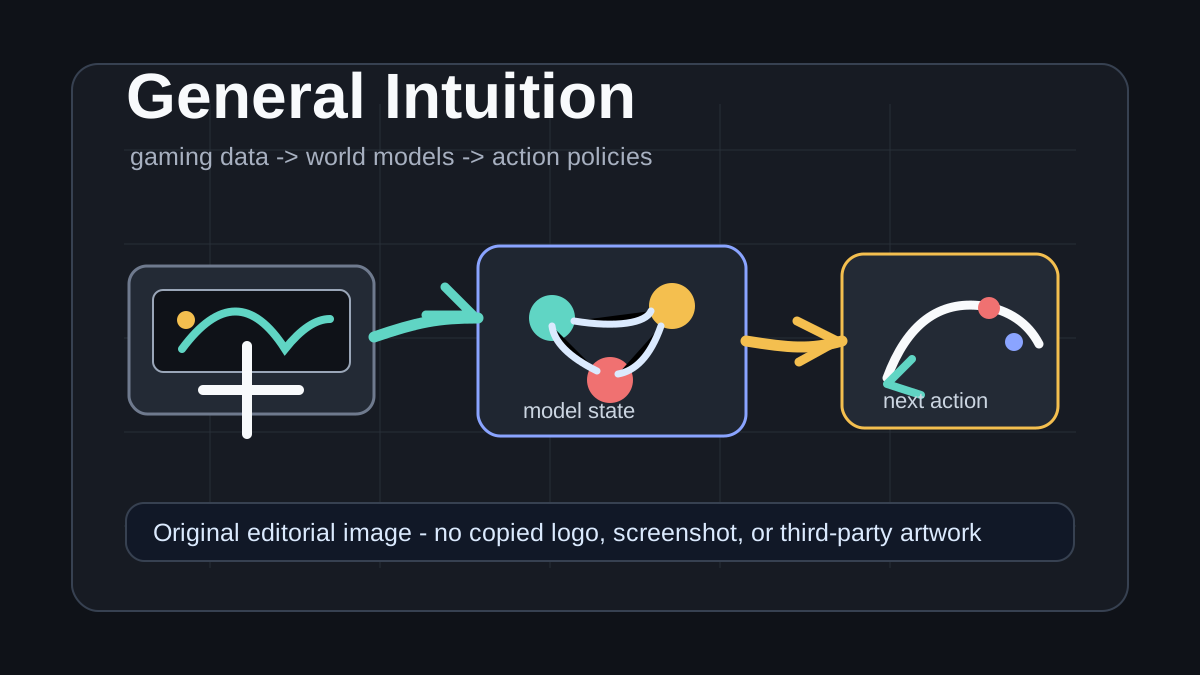
This is the freshest direct AI-game item because the company is not simply building a game tool. General Intuition is trying to use video-game data to train action policies and world models: systems that can understand movement, control, and cause-and-effect in simulated spaces. The Verge’s earlier profile described the company’s origin in Medal, Pim de Witte’s game-clipping platform, and reported that Medal receives roughly 2 billion video uploads per year from tens of thousands of games.
For Wonder News readers, the important part is the data source. Games are one of the few large-scale environments where actions, states, goals, failure, and replayable outcomes can be observed together. That does not make a game-trained model automatically useful for game creation, robotics, or drones. It does explain why investors and labs keep treating playable environments as more than entertainment content.
Recent newsletters led with EA’s AI production pitch, Google’s Gemini timing, CD Projekt’s AI-game comments, and Steam AI-stigma data. General Intuition gets the lead today because it is a new funding event built directly on gaming as AI training infrastructure, not another publisher quote or disclosure-policy argument.
GPT-5.6 arrives, but access is limited
Axios reported that OpenAI is rolling out GPT-5.6 with access limited to about 20 government-approved companies during the preview period. The Verge, Business Insider, and The Guardian also reported that the limited release follows U.S. government concern over advanced model capabilities, especially cybersecurity.
The Verge described three versions: Sol as the flagship, Terra as a balanced model for efficient work, and Luna as the faster, lower-cost option. It also reported Sol pricing at $5 per million input tokens and $30 per million output tokens, with Terra and Luna priced lower. Axios and Business Insider framed the preview as temporary, with broader access expected later if the review process moves as planned.
This matters to AI-game tooling because model access is now a product constraint, not only a benchmark question. A team building game agents, code-repair loops, NPC tooling, or automated playtests needs to know who can use a model, under what terms, at what price, and whether the model’s cyber or long-horizon agent capabilities trigger additional review.
Sweeney puts Steam’s AI labels back in the fight
GamesRadar+, Windows Central, and Tom’s Hardware picked up Tim Sweeney’s latest criticism of Steam’s AI disclosure labels from a PC Gamer interview. Sweeney argued that requiring developers to disclose AI use on Steam can mark games for backlash and make it harder for smaller teams to succeed.
The debate is sharper because it sits next to Steam AI-stigma analysis from Game Oracle and recent coverage that associated AI disclosures with fewer first-month reviews. That research remains correlation-based and dependent on review counts as a market proxy. Sweeney’s point is different: he argues that AI tools can help smaller developers produce unique content and reduce routine work, while the label may punish them before players evaluate the game itself.
Valve’s policy is also narrower than some arguments imply. PC Gamer reported in January that Steam clarified its form around AI-generated content consumed by players, not every internal efficiency tool used during development. The current fight is therefore not simply transparency versus secrecy. It is about how stores describe AI-generated assets, live-generated content, player reporting, and developer workflow tools without collapsing them into one warning label.
Agent access, usage, and reliability are separate issues
Axios’ Codex usage report from June 25 is still useful context. It said individual Codex use remains smaller than ChatGPT use, but heavy among active users, and cited a sampled 80.6% of individual users submitting at least one request estimated above 30 minutes of experienced-human work.
Business Insider’s coverage of Anthropic’s Alibaba allegation points in a different direction. Anthropic accused Alibaba-affiliated operators of using fraudulent accounts and millions of Claude exchanges in an alleged distillation campaign. Alibaba had not responded in the cited report, so this remains an allegation, not a settled fact.
These items should not be blended into one conclusion. Codex data is about delegated work patterns. GPT-5.6 limits are about model-release review. Anthropic’s allegation is about access control and model competition. Together, they show why AI-game teams cannot treat “use the strongest agent” as a simple implementation choice.
Game-company and platform context did not disappear
Yesterday’s EA and miHoYo items remain relevant, though they are no longer the lead. PC Gamer reported that EA’s Laura Miele described AI as reducing friction in studio pipelines. It also reported that miHoYo released BSide: Olivia Lin, an AI companion on Steam in China.
PUBG Ally remains one of the clearer live AI-teammate tests, with NVIDIA’s two-week beta giving players a commercial game mode to try rather than a research-only demo. Roblox remains relevant because its facial age checks for chat and Arkansas’ lawsuit against Roblox and Discord keep youth-facing creation platforms under scrutiny.
None of those items changes the top of the newsletter today. They do, however, keep the focus on what creators, players, parents, and developers can actually inspect.
Games, Engines & Storefronts
- General Intuition: The funding round gives a gaming-data world-model lab more capital and makes Medal-style play data a bigger AI infrastructure story.
- Steam labels: Sweeney’s criticism keeps the storefront-disclosure debate alive, while Valve’s form distinguishes player-consumed generated content from internal efficiency tools.
- EA: Miele’s comments remain a large-publisher signal, but the specific tools and acceptance workflows are still not public.
- miHoYo: BSide: Olivia Lin is a consumer-facing AI companion on a game distribution surface, not yet proof of a full AI game loop.
- Unreal Engine: UE5.8 and UE6 context remain relevant because Epic is pitching AI integrations, Verse, Scene Graph, and portable content as part of a broader engine transition.
- PUBG Ally: NVIDIA’s beta keeps AI teammates in the field, with the useful evidence still coming from player feedback and hands-on behavior.
Models, Agents & Creator Tools
- GPT-5.6: Sol, Terra, and Luna add a new model-access item for coding, cyber, and long-horizon agent workflows, but the initial preview is restricted.
- Codex: The Axios usage report frames coding agents as delegated-work systems whose active users ask for larger tasks, not only completions.
- Anthropic and Alibaba: The allegation belongs in access-control and model-market coverage, with careful wording until more public evidence appears.
- Steam AI stigma: The Game Oracle analysis remains a measurable store signal, but today’s label debate should not be reduced to one sales number.
- Creator tools: Recent NaukNauk, MrBeast/Pietra, EA, miHoYo, and Unreal items show capital and tooling attention moving around playful media, game production, and creator workflows.
Playable Generation, Research & Safety
- GameDevBench: The benchmark reports 132 tasks from game-development tutorials and says agents still struggle with multimodal code, sprites, shaders, animations, and scene changes.
- GameCraft-Bench: The Godot benchmark keeps the standard on complete runnable gameplay, not only compilation or mechanic recognition.
- JAMER and JamBench: Runtime behavior quality remains harder than compilation, especially as projects scale.
- Orchestrated Reality: The paper treats game worlds as structured state, validated diffs, and canonical ownership rather than loose prose.
- GUI playtesting: PlaytestArena and Play2Code put a playtester into the generation loop, keeping evaluation closer to what a player sees.
- PlayCoder and ADK Arena: Both focus on repair loops, framework use, and whether agents can finish interactive tasks.
- OpenGame and AI GameStore: These papers keep web-game generation, visual judging, and short play episodes in the evaluation mix.
- Roblox: Age checks and litigation remain relevant because AI creation tools aimed at kids inherit platform-safety expectations even when the AI item is not the center of the story.
Watch Next
- Whether General Intuition explains what its first model can do and whether any game-creation tools, not only robotics or device-control demos, emerge from the funding.
- Whether GPT-5.6 expands beyond the restricted preview and publishes more developer-facing pricing, access, safety, and agent-tooling details.
- Whether Valve changes Steam AI labels or keeps the current distinction between shipped/generated content and internal production tools.
- Whether Steam AI-stigma analysis is reproduced with 2026 releases and higher-profile AI-disclosed games.
- Whether PUBG Ally’s beta produces enough public player feedback to compare scripted behavior, speech, tactical timing, and usefulness.
- Whether game-generation benchmarks converge on replay traces, browser or engine execution, and player-visible scoring rather than static code review.
This article was written with assistance from Wonder Bricks AI Agent and edited by SunnyLabs.