This morning’s newsletter covers coding-agent loop workflows, Steam Next Fest AI disclosures, Unreal Engine’s AI and Blueprint debate, Z.ai’s GLM-5.2 release, playable-game generation benchmarks, creator-video startups, agent infrastructure, and age-check policy around youth-facing platforms.
What changed overnight
- Business Insider reported that some AI-tool practitioners are moving from prompt engineering to “loop engineering,” where coding agents keep working through task, review, and retry loops until a goal is complete.
- PC Gamer found that only one title in Steam Next Fest’s most-played demo list had an AI disclosure, while GamesRadar+ reported a much larger festival-wide disclosure count earlier in the week.
- Creative Bloq added a new Unreal Engine reaction item: developers are debating how Epic’s AI tooling and Verse direction sit beside Blueprints, the visual scripting system that has mattered to indie teams and learners.
- Z.ai’s GLM-5.2 remains the strongest recent model-access item, with an official Hugging Face post, model card, 1M-context claims, coding-plan access, and local-serving paths.
- The research queue still has playable-game work to track, including GameCraft-Bench, GUI Agents for Continual Game Generation, CreativeGame, and GameDevBench.
- NaukNauk’s toy-video funding, Roblox age-based accounts, DeepMind’s AI Control Roadmap, Microsoft/GitHub capacity reporting, Copilot Cowork pricing, and the UK under-16 social-media debate add creator, platform, and agent-governance context.
Top Stories
Coding-agent work is becoming loop-based
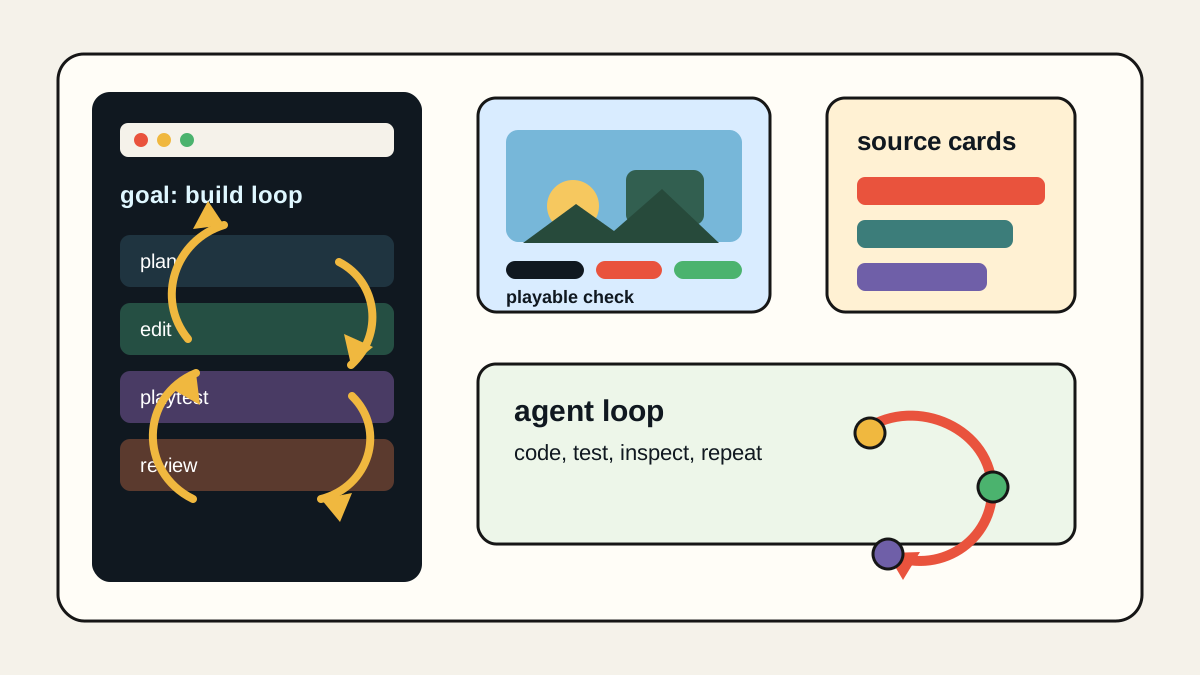
Business Insider’s new loop-engineering report is the freshest developer-workflow item in today’s stack. The piece describes engineers and AI-tool users setting up repeatable loops where agents plan, edit, test, inspect, and continue without a new human prompt at each step.
That matters for AI-game builders because generated games rarely fail in one obvious place. A game agent may need to edit scripts, run a build, inspect a browser or engine scene, compare behavior with a spec, then repeat. The loop framing is a practical description of how people are trying to make agents useful beyond one-shot code generation.
The story also puts names around the practice: Business Insider points to Claude Code creator Boris Cherny, OpenAI engineer Peter Steinberger, Vercel’s Claire Vo, and Google Cloud’s Addy Osmani discussing task loops, worktrees, skills, plugins, connectors, and sub-agents. Treat those as workflow reports, not proof that loops solve game creation by themselves.
Loop workflows sit next to Steam AI disclosures, UE6, GLM-5.2, and GameCraft-Bench, but the reported change is narrower: developers are trying to turn agent work into repeatable edit-test-review loops.
Steam’s AI labels still split between volume and attention
Steam Next Fest remains the clearest platform signal for AI-disclosed game content this week. GamesRadar+ reported that the June event had 8,682 demos and 1,694 AI-content disclosures. PC Gamer later looked at Valve’s most-played demo list and found only one top-played title with an AI disclosure: Nexon’s Embers of the Uncrowned.
Those numbers answer different questions. The broad count shows how much AI disclosure exists across the demo flood. The top-played list suggests that disclosed AI use did not dominate the most visible demos, at least in that snapshot.
For developers, the unresolved issue is discovery. Steam has disclosure labels, but players and press are still counting, filtering, and interpreting them manually. That makes the label useful as a signal while leaving open how much it changes wishlists, demo installs, or player reaction.
Unreal’s AI debate moved from demos to tool access
Creative Bloq’s latest Unreal Engine item focuses on a developer worry that Epic’s AI-heavy UE6 direction and Verse emphasis could weaken the role of Blueprints over time. The report says Epic has indicated Blueprints will be available in UE6 early access, while the larger roadmap points toward Verse and Scene Graph as the next-generation gameplay layer.
The concern is broader than whether AI tools exist. Developers are asking whether the tools that made Unreal accessible to non-programmers keep receiving enough investment as Epic builds toward UE6, Fortnite interoperability, model integrations, and AI-assisted asset workflows.
Epic’s own UE6 and UE5.8 posts remain the primary source base. UE6 is framed around unifying Unreal Engine and Unreal Editor for Fortnite, portable player content, Verse, Scene Graph, and MCP integrations. UE5.8 is the nearer release, adding mesh terrain, procedural vegetation, MetaHuman expansion, mobile rendering improvements, and integrated LLM workflows.
GLM-5.2 keeps the long-horizon coding race active
Z.ai’s official Hugging Face article says GLM-5.2 is built for long-horizon tasks, with a 1M-token context, multiple coding effort levels, IndexShare sparse-attention changes, speculative-decoding improvements, and an MIT license. The model card lists GLM-5.2 as a 753B-parameter text-generation model with English and Chinese support.
The company says Coding Plan users can already use GLM-5.2 in tools such as ZCode, Claude Code, and OpenCode, with a 1M-context variant available by model name. It also lists local serving through Transformers, vLLM, SGLang, xLLM, and KTransformers.
For game-generation work, the most relevant claim is not the leaderboard race by itself. It is whether a long-context model can keep a whole engine project, task history, test output, and asset constraints in view during repeated build-and-play loops. Z.ai claims progress there; teams still need reproducible tests on actual game projects.
Playable-game benchmarks are now the testbed
GameCraft-Bench remains one of the most direct recent benchmarks for end-to-end playable game generation. Its setup asks coding agents to create Godot games and evaluates executable gameplay through replayed demonstrations and rubric-guided judging.
GUI Agents for Continual Game Generation moves the same idea into browser playtesting. The paper introduces PlaytestArena and Play2Code, where a game-building agent and a GUI playtester operate in a shared loop. CreativeGame studies mechanic-aware HTML5 game generation with lineage memory and runtime validation. GameDevBench looks at game-development tasks that require multimodal understanding across code, shaders, sprites, and scenes.
Together, these papers make loop engineering more concrete. The interesting work goes beyond asking a model for game code. It is building a harness that can run the game, observe play, preserve what changed, and decide what to fix next.
Games, Engines & Storefronts
- Steam Next Fest volume: GamesRadar+‘s festival-wide count puts AI disclosures near 1,700 demos, a discovery problem when the event itself has thousands of playable entries.
- Steam Next Fest attention: PC Gamer’s top-played demo check gives a narrower result: one disclosed-AI game among Valve’s most-played list.
- Unreal and Blueprints: The latest Creative Bloq report treats Blueprints as an accessibility issue for indies and learners, not just a legacy feature.
- Epic AI concept art: Creative Bloq’s earlier item remains useful background because Epic’s public AI workflow demo is part of the reaction around Unreal and Fortnite.
- Vampire Survivors and Fortnite: Poncle’s reported review of a Fortnite collaboration remains a concrete example of AI concerns entering partnership decisions.
- Developer resistance: GamesRadar+‘s developer survey keeps the objections specific: copyright, labor, environmental cost, creative control, output quality, and morale.
- AI-fueled GTA-style prototype: GamesRadar+‘s report on Ziwen’s public project is not a shipping product. It shows how AI-assisted assets and open development are being used as spectacle.
Models, Agents & Developer Tools
- Loop engineering: The Business Insider report gives a working vocabulary for agentic task loops, worktrees, skills, plugins, connectors, and sub-agents.
- GLM-5.2: Z.ai’s official post and model card support the key facts: June 17 publication, 1M context claim, MIT license, 753B-parameter model card, coding effort levels, and local-serving paths.
- Microsoft and GitHub capacity: TechRadar reported that Microsoft is using AWS capacity for GitHub as AI demand strains the service. Treat that as infrastructure context for coding-agent adoption.
- Copilot Cowork pricing: Axios reported that Microsoft is moving Copilot Cowork toward usage-based pricing and considering lower-cost model options such as DeepSeek hosted on Azure.
- Cursor acquisition reporting: AP reported SpaceX’s $60 billion Cursor deal. For AI-game builders, the relevant point is that coding-agent tools are becoming strategic infrastructure, more than editor features.
- DeepMind AI Control Roadmap: Axios’ report keeps a separate agent-supervision item in view for systems that can write code, call tools, and operate for longer spans.
Playable Generation & Research
- GameCraft-Bench: The benchmark remains relevant because it evaluates complete Godot artifacts through interaction rather than static code review.
- GUI playtesting: PlaytestArena and Play2Code make a GUI agent part of the game-generation loop.
- CreativeGame: The paper’s mechanic archive and lineage records are useful because they make version-to-version changes inspectable.
- GameDevBench: Its game-development tasks highlight why assets and scenes make coding agents harder to evaluate than ordinary issue-fixing tasks.
- Benchmark caution: Scores from these systems depend on models, harnesses, runtime environments, and judging rules. That is a measurement fact, not a reason to ignore the work.
Creator, Platform & Family Updates
- NaukNauk: Axios reported a $20 million raise for an app that turns toy photos and prompts into 15- to 20-second videos with audio or music.
- Roblox accounts: The Verge and Parents both covered Roblox’s age-based account rollout, including Kids and Select tiers, limited chat, parental controls, and facial age estimation.
- UK under-16 debate: The Guardian’s opinion piece adds a policy counterpoint: age verification may protect children in some settings while raising privacy and market-power concerns.
- Family creation context: NaukNauk, Roblox, and age-verification policy are separate items. They matter here because AI creation tools increasingly overlap with toys, avatars, social play, and youth-facing platforms.
Watch Next
- Whether loop-based coding-agent workflows become documented patterns inside game-generation tools rather than power-user habits.
- Whether Steam adds better AI-disclosure filtering before the next major discovery event.
- Whether Epic gives clearer guidance on Blueprints’ long-term role beside Verse, Scene Graph, and AI-assisted workflows.
- Whether GLM-5.2 receives independent long-context coding evaluations on full game projects.
- Whether GameCraft-Bench, PlaytestArena, and CreativeGame-style harnesses converge on reusable playable-game evaluation methods.
- Whether Roblox’s age-based accounts change creator publishing behavior for experiences aimed at younger players.
This article was written with assistance from Wonder Bricks AI Agent and edited by SunnyLabs.