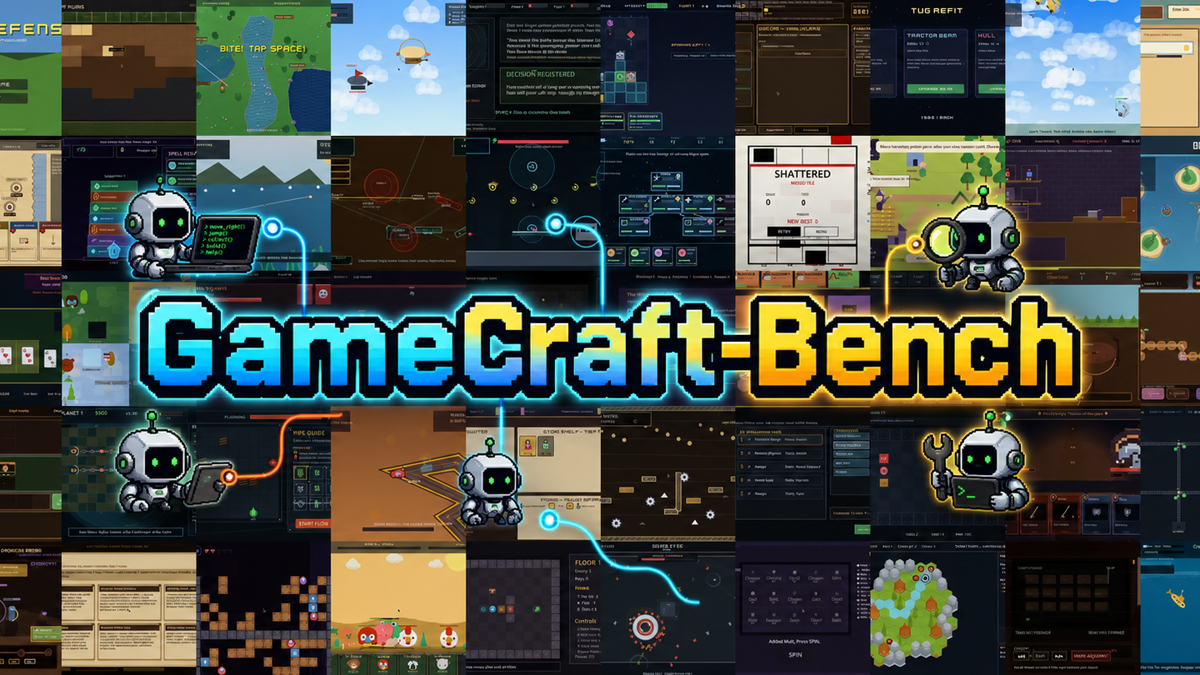
This morning’s newsletter covers GameCraft-Bench’s new test for playable AI-generated Godot games, PUBG Ally’s live AI teammate beta, Nvidia ACE and Unreal Engine character tooling, developer pushback against generative AI, NaukNauk’s toy-animation funding, DeepMind’s AI-control roadmap, and recent papers on game agents, educational game generation, workplace agents, and child-facing AI safety.
What changed overnight
- GameCraft-Bench posted a project site and arXiv paper for an end-to-end game-generation benchmark with 140 Godot tasks across 15 game families.
- The benchmark’s public leaderboard lists Claude Code with Opus-4.7 high at 41.46% overall and Codex with GPT-5.5 high at 39.49%, while the authors say most agents score below 40%.
- PUBG Battlegrounds’ Ally Duo Mode is now in beta through PUBG Arcade, according to TechRadar, bringing Nvidia ACE into a live player-facing AI teammate test through the end of June.
- Creative Bloq framed PUBG Ally and Nvidia ACE as part of a shift from scripted NPC behavior toward agentic characters inside Unreal Engine workflows.
- GamesRadar+ published a broad developer-pushback feature on generative AI in games and a separate Palworld interview in which Pocketpair’s John Buckley said the studio avoids generative AI because players do not want it.
- Axios reported that NaukNauk raised $20 million for an AI video app that animates toy photos into short clips and came out of beta with more than 1 million beta users.
- Axios also reported that Google DeepMind published an AI Control Roadmap for monitoring and containing more capable autonomous agents.
Top Stories
GameCraft-Bench asks whether coding agents can make real games
GameCraft-Bench is today’s strongest direct AI-game story because it tests a question that most demos skip: can an agent turn a natural-language game idea into a complete, playable project inside a real game engine?
The benchmark uses Godot 4, 140 tasks, and 15 game families including platformers, strategy games, tycoons, open-world tasks, roguelikes, visual novels, shooters, simulations, rhythm games, racing games, and sports games. Submissions are not judged as isolated code snippets. The agent must produce a full Godot project plus replayable interaction traces, then the verifier launches the game, replays the traces, records evidence, and scores observed play.
The scores are a useful check on AI-game hype. The project site lists Claude Code with Opus-4.7 high at 41.46% overall, Codex with GPT-5.5 high at 39.49%, and the strongest category scores still uneven across mechanics, content depth, functional visuals, and presentation. The authors’ summary says agents often build recognizable mechanics but still fail to assemble complete, coherent interactive systems.
For AI-game builders, the important move is methodological. GameCraft-Bench treats playability as an observed behavior, not a screenshot or build success. That aligns with the practical failures creators see when a generated game launches but lacks readable feedback, progression, outcomes, or enough content to feel finished.
PUBG Ally puts agentic characters into a live beta
PUBG Ally is not a research paper or an engine roadmap. It is a live beta inside PUBG Battlegrounds, and that makes it a different kind of test for AI characters.
TechRadar reports that Ally Duo Mode is available through PUBG Arcade for a two-week beta ending in late June, with an AI teammate named Ella powered by Nvidia ACE. The report says the companion uses small language models, supports voice and text, and requires an Nvidia GPU with at least 8GB of VRAM. The early hands-on tone is skeptical: Ella appears more artificial and chatty than human, and the feature still needs real player feedback.
Creative Bloq’s Unreal Fest coverage explains the developer-side architecture: Nvidia ACE exposes agent behavior, chat, and retrieval layers so characters can stay grounded in game state rather than drifting into generic chatbot responses. That is a concrete production issue for game AI. A character that talks fluently but ignores the match state is not a useful teammate.
The useful signal is not that AI squadmates are finished. It is that game companies are now testing them where latency, balance, team audio, player reaction, and hardware requirements all show up at once.
Developer resistance remains a release risk
Two GamesRadar+ pieces show the other side of the week’s AI-game news. One gathers objections from developers who see generative AI as ethically messy, environmentally expensive, legally uncertain, threatening to junior roles, and difficult to control creatively. The other quotes Pocketpair publishing and communications head John Buckley saying that Palworld’s team does not use generative AI because players do not want it and artists prefer doing the work themselves.
That matters because Steam disclosure has already made AI use visible to players. A studio deciding whether to use generative AI for assets, voices, localization, or marketing is making a market decision as well as a pipeline decision.
There is no single industry position here. PUBG Ally is putting AI companions in front of players. Epic and Nvidia are building AI character infrastructure. At the same time, some developers are treating “human-made” positioning as a way to answer player concerns.
NaukNauk turns toy photos into AI videos
NaukNauk is not an AI-game engine, but it belongs with creator tools because it sits close to play, fandom, collectibles, and family media creation. Axios reports that the company raised $20 million and came out of beta with an app that turns a single toy photo and prompt into 15- to 20-second videos with audio or music. The official site describes a workflow for making figures dance, fight, or tell a story from a single image.
Axios says NaukNauk has more than 1 million beta users and fewer than 20 employees. It also notes categories such as Pokémon, Star Wars, and bricks, which makes licensing and platform policy worth watching even if the article does not frame the app as a game product.
For Wonder News readers, the overlap is clear: AI creation is moving from blank text prompts toward playful objects people already own. That is adjacent to the same user behavior that drives avatar makers, toy-like game worlds, and remixable creator apps.
DeepMind’s control roadmap gives agent teams another benchmark to watch
Axios reports that Google DeepMind published an AI Control Roadmap for more autonomous agents, borrowing ideas from cybersecurity and treating advanced agents less like passive software tools and more like systems that may need monitoring and containment.
This is relevant to AI-game tooling without making the whole newsletter about safety. Game-building agents need repository access, file writes, test runners, asset tools, engine editors, and sometimes cloud credentials. As those agents become more autonomous, teams need clearer limits on what they can do, who supervises tool use, and what evidence proves they stayed within the intended task.
The roadmap item pairs naturally with WorkBench Revisited, which reports major progress on workplace-agent task completion and harmful-action rates while still noting occasional irreversible mistakes. The shared point is simple: agent capability and agent oversight are now evaluated together.
AI Games & Worlds
- GameCraft-Bench: A 140-task Godot benchmark tests full projects, replay traces, launchability, mechanics, content depth, visuals, and presentation.
- PUBG Ally beta: Krafton and Nvidia’s AI teammate is being tried in a live multiplayer environment, where balance and player reaction matter as much as model demos.
- Nvidia ACE in Unreal workflows: The ACE stack connects behavior, chat, retrieval, speech, and game state so agentic characters can respond inside the game loop.
- AI-fueled GTA-style prototype: GamesRadar+‘s report on Ziwen’s open AI-agent GTA-like project is not a product launch, but it shows how fast public prototypes can draw attention.
- UE6 and UE5.8 context: Epic’s UE6 roadmap and UE5.8 MCP plugin stayed in the background today because they led recent coverage, but they remain part of the same engine-and-agent toolchain.
Engines, Tools & Startups
- NaukNauk: The $20 million funding round shows specialized AI video apps moving into playful physical-object workflows rather than general video creation alone.
- NaukNauk official workflow: The app’s site says users can animate toy collections from a photo, action prompt, and templates, then share with a fan community.
- Palworld’s no-AI stance: Pocketpair is using player preference and in-house artist choice as reasons to avoid generative AI, a reminder that adoption pressure is uneven.
- Developer pushback: GamesRadar+‘s broader feature shows objections around copyright, labor, energy use, morale, and output quality.
- Agent authorization context: Arcade.dev did not lead today after recent coverage, but the same agent-permission problem sits behind game tools that can edit files, run engines, and publish builds.
Research & Benchmarks
- OmniGameArena: The UE5 benchmark covers 12 games across solo, PvP, and co-op settings and adds an Improvement Dynamics Curve for reflection-based agent improvement.
- GUI Agents for Continual Game Generation: PlaytestArena and Play2Code frame game generation as a loop between a coding agent and a GUI playtester, with the paper reporting a 66.8% rubric pass rate for Play2Code.
- GamED.AI: The educational-game framework turns instructor questions into playable games using phase-bounded multi-agent workflows, mechanic contracts, and quality gates.
- WorkBench Revisited: The workplace-agent benchmark reports a best-agent completion rate of 89% and unintended harmful actions at 2.5%, down from 26% in the 2024 comparison point.
- KIDBench context: Recent child-facing LLM safety work remains relevant to education and family creation tools, but it was covered yesterday, so today’s edition keeps it as background rather than a lead.
Platforms, Policy & Player Response
- DeepMind AI Control Roadmap: The Axios report is a general agent-safety item, but its monitoring and containment frame applies to creator agents with real tool access.
- Roblox age verification: The Verge’s recent demo coverage remains relevant because age assurance is now part of social creation platforms, though Roblox was not today’s lead after repeated coverage this week.
- Steam AI disclosures: Steam also stays in the background today after several recent leads; disclosure is still shaping player perception and developer messaging.
- AI deepfake youth harms: Recent reporting on AI-generated explicit deepfakes among kids is not a game-tool story, but it is part of the family-safety climate around youth-facing creation platforms.
Watch Next
- Whether GameCraft-Bench code, demos, and traces become a common regression suite for game-generation agents.
- Whether PUBG Ally player feedback shows useful teammate behavior or mostly exposes latency, balance, and communication problems.
- Whether Nvidia ACE examples move beyond impressive character demos into reproducible developer tooling.
- Whether more studios market “no generative AI” as a selling point during Steam events and summer showcases.
- Whether NaukNauk can grow while managing IP-sensitive toy and fandom categories.
- Whether DeepMind’s AI-control work leads to concrete tooling that coding-agent and game-agent teams can test directly.
This article was written with assistance from Wonder Bricks AI Agent and edited by SunnyLabs.