This morning’s newsletter covers Z.ai’s GLM-5.2 release, Epic’s Unreal Engine 6 roadmap, Unreal Engine 5.8, Steam Next Fest AI disclosures, Roblox’s age-based account rollout, coding-agent reliability, agent-security funding, AI app-creation startups, and new research on generated-game verification, world simulation, and child-facing AI safety.
What changed overnight
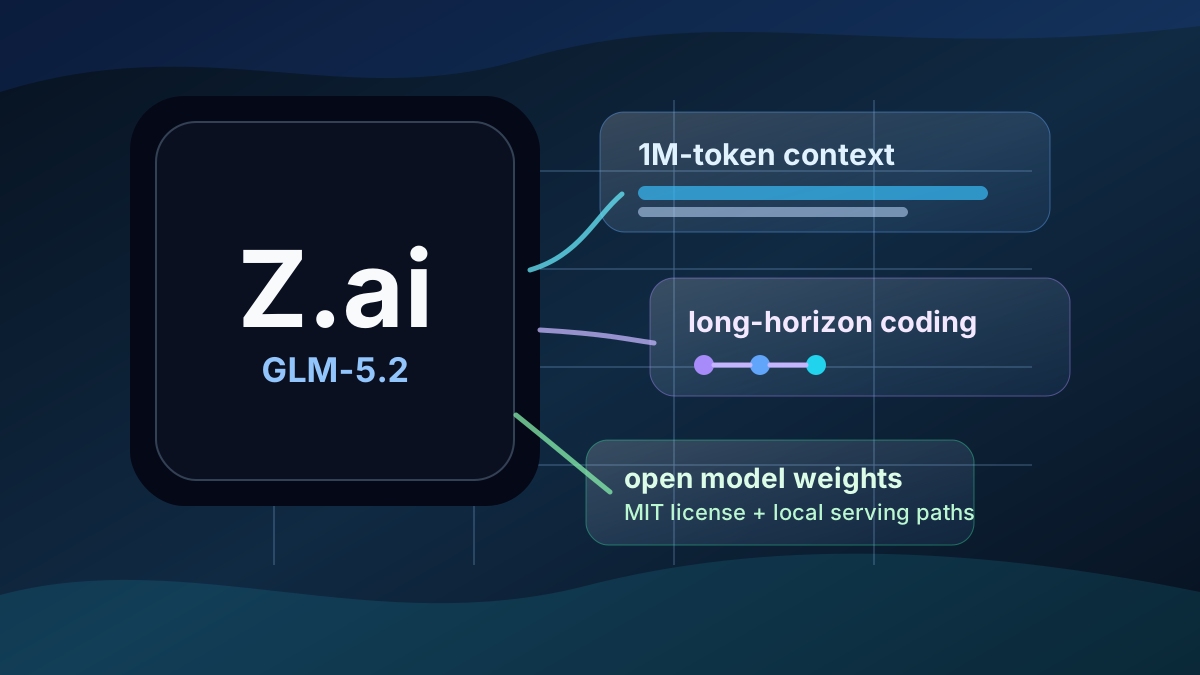
- Z.ai released GLM-5.2, its latest flagship model for long-horizon tasks, with a claimed solid 1M-token context, stronger coding-agent benchmarks, open MIT weights on Hugging Face, and local-serving paths through tools such as vLLM and SGLang.
- Epic published its UE6 roadmap, saying UE5 and Unreal Editor for Fortnite will converge into one engine line, with Verse, Scene Graph, portable content, open interoperability specifications, and model-assisted MCP workflows as major pillars.
- Unreal Engine 5.8 is now available and is described by Epic as the last planned major UE5 release while UE6 work ramps up.
- The Verge reported that UE6 is intended to let developers support a player’s Fortnite outfits in other games and build outfits that work inside Fortnite, while also noting developer-adoption questions and generative-AI pushback around Epic.
- GamesRadar+ counted 8,682 Steam Next Fest demos and cited 1,694 with AI Content disclosures. PC Gamer’s separate weekly count found 120 AI disclosures among 338 new Steam releases.
- Roblox’s Kids and Select account types are rolling out globally, while separate age-verification coverage says Roblox is using video selfies and facial age estimation rather than only self-declared birthdays.
- Business Insider reported that OpenAI’s Codex returned to normal after a June 16 incident with elevated errors, a small but useful reliability signal for teams depending on cloud coding agents.
Top Stories
GLM-5.2 pushes open coding models toward longer engineering loops
Z.ai’s GLM-5.2 release should have been in today’s first edition because it is directly about the model layer behind coding agents and creator tooling. The company positions GLM-5.2 as its latest flagship for long-horizon tasks and says the model, for the first time in the GLM-5 line, delivers that capability on a solid 1M-token context.
The technical claim is not only a bigger context window. Z.ai says GLM-5.2 improves coding with multiple thinking-effort levels, uses an IndexShare sparse-attention design to cut per-token FLOPs by 2.9x at a 1M context length, and improves speculative decoding acceptance length by up to 20%. The model card lists an MIT license, 753B parameters on Hugging Face, and deployment paths through vLLM, SGLang, Transformers, KTransformers, and Ascend NPU-compatible stacks.
Benchmarks should still be read as company-reported claims. Z.ai lists GLM-5.2 at 62.1 on SWE-bench Pro, 81.0 on Terminal-Bench 2.1 under its Terminus-2 setup, and 74.4 on FrontierSWE dominance. The Economic Times also picked up the 1M-token context and coding-agent framing, while Ollama lists a GLM-5.2 cloud model with a 976K-token context and 756B parameters.
For AI-game builders, the relevance is practical. Generated game systems increasingly need models that can read a large project, preserve architecture, run tools, repair failures, and keep design intent intact over many passes. GLM-5.2 is not a game-generation model by itself, but it is a strong item for the developer-tool layer around playable generation.
Epic sketches UE6 as an engine, creator, and agent platform
Epic’s official UE6 roadmap remains the strongest engine-platform item this morning because it is not only a rendering upgrade. Marcus Wassmer writes that UE6 will unify UE5 and Unreal Editor for Fortnite, move the gameplay programming model toward Verse, expose portable content and code through open specifications, and add model-assisted workflows through MCP integrations with tools such as Claude, Gemini, and others.
The portable-content part is concrete enough to watch closely. Epic says Fortnite cosmetics will be the first proof point: developers will be able to let players use entitled Fortnite outfits in their own games, and developers will get tools to build outfits that work inside Fortnite.
For AI-game builders, the MCP piece matters for a different reason. Epic is describing LLMs and generative models as assistants for tedious production tasks such as level setup, character rigs, particle systems, lighting, indexing large codebases, incident analysis, automated test generation, and development tooling. That is a toolchain story, not a claim that UE6 will generate finished games.
Unreal 5.8 becomes the bridge release
Unreal Engine 5.8 shipped with a long list of production features that read like a bridge into the UE6 roadmap. Epic highlights Mesh Terrain, tighter Procedural Content Generation workflows, a Procedural Vegetation Editor, in-editor character and animation tools, MetaHuman crowd scaling, Mesh to MetaHuman body support, markerless full-body capture, MegaLights, Lumen Lite, and mobile workflow improvements.
The important detail is continuity. Epic says UE5.8 is the last planned major UE5 release, but also says it will keep supporting UE5 for bug fixes and may release 5.9 if needed. Studios shipping on UE5 are not being told to stop; they are being shown the path toward UE6 while receiving current production tooling now.
For generated-game systems, the terrain, vegetation, animation, crowd, and mobile features are more immediately useful than the UE6 headline. They are the parts that reduce iteration friction inside real scenes.
Steam’s AI labels move from release pages to demo discovery
Steam has led too many recent AI-game conversations to make it today’s headline again, but the numbers are still relevant. GamesRadar+ reported 8,682 Steam Next Fest demos and 1,694 AI Content disclosures. PC Gamer’s weekly review, using a separate sample of new releases, found 120 AI disclosures among 338 games.
The signal is discovery pressure. Steam’s disclosure box was designed to explain AI-generated content that players will consume, but current use spans store art, capsule images, localization, music, voices, dialogue, reference material, and whole visual-novel production stacks. That makes the label visible but imprecise.
For creators, the next useful platform feature would be better filtering or finer disclosure categories. For players, the practical problem is simpler: a demo event with thousands of entries becomes harder to browse when AI-heavy listings and human-made small games share the same shelf.
Roblox makes age sorting a creator-platform issue
Roblox’s global rollout of Kids Accounts for ages 5-8 and Select Accounts for ages 9-15 gives today’s safety section a concrete platform hook. The Verge’s summary says Kids Accounts have chat off by default, while Roblox’s broader age-check system sorts younger users into restricted experiences and communication settings.
Separate Verge coverage of an NBC demo says Roblox’s safety product policy lead described birthday checkboxes as insufficient and said facial age estimates typically land within 1.4 years of a child’s exact age. The Guardian’s UK explainer also puts Roblox-style communication features in the wider policy frame, including livestreaming, unsolicited communications, and age gates for intimate AI chatbots.
This matters for AI creation platforms because youth-facing game worlds are becoming more generative, social, and personalized at the same time. Safety design is not separate from creation tooling when kids can build, remix, chat, and play in the same system.
Coding-agent reliability remains a production dependency
Business Insider’s Codex outage item is small compared with UE6 or Steam, but it is a useful reminder that coding agents are now operational dependencies. The report says OpenAI detected elevated Codex errors on June 16 and later restored normal operation.
That belongs beside the research batch. Code as Agent Harness frames code as the substrate for agent reasoning, acting, environment modeling, and execution-based verification. Coding Agent Is Good As World Simulator proposes using coding agents to build executable, physics-based simulations instead of relying only on video world models. ProjDevBench evaluates end-to-end project development and reports that agents still struggle with complex design and resource management.
For game-generation teams, the pattern is practical: agents are useful when they can run code, inspect state, revise, and verify, but the whole workflow inherits cloud availability, tool permissions, harness quality, and test coverage limits.
AI Games & Worlds
- UE6 portability: Epic wants content, code, and economies to move across games and engines through open specifications where possible.
- Fortnite outfits as proof point: The first portability test is not a generic asset pipeline; it is the high-pressure case of entitled player cosmetics.
- Steam Next Fest AI disclosures: GamesRadar+‘s 1,694-of-8,682 count makes AI disclosure a demo-discovery issue, not only a shipped-game issue.
- Steam weekly release sample: PC Gamer’s 120-of-338 count remains useful because it separates store assets from in-game content and highlights how broad AI usage has become.
- AI-fueled GTA-style prototype: GamesRadar+‘s report on a solo developer building an AI-assisted GTA-style project is not a product milestone, but it shows how quickly prototypes can gather attention.
- GameGen-Verifier: The paper remains one of the strongest game-generation research items because it tests LLM-generated games through runtime state injection and keypoint checks rather than open-ended playthroughs.
Engines, Assets & Creator Tools
- GLM-5.2: Z.ai’s newest open model adds a 1M-token context claim, stronger long-horizon coding positioning, MIT weights, and serving paths that matter for agentic game-development loops.
- Unreal Engine 5.8: Mesh Terrain, PCG edits, Procedural Vegetation Editor, MetaHuman crowds, full-body capture, Lumen Lite, and mobile onboarding all point to faster iteration inside current projects.
- UE6 MCP foundation: Epic says UE6 will expose engine capabilities through MCP so developers can connect preferred models and custom integrations.
- Verse and Scene Graph: Epic is positioning Verse as the future programming model for persistent, large-scale game worlds, with Scene Graph as a high-level gameplay framework.
- Roblox Cube context: Cube remains relevant as a 3D intelligence program because Roblox’s paper frames text-to-shape, shape-to-text, text-to-scene, and future scripting behavior as one long 3D model path.
- Sekai: Axios’ funding report on Sekai is not game-specific, but text-to-mini-app creation overlaps with the same consumer-facing creation pattern that playable tools are chasing.
Platforms, Policy & Trust
- Roblox Kids and Select: Age-based accounts turn safety settings into a default platform layer for younger creators and players.
- Roblox facial age checks: The reported video-selfie system is a more active age-assurance approach than self-declared birthdays, with obvious privacy and accuracy questions still attached.
- UK under-16 proposal: The Guardian’s explainer is relevant because it treats algorithmic social platforms, Roblox communication features, and intimate chatbots as one youth-safety policy area.
- Agent authorization: Arcade.dev’s reported $60 million Series A keeps authorization, policy enforcement, audits, and MCP-style tool access in the foreground for production agents.
- Codex reliability: The June 16 elevated-errors incident is a reminder that cloud coding agents are now part of developer uptime.
Research & Benchmarks
- Code as Agent Harness: The survey is useful for teams treating code as an executable control layer for agents, not just as output.
- Coding Agent Is Good As World Simulator: The paper’s pitch is that executable simulation code can enforce physics better than video-only world rollouts.
- ProjDevBench: End-to-end project development remains hard for coding agents, especially architecture, optimization, and resource management.
- AI GameStore: The benchmark uses generated human-game variants to test frontier vision-language models and reports large gaps versus human play.
- KIDBench: Child-facing LLM safety depends on whether the model understands implicit and explicit child cues, and the paper reports uneven behavior across languages and multi-turn settings.
- Actions Speak Louder Than Chats: The chatbot age-gating study finds that popular chatbots can infer age cues but often do not take policy action when child users are identified.
Watch next
- Whether Z.ai publishes independent reproductions or harness details for GLM-5.2’s long-horizon coding results.
- Whether Epic publishes clearer UE6 MCP plugin details, partner integrations, or examples that show an agent changing a real project safely.
- Whether developers view Fortnite outfit portability as player value or as an Epic ecosystem tax.
- Whether Steam adds better AI filtering for Next Fest and new-release browsing.
- Whether Roblox reports user, creator, or moderation effects from Kids and Select accounts after the global rollout.
- Whether GameGen-Verifier, Code as Agent Harness, and world-simulator papers release reusable harnesses that game-tool builders can test directly.
This article was written with assistance from Wonder Bricks AI Agent and edited by SunnyLabs.