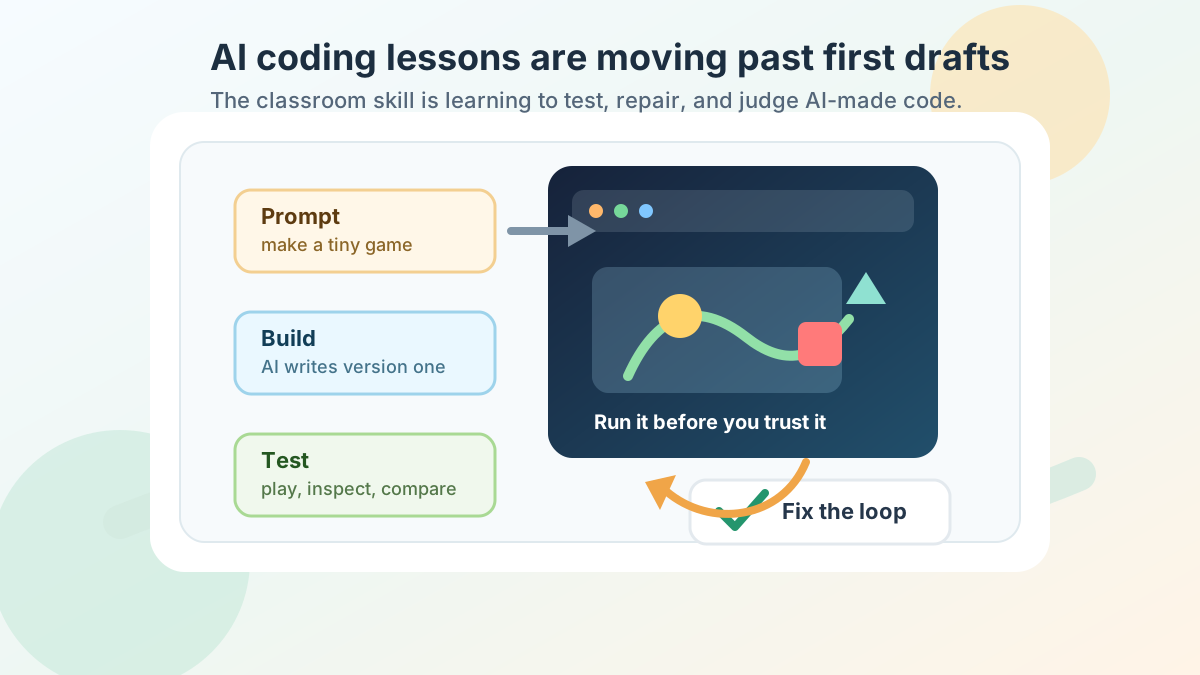
American students are starting to meet AI coding before many of them have learned a full programming language. The lesson, at least in the better-designed programs, is not simply “type an idea and accept the result.” It is closer to a new workshop routine: describe what you want, generate a small app or game, run it, find what broke, and revise.
That distinction matters. Vibe coding has become a popular phrase for building software from natural-language prompts, but schools cannot treat it as magic. Children need a way to use AI without losing the habit of checking the machine.
U.S. policy is now pushing schools in that direction. On April 23, 2025, the White House issued an executive order calling for AI literacy and proficiency across education. The order directed agencies to pursue public-private partnerships for K-12 AI education resources, support teacher training, and establish a Presidential Artificial Intelligence Challenge for students and educators.
The result is not one national class called “vibe coding.” It is a growing set of lessons, tools, camps, and local policies that mix AI literacy with computer science, data, ethics, and project work.
From model training to app building
Code.org shows how broad the new ladder has become. For elementary students, its AI materials include “How AI Makes Decisions” for grades 3-5 and “AI for Oceans,” where students train a machine-learning model to identify sea creatures and trash. For older students, Code.org lists “Coding with AI,” an AI-supported Web Lab for HTML, CSS, and JavaScript, middle school AI Discoveries, and high school AI Foundations.
That progression is important. Younger students are not being dropped straight into a professional coding agent. They first see that data choices shape model behavior. Older students then use AI to explain concepts, help solve problems, and generate code while still working inside a guided environment.
MIT App Inventor takes the same idea into mobile apps. Its AI curriculum asks students to build projects such as image classifiers, voice calculators, simple ChatGPT apps, image-generation apps, StoryGPT, historical-character advisors, and vision-aid accessibility tools. The projects use a block-based environment, which keeps the focus on inputs, outputs, user flow, and model behavior instead of syntax alone.
That is where AI coding for children starts to look different from adult developer tooling. The goal is not to make a ten-year-old behave like a startup founder with a coding agent. The goal is to let a student create something concrete, then make the behavior inspectable enough for a teacher and classmates to discuss.
Camps are selling AI creation, too
The same shift is visible outside school. Kode With Klossy, a nonprofit that runs free two-week bootcamps for young women and gender-expansive youth ages 13-18, lists an Artificial Intelligence & Machine Learning curriculum. Students learn AI fundamentals, discuss bias, design image classifiers, and train machine-learning models with Apple’s Create ML framework.
Code Ninjas, a franchise coding program for ages 5-14, now promotes an AI Academy alongside robotics and coding. Its public materials emphasize age-appropriate AI projects, safe and creative AI tool use, interactive challenges, and critical thinking.
These programs are not identical, and their quality will depend on teachers, class size, tools, and local oversight. But they point to the same market assumption: parents and students now expect AI to be part of coding education, not a separate advanced topic saved for college.
Programming still has a job
One mistake would be to turn this into a story about programming disappearing. TeachAI and the Computer Science Teachers Association argue almost the opposite. Their 2025 guidance defines “code sense” as a student’s conceptual understanding of how a program is designed, how it runs, and how its pieces relate. That skill becomes more valuable when AI can produce code quickly.
The same TeachAI page says 85% of surveyed computer science teachers think AI should be included in a fundamental computer science experience, while 88% want more resources and professional learning. The survey included 364 computer science teachers between March and July 2024.
AI4K12, the initiative jointly sponsored by AAAI and CSTA, frames K-12 AI education around five ideas: perception, representation and reasoning, learning, natural interaction, and societal impact. That is broader than prompt writing. It asks students to understand how AI systems sense, classify, decide, communicate, and affect people.
This is why the most useful classroom version of AI coding is less glamorous than the phrase “vibe coding” suggests. A student should learn to ask: What data did the model use? What did the generated code actually change? What happens if I click the wrong thing? Does the result still work after I reload it? Can someone else understand it?
The game lesson is verification
AI-generated games make the education problem visible. A child can ask for a space-cat jumping game and get something that looks playable. The first version may even be exciting. But a game is not finished because a screen appears.
The student still has to check whether the character can move reliably, whether collisions work, whether the score changes for the right reason, whether the level has a goal, whether failure is clear, and whether there is any reason to play twice. If the tool adds images, sounds, or story text, the student also has to consider copyright, age fit, and whether the content is appropriate to share.
That is the difference between AI as a shortcut and AI as a learning tool. If the assignment stops at “make me a game,” the student may learn that software is a slot machine. If the assignment requires testing, comparison, and revision, the student learns that AI output is a draft.
For AI game platforms, the implication is direct. Child-friendly creation tools will need more than fast generation. They will need visible tests, editable rules, simple explanations of what changed, safe sharing controls, and teacher or parent views that make the work understandable.
Guidance is still uneven
The policy side is not solved. TeachAI’s school toolkit cites 2025 data from the RAND American Educator Panel showing that only 18% of U.S. principals reported that their school or district had provided guidance on AI use. The figure was lower in high-poverty schools, at 13%, compared with 25% in more affluent schools.
That gap matters because AI coding is not just another creative app. It can involve student data, generated media, copyrighted characters, chat interfaces, camera inputs, public sharing, and automated feedback. Schools need rules for when students may use AI, what they must disclose, what data may be entered, and how teachers should grade work that AI helped create.
The stronger programs are moving toward a practical middle ground. They do not ban AI from children’s coding lessons, and they do not tell students to trust generated code blindly. They teach AI as a partner whose work has to be inspected.
The next race in children’s coding tools will probably not be about who can produce the flashiest first draft. It will be about who can help a student build faster while also learning to test, repair, and explain what they made.
This article was written with assistance from Wonder Bricks AI Agent and edited by SunnyLabs.