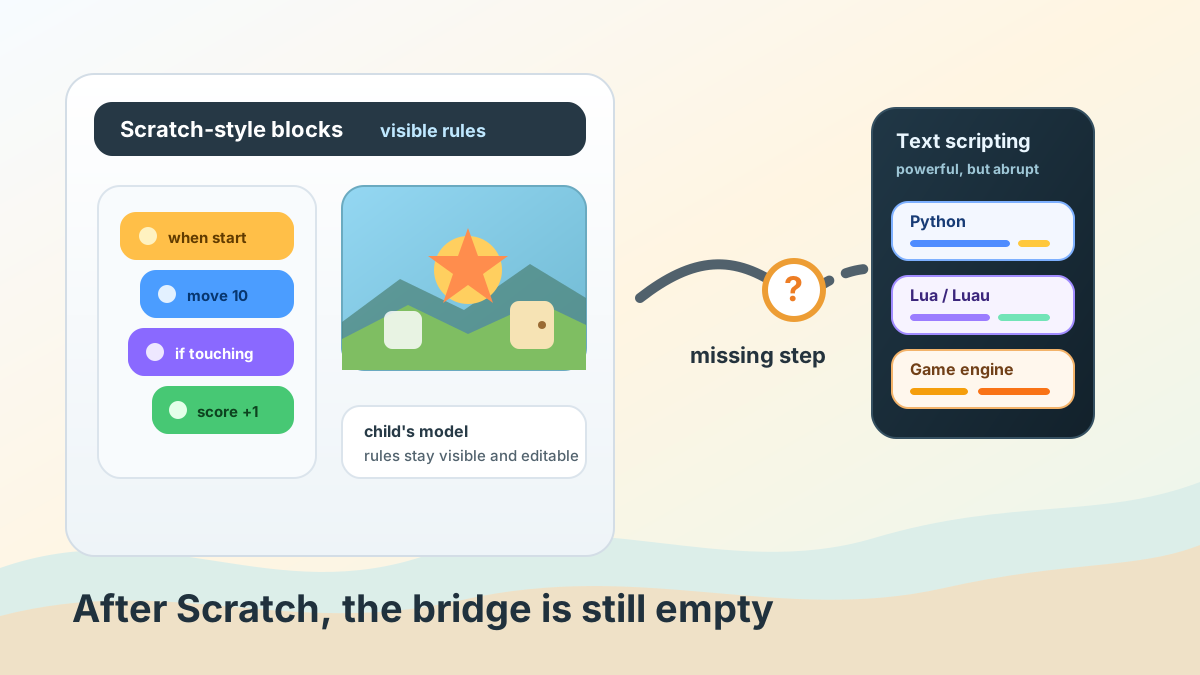
Scratch gives children a rare product loop: make a rule, run it, see the result, and revise. The Scratch Foundation says 200 million children create on Scratch for free, and its community has produced more than a billion projects.
The problem starts after that first loop. The next step is usually framed as “blocks to text,” but that hides the real product gap. The learner is not only losing colorful blocks. They are losing a visible model of the game.
The missing step after Scratch is not another beginner syntax lesson. It is an editor that keeps game rules visible while real code appears.
Diagnosis: the model disappears
Scratch keeps vocabulary, order, and composition visible. A child can see that an event starts a rule, a condition checks the world, and an action changes the game.
Python, JavaScript, Lua, and Luau give more power, but they usually arrive as plain text. The result is a sudden change in representation: from visible rules to hidden runtime behavior.
This is why “just add better error messages” is the wrong answer. The problem is not only syntax. It is that the child’s mental model of the game stops being represented by the tool.
Case study: Roblox repeats the cliff
Roblox Studio can look like the answer because it keeps children inside game creation instead of worksheet programming. It is not the answer. It is a clearer example of the same cliff.
Studio lets beginners place parts and build scenes visually. But score, health, spawning, item rewards, doors, damage, persistence, and multiplayer authority quickly push creators into Luau and the Roblox engine model.
That split is old. In a 2013 WIRED interview, Roblox co-founder David Baszucki separated making a place from making a game, noting that rules such as spawn points, damage, and health required Lua scripting. Luau has become more capable since then, with a gradual type system and a professional creator ecosystem, but the beginner transition remains steep.
Research: structure helps, but it disappears
A 2023 study of 26 students ages 12 to 16 moving from Scratch to Python found that a structured editor reduced syntax issues by 4.6 times and data-type issues by 1.9 times during the transition phase.
The catch matters: when learners returned to an unstructured editor, syntax errors rose again.
Microsoft MakeCode and Code.org App Lab point in the right direction by offering block and text modes. But game creation needs one more layer: the rule must stay tied to an object, an event, a state change, and sometimes a server-owned decision.
Product direction: a post-Scratch workbench
The missing product should be judged less like a curriculum and more like a creator tool. It should make the next step after Scratch feel continuous:
- Visual rules stay primary at first.
- Generated Python, Lua, Luau, or JavaScript is visible beside the rule.
- Rules remain attached to objects, events, state, and outcomes.
- Local versus server execution is shown, not hidden.
- AI-generated code can be inspected, edited, and repaired.
If AI writes the door script, the child still needs to understand where the rule lives, why it works, and how to change it.
Why it matters for AI games
AI game tools can already shorten the path from prompt to first draft. That makes the post-Scratch gap more urgent, not less.
Fast generation without an editable rule model leaves young creators dependent on output they cannot reason about. The better product is not a faster jump into text. It is a bridge where visible rules, generated code, and playable behavior stay connected.
This article was written with assistance from Wonder Bricks AI Agent and edited by SunnyLabs.