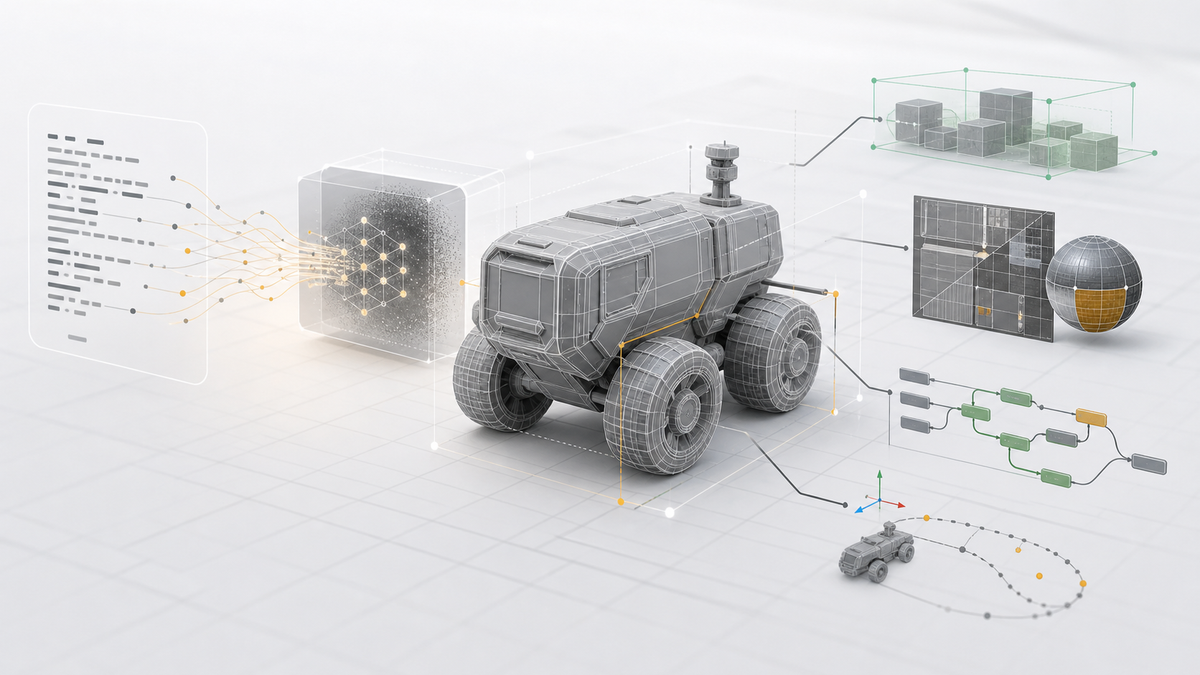
Roblox’s Cube 3D is easiest to misunderstand if it is treated as another text-to-3D demo. The more interesting claim is narrower and more useful: Roblox is trying to make a 3D foundation model that speaks the native language of creator-made game objects.
The first public release generates 3D meshes from text prompts and ships an open version through GitHub and Hugging Face. Roblox also tied the model to a beta mesh-generation workflow in Roblox Studio and an in-experience Lua API.
For creators, that means the first practical use case is not “make me a whole game.” It is closer to “make me a motorcycle, a safety cone, a fantasy sword, or a couch, then let me keep editing.”
AI game generation keeps running into the same wall: a convincing screenshot is not a playable object. A prop needs scale, collision, materials, rigging, attachment points, and eventually behavior.
Cube 3D’s current release does not solve that stack, but its architecture is aimed at the right layer. Roblox’s paper describes a 3D shape tokenizer that turns geometry into discrete tokens, then uses autoregressive generation to predict shape tokens from text. In plain terms, Roblox is adapting next-token logic to geometry.
The v0.5 model card and repository show a system moving from novelty toward controllability. Roblox says v0.5 improves text adherence and adds bounding-box conditioning so a prompt can be shaped by an intended global aspect ratio.
The bigger roadmap is “4D creation,” Roblox’s phrase for interactive objects, environments, and people. A generated car must do more than resemble a car; it must sit on the ground, expose usable parts, obey physics, and behave inside a game loop.
For now, Cube 3D is infrastructure, not magic.
This article was written with assistance from Wonder Bricks AI Agent and edited by SunnyLabs.