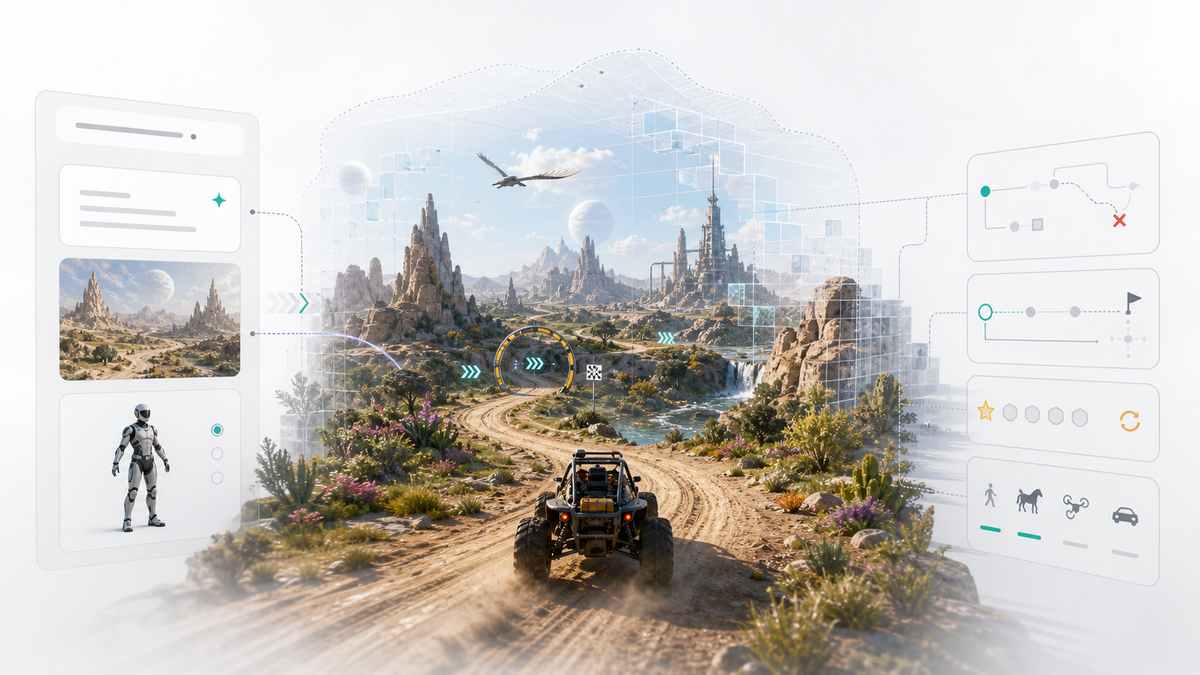
Project Genie makes its case when the camera starts moving. The scene is no longer a still image waiting to be admired; it is a space trying to keep up with the player.
Google calls Project Genie an early research prototype for creating and exploring worlds from text or images. The label is accurate. Genie is testing whether a model can become the ground under your feet fast enough for play.
On spectacle, the answer is often yes. On play, the answer is still mostly no.
DeepMind’s Genie 3 announcement gives the technical reason to pay attention: real-time navigation at 24 frames per second, 720p resolution, several minutes of interaction, and visual memory that can reach back about a minute. Compared with Genie 2, whose examples often lived in the 10-to-20-second range, that is real progress.
A game starts when the place makes a promise: the player’s actions will have consequences.
Hands-on reports make Genie sound most charming when expectations stay low. A rough racing space can imply a goal because a track already tells the player what to do. A character wandering through a generated fantasy scene can feel delightful for a minute. But the delight arrives before the rules do.
The control layer is thin. The public experience is built around short explorations and basic movement rather than a designed verb set. Google also lists limits that matter directly for games: constrained direct actions, difficult multi-agent simulation, imperfect text, and limited duration.
There is a trust problem, too. If paint disappears, a road becomes grass, or input arrives late, the player stops reading the world as a rule system. They start reading it as video that happens to respond.
Genie’s practical future is probably closer to a sketchpad. It could help designers audition spaces, educators stage explorable concepts, or researchers train agents in varied environments. As a play experience, though, Project Genie remains narrow: a remarkable generated-world demo with a thin game loop.
Retest it when it has goals, feedback, sturdier controls, and a reason to return.
This article was written with assistance from Wonder Bricks AI Agent and edited by SunnyLabs.