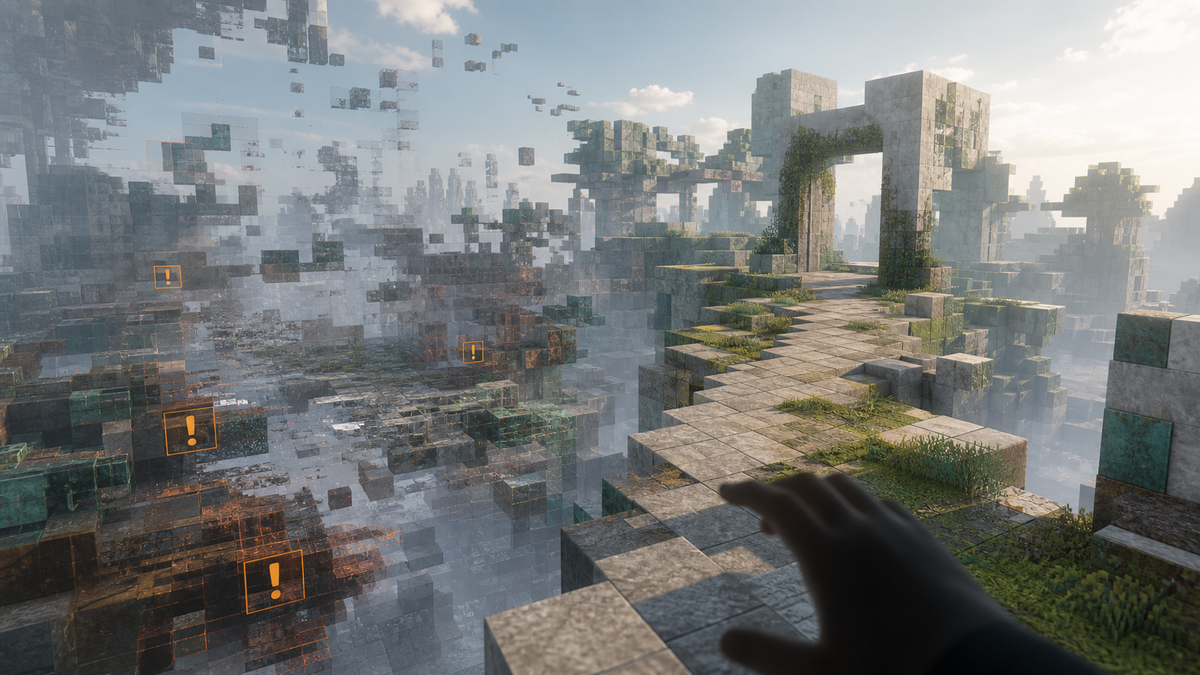
In the first minutes of Oasis, the uncanny part is its near-obedience. It looks like Minecraft, accepts familiar inputs, then quietly refuses to keep the world stable.
A path turns into a different path. A texture seems to remember what it should be, then gives up. The player moves, clicks, looks around, and the world answers in real time, but it answers like a dream trying to pass a rules test.
As a demo, Oasis lands. Decart and Etched showed a Minecraft-like world that does not depend on the usual stack of meshes, shaders, entity logic, authored physics, and stored world state in the way a normal game does. Public reporting described a system rendering in real time at roughly 20 frames per second.
As a game, Oasis breaks exactly where a generated world is expected to break. Minecraft works because its blocks are promises. If you mine one, place one, build a wall, or dig a staircase, the world remembers. Oasis often gives you the image of that promise without the underlying contract.
The instability gives Oasis some of its charm. Sudden visual mutations and accidental scene changes can feel like the model is improvising. In a toy, that is enough for a few minutes. In a game, surprise turns into noise when the player cannot form intent and see that intent survive.
Oasis shows the current world-model bargain plainly. It gains immediacy by generating the whole scene, but loses the sturdy abstractions games rely on: state, rules, collision, entities, authored affordances, and inspectable logic.
Oasis deserves attention because it became playable before it became coherent. Retest it when the world remembers what the player did five minutes ago, when rules survive camera turns, and when the demo offers something better than watching a model almost understand a game.
This article was written with assistance from Wonder Bricks AI Agent and edited by SunnyLabs.