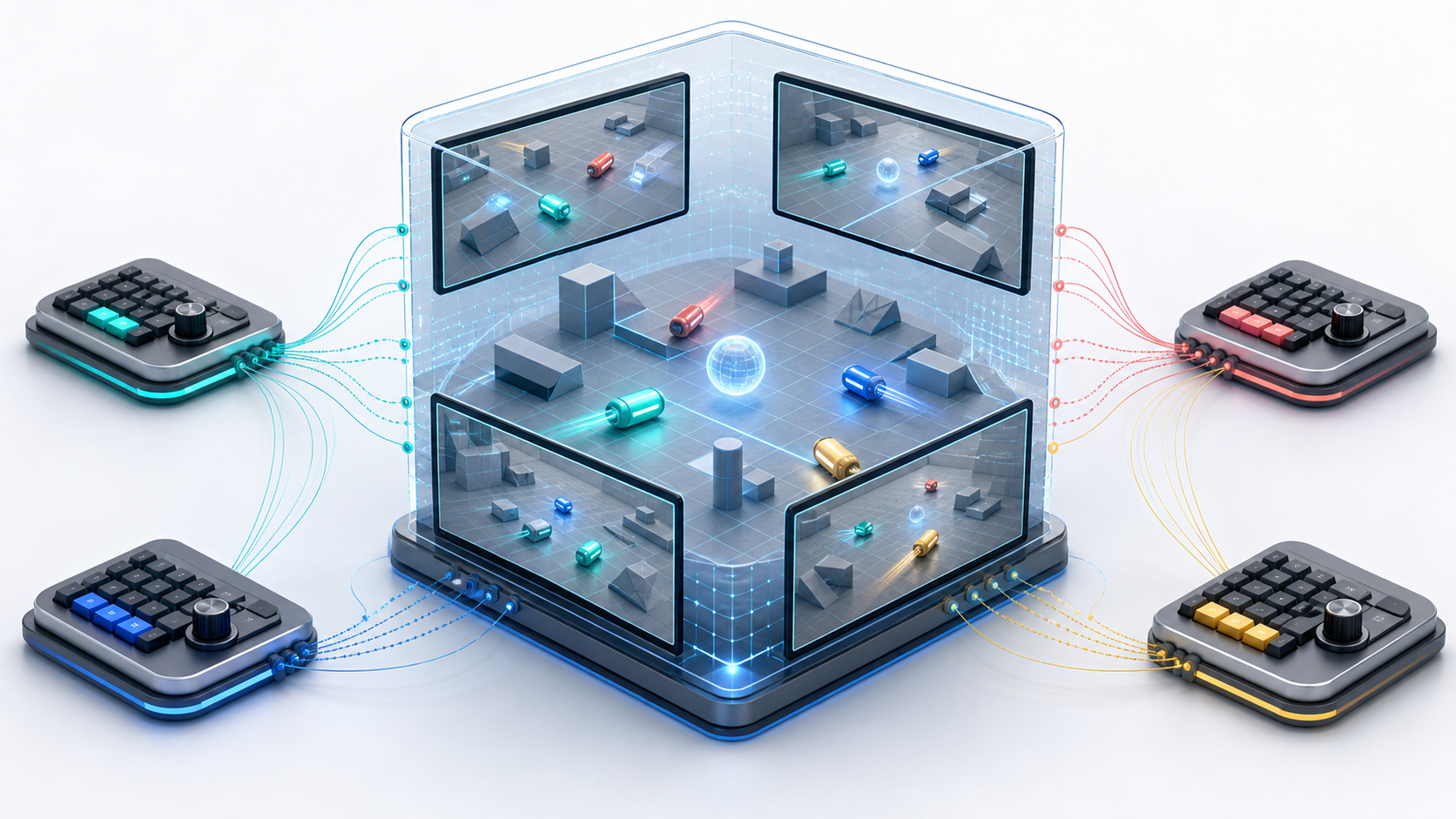
General Intuition and Kyutai have released MIRA, a browser-playable multiplayer world model built in collaboration with Epic Games. In the public demo, four players use their keyboards to play a 2v2 car-soccer match inspired by Rocket League while an AI model generates the video in real time.
The news is not simply that MIRA resembles a familiar game. The sharper question is whether a model trained on video and actions can keep one shared game world coherent enough for several people to play inside it.
According to the project page and blog post, MIRA is a 5B-parameter diffusion transformer paired with a 600M-parameter video representation codec. It generates the four-player view at 20 frames per second from the actions pressed by all players.
The researchers trained it on roughly 10,000 hours of 2v2 matches collected from self-play between publicly available Rocket League bots. Each match produced four synchronized player recordings, with action streams aligned to the same timeline.
That setup matters. The team says physics data, such as car and ball positions, was logged for evaluation, but the world model itself learned from pixels and actions rather than privileged engine state.
For generated games, multiplayer is a tougher test than a single camera view. A plausible next frame is not enough. The ball, vehicles, boost, goals, event messages, and four player perspectives have to stay consistent enough for the match to remain playable.
The demo also tests generalization. The training data came from expert bots, but the live demo accepts human keyboard play, which is less predictable. The team says MIRA can run for long periods when play stays within the broad shape of a normal match.
That does not make it a finished game platform. The blog post is direct about the limits. Replays can fail because the model has only a short context window and may invent a plausible replay that does not match the goal that just happened. Single-player variants struggle more with hidden information, such as cars outside the camera view. If players push the simulation far away from normal match behavior, the world can become unstable before recovering.
Those caveats are why MIRA is better read as a research demo than as a product launch. The project does not claim to replace Rocket League. It frames game simulation as a cleaner step toward physical AI, where researchers want models that can predict how environments respond to actions before testing systems in more expensive or risky real-world settings.
The release is also useful because it is not only a demo. The team is publishing training and inference code, along with the Rocket Science dataset. The dataset is described as a 1,000-hour slice of matches, or 4,000 player-hours across four synchronized views, with video, action streams, and logged physics state.
MIRA is not a shortcut to finished AI-generated games. It does show that controllable multiplayer video worlds are moving beyond clip generation. The next question is whether systems like this can move from impressive live demos to inspectable rules, persistent state, clear asset policies, and game loops that real players want to return to.
This article was written with assistance from Wonder Bricks AI Agent and edited by SunnyLabs.