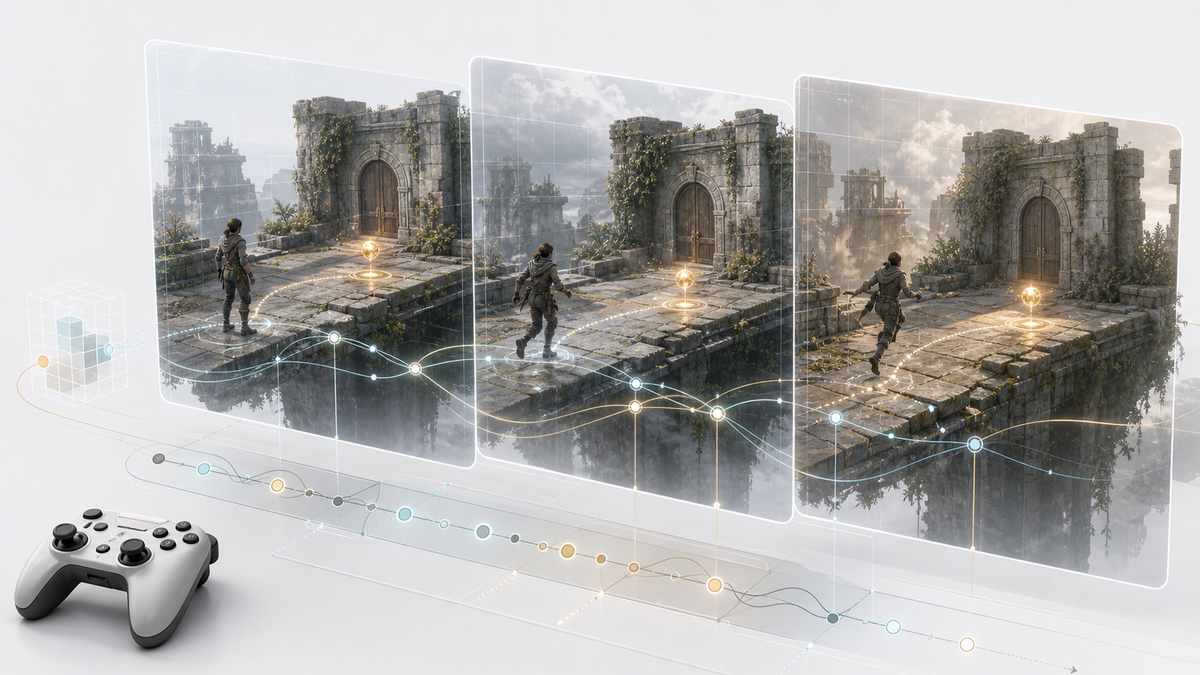
Microsoft’s Muse is easy to misread if you watch only the generated footage. The clips look like a low-resolution game being hallucinated forward. The more important part is the evaluation frame around them.
Muse, the name Microsoft gives to its World and Human Action Model line, is not a general game engine. It is a generative model trained on gameplay video and controller actions. It can predict visuals from actions, actions from visuals, or generate both.
For AI-generated games, convincing motion is only the entry ticket. The harder test is whether the model preserves enough of a playable world for design work to matter.
The Nature paper’s useful contribution is its three-part test: consistency, diversity, and persistency.
Consistency asks whether the world behaves like the game it is supposed to model. Does the character respond to input? Do walls remain walls? Do stairs, attacks, jumps, and objects keep their role over time?
Diversity matters because designers rarely need one continuation. They need alternatives: different routes, camera choices, character behaviors, and visual variants from the same starting condition.
Persistency is the hardest requirement. If a designer adds a power-up, enemy, jump pad, or environmental affordance, the model has to remember it long enough for the idea to be inspected. If the edit melts away after a few frames, the tool is only making animated concept art.
The later Quake II Copilot demo made the gap visible: a browser-playable AI-generated scene is a stronger product signal than a research video, but reports described it as basic, blurry, time-limited, and more suggestive than durable.
Muse is valuable because it names the bar: keep a playable idea coherent after the player touches it.
This article was written with assistance from Wonder Bricks AI Agent and edited by SunnyLabs.