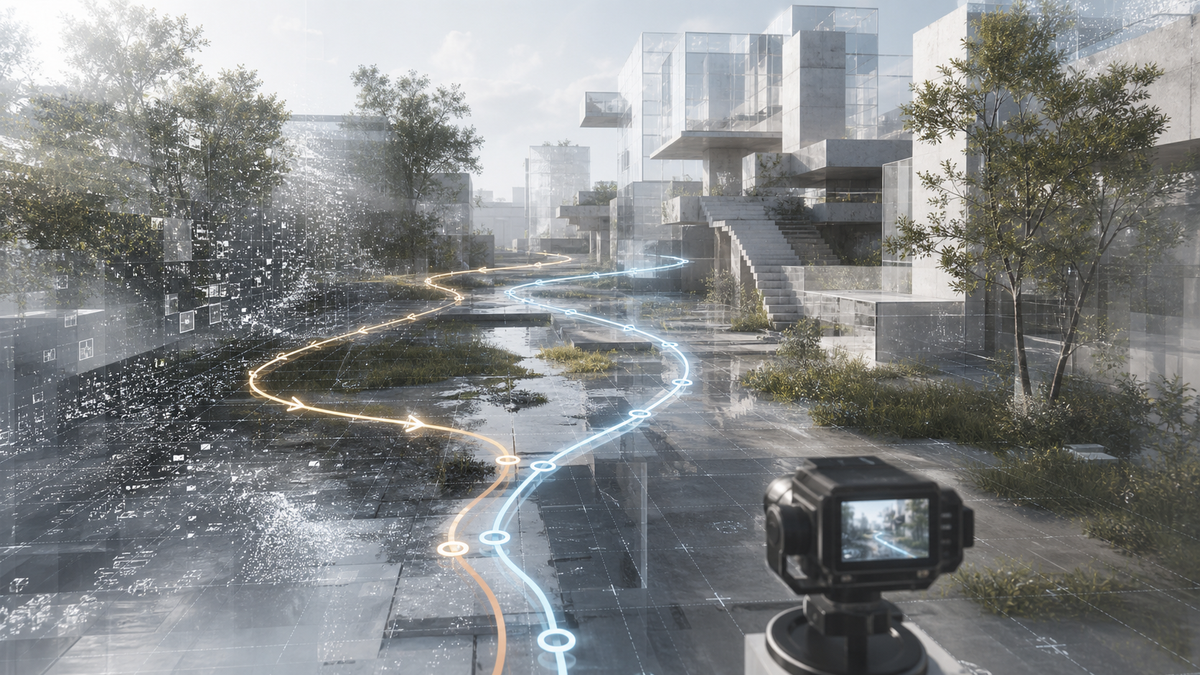
iWorld-Bench answers a question that generated-game demos often avoid: if a world model makes a beautiful first-person video, can it still obey the player?
The benchmark is built for interactive world models rather than ordinary video generation. Its authors report a dataset of 330,000 video clips, a selected evaluation set of 2,100 high-quality samples, and 4,900 test tasks. The task design is the useful part.
iWorld-Bench asks models to follow action commands, track camera trajectories, and return to places they should remember.
For AI games, that is the right test. A generated game world has to respond when the player moves forward, turns, backs up, revisits a hallway, or expects the same object to remain where it was.
World-model announcements are getting better at spectacle. DeepMind’s Genie 3, for example, was presented as a general-purpose world model that can generate navigable environments in real time at 24 frames per second and 720p for a few minutes. That is a serious research milestone, but not a full game-readiness test.
Adjacent papers point in the same direction. Matrix-Game frames interactive world modeling around controllable Minecraft-style generation, action-labeled gameplay data, and a GameWorld Score. Hunyuan-GameCraft-2 shifts control beyond fixed keyboard schemas, using language, keyboard, and mouse signals to drive interactive game video.
iWorld-Bench’s useful contribution is to make claims harder to blur. A model can score well on smoothness while still drifting off the commanded path. It can render sharp textures while forgetting that a return route should close the loop.
The benchmark still does not prove fun, agency, rule systems, multiplayer behavior, editability, safety, or long-session persistence. But it pushes the evaluation conversation where it needs to go.
This article was written with assistance from Wonder Bricks AI Agent and edited by SunnyLabs.