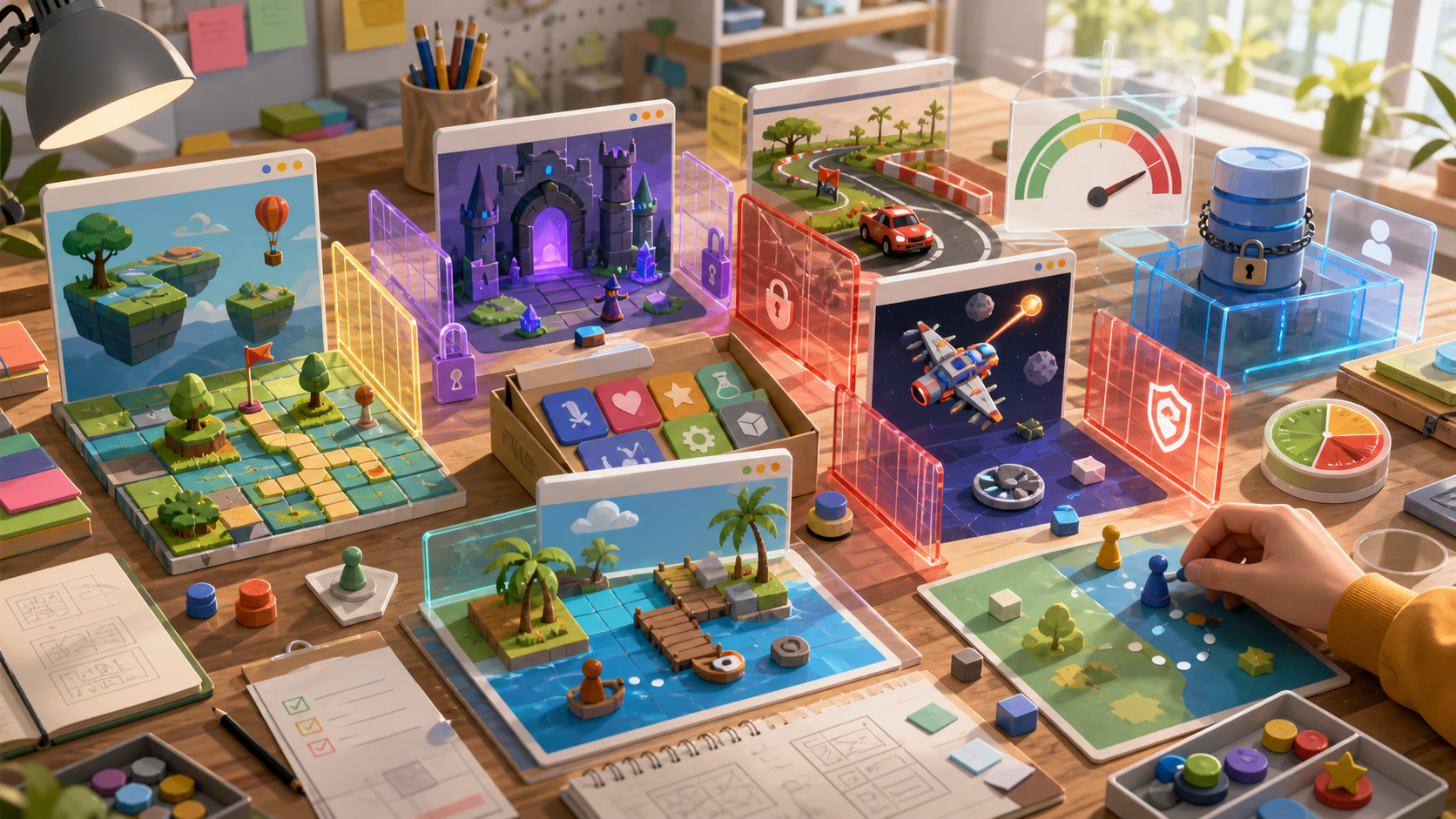
Claude Fable 5 is becoming a public stress test for agentic game creation.
Anthropic is pitching the model as a major step for long, complex work across coding, reasoning, vision, and research. The internet has chosen a simpler test: ask it to make games, play games, and reveal where the agent breaks.
The most useful examples are browser demos. TechCrunch covered Ethan Mollick’s Fable-made games built through Claude Code, including an arcade snake game, a cave-lighting exploration game, and a literary walking piece. They are not commercial releases. They are not proof that Fable 5 can maintain progression, multiplayer state, or a durable content pipeline.
They are useful because they are playable.
That is a meaningful bar in AI-game coverage. The field has plenty of impressive screenshots and short videos that fall apart once a player asks for controls, goals, failure states, or replay. Fable 5’s early demos move the question from “can it draw something game-like?” to “can it assemble an interactive artifact that a stranger can test?”
For small self-contained prototypes, the answer appears to be yes. For production games, the answer is still open.
A generated snake game can be judged in minutes. A persistent multiplayer world needs account state, authoritative servers, session recovery, save migration, moderation, latency handling, analytics, abuse controls, and a way for creators to inspect what the model made. Fable 5 compresses the first playable draft. It does not erase the runtime.
The Pokemon FireRed example adds another angle. Phandroid covered Anthropic’s timelapse of Fable 5 playing through the game from raw screenshots without maps or walkthroughs. The approach was not elegant, but it completed a long objective through visual state reading and game reasoning. That matters because the same skill could help a model test its own generated game, inspect a failure, and decide what to patch.
Then come the constraints.
Anthropic’s safeguards route some higher-risk requests away from Fable 5 to another model. Axios reported that the conservative routing covers areas such as cybersecurity, biology, chemistry, and model distillation. The Verge tested the biology side and found ordinary prompts blocked alongside risky ones. Anthropic described that as an intentional tradeoff while it improves detection.
For game builders, the immediate lesson is predictability. Creative agents run long chains of planning, coding, testing, and repair. If a model changes capability level or routes a task across a hidden boundary, the creator may not understand why output quality changed. A safety boundary can be necessary and still disrupt harmless workflows.
Cost and data are part of the same story. Reporting around the launch describes premium pricing, capacity limits, usage-credit questions, and enterprise concerns about data retention. A one-off demo can absorb expensive inference. A consumer game-creation platform cannot assume users will stop after one prompt. They will revise levels, regenerate assets, ask for variants, and run agentic repair loops until the result feels playable.
That leaves Fable 5 in a more interesting place than the “one-click game” headline. It is not a finished game factory. It is a public test of whether frontier agents can turn ideas into playable drafts while staying predictable enough for real product work.
The next milestone is not another stranger Snake clip. It is a generated game that survives editing, hosting, multiplayer state, moderation, cost control, and a second play session.
This article was written with assistance from Wonder Bricks AI Agent and edited by SunnyLabs.