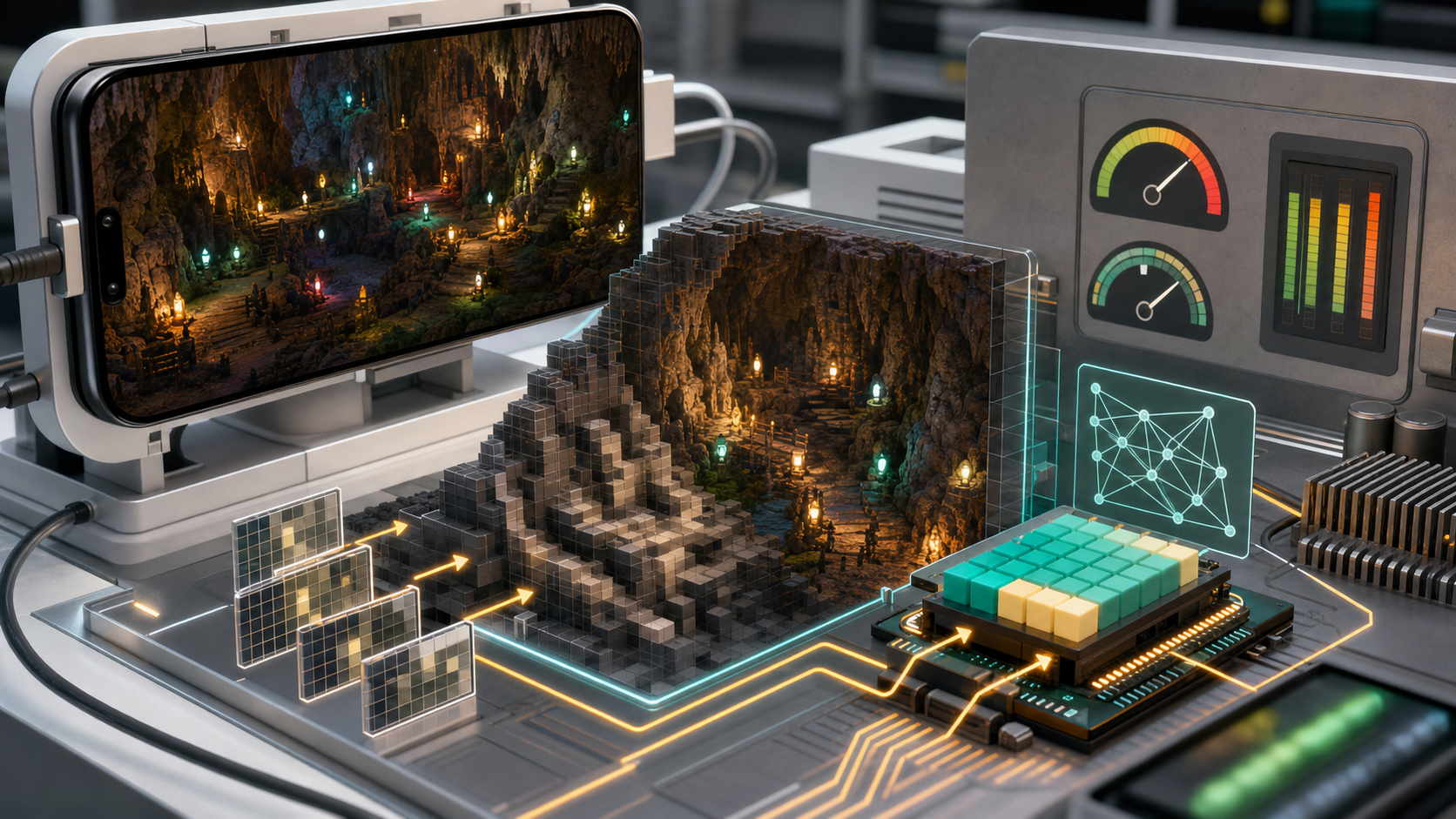
Arm’s Neural Dawn matters less as a coming mobile game than as a production marker. The demo, built with Sumo Digital, is Arm’s clearest attempt to show neural graphics as a game-development workflow rather than a graphics keynote slide.
Android Central reported that Neural Dawn is planned for Q4 2026, has four levels and roughly 120 minutes of gameplay, and uses Unreal Engine 5.5’s MegaLights technique for scenes with many dynamic lights. The practical claim is simple: mobile games have tight thermal and power budgets, so AI-assisted rendering can buy image quality without asking the phone to brute-force every pixel.
The stack described around the demo includes Arm Neural Super Sampling, neural denoising, frame upscaling, and future Mali GPUs with dedicated neural accelerators. Arm’s own playbook, updated June 10, frames the material for game developers and graphics engineers evaluating whether neural graphics fit their mobile game.
That puts Arm in the same strategic lane as PC-side neural rendering, but with a different constraint. NVIDIA’s DLSS and AMD’s FSR are already familiar to PC and console developers as ways to render less and reconstruct more. Arm’s pitch is narrower and more mobile-specific: make expensive lighting and smoother output viable inside phone-class power limits.
The early-access program also shows the audience. Arm is asking studios to apply for pre-release tooling, models, and technical guidance, with access limited by technical alignment and capacity. This is not a broad public SDK moment yet.
For generated games, the relevance is not just prettier caves. AI-generated worlds tend to be visually unstable, expensive to render, and hard to preserve across devices. A neural graphics layer could help lightweight clients show richer worlds while a server or model system handles rules, generation, and moderation elsewhere.
The caveat is hardware reach. Android Central notes that the first path appears tied to upcoming Mali GPUs with neural accelerators, which limits obvious coverage in North America and excludes phones built around other GPU families. Neural Dawn may prove the pipeline before it proves the market.
What to watch next is whether Arm turns the playbook into repeatable shipping guidance: performance budgets, fallback modes, engine integration, and a list of real third-party games using the stack outside Arm’s own showcase.
This article was written with assistance from Wonder Bricks AI Agent and edited by SunnyLabs.