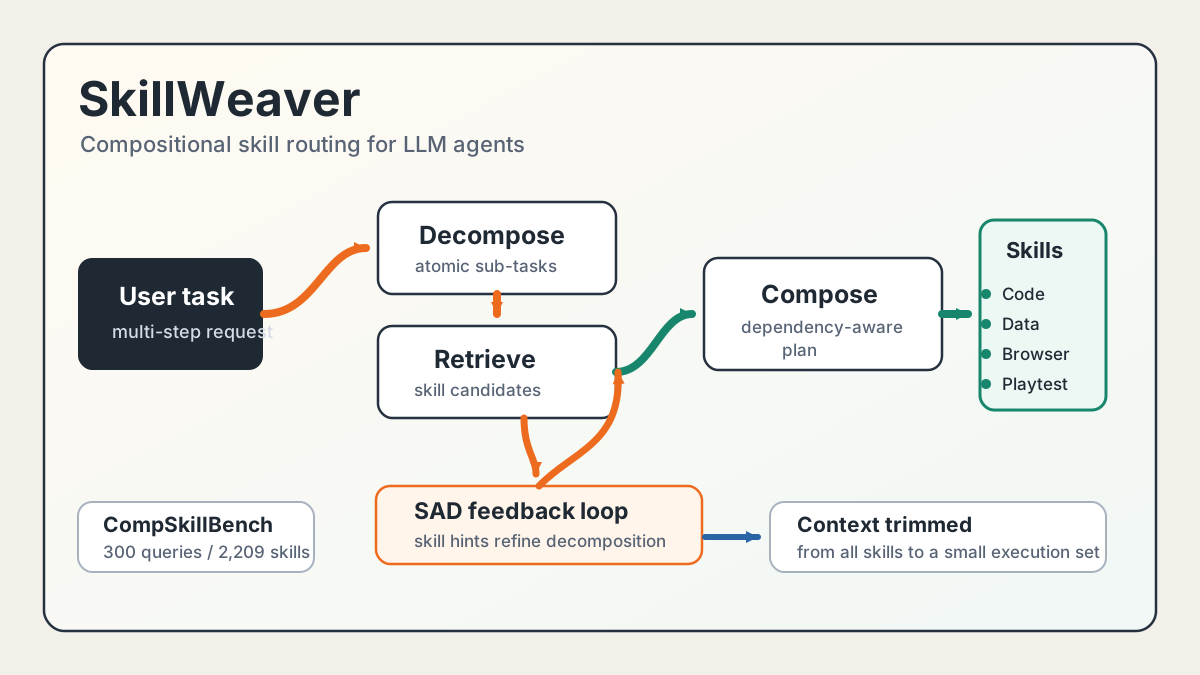
Alibaba Cloud researcher Xueping Gao has put forward SkillWeaver, a research framework for helping LLM agents choose and combine skills from large tool catalogs. The paper, submitted to arXiv on June 16, 2026, does not announce a consumer product. It studies a problem that becomes urgent as agent platforms add more reusable capabilities.
SkillWeaver calls that problem “compositional skill routing.” Given a multi-step request, an agent must break the job into smaller tasks, retrieve a relevant skill for each task, and produce an execution plan that respects dependencies. It also has to do this without loading the entire skill library into the model context.
For AI-generated games, the problem is immediate. A capable game-building agent may need to scaffold a project, import assets, run browser automation, inspect screenshots, debug physics or collision behavior, localize UI copy, and publish a build. The quality of the result depends on whether the system calls the right capabilities in the right order, not just whether the base model can write code.
Why skill routing matters now
Agent Skills are portable instruction folders centered on a SKILL.md file. The public Agent Skills overview describes them as a lightweight format for packaging specialized knowledge, workflows, scripts, references, and templates that an agent can load on demand. The Model Context Protocol documentation now has a “Build with Agent Skills” guide for MCP server development, with composing skills that route an agent through server design, interactive app widgets, and MCP bundle packaging.
MCP gives agents a common way to connect to tools and data sources. Skills give agents procedural knowledge about when and how to use specialized capabilities. Together, they create a new operations problem: a larger catalog gives agents more options, but it also makes choosing the right path harder.
SkillWeaver’s paper draws a sharp line between single-tool selection and multi-skill routing. Picking one API for one intent is not the same as handling a request such as “download the dataset, transform it, and create visual reports.” The latter requires ordered composition. If the agent decomposes the task too broadly, retrieval misses useful capabilities. If it decomposes too finely, it may add needless steps, waste context, or make the plan harder to execute.
How SkillWeaver narrows the catalog
The framework has three stages.
First, an LLM decomposes a user request into atomic sub-tasks. Second, a bi-encoder retriever searches a skill library for candidates for each sub-task, using FAISS indexing over skill metadata and bodies. Third, a compose stage sketches a dependency-aware plan, selecting skills across the chain rather than treating each step as isolated.
The most interesting part is Skill-Aware Decomposition, or SAD. SkillWeaver first runs a normal decomposition, retrieves likely skill candidates, then feeds the candidate names back as hints so the model can revise its breakdown using vocabulary that exists in the skill library. In plain terms, the agent is not just asking “what are the steps?” It is asking “what are the steps that map cleanly onto tools I actually have?”
That matters because generic planning language often fails at retrieval. A model may say “process the file” when the catalog contains OCR, PDF parsing, CSV normalization, vector indexing, and database ingestion skills. SkillWeaver tries to pull the plan closer to the catalog without showing the model the whole catalog.
What CompSkillBench measured
The paper also introduces CompSkillBench, a benchmark built from 2,209 unique skills sourced from the public MCP ecosystem and mapped into 24 functional categories. The benchmark contains 300 compositional queries: 150 easy two-skill tasks, 100 medium three-skill tasks, and 50 hard tasks requiring four or five skills.
The reported numbers show both the promise and the gap. With Qwen2.5-7B-Instruct as the primary decomposer, ordinary decomposition reaches 51.0% strict decomposition accuracy and 34.2% top-1 category recall. Adding SAD raises strict decomposition accuracy to 67.7% and relaxed decomposition accuracy to 84.3%, while top-1 category recall moves to 37.0%.
That is a useful gain, but not a finished agent system. Top-10 category recall sits around 70%, which means the right category is often somewhere in the candidate list, but not reliably at the top. The paper’s own discussion points to reranking as a next step. A Qwen2.5-7B listwise reranker pilot raises top-1 category recall from 37.1% to 40.9%, and an encoder spot-check reaches 45.1%.
The context-window result explains why this matters for products. Naively exposing all 2,209 skills would consume an estimated 884,000 tokens. Top-10 retrieval drops that to about 4,000 tokens. SkillWeaver’s average routed plan exposes about 2.9 skills, or roughly 1,160 estimated tokens at execution time. In the paper’s accounting, that is a 99.9% reduction in task-time skill context.
What the paper has not shown
SkillWeaver should not be read as proof that Alibaba Cloud has solved autonomous software or game creation. The paper is explicit about its limits. The benchmark queries are synthetic compositions over real skill entries. The controlled evaluation measures retrieval and category matching, not full execution with real tools, error recovery, authentication, permissions, or side effects. The compose stage is part of the architecture, but its isolated evaluation would need compatibility annotations the benchmark does not yet provide.
There is also an important name distinction. A separate 2025 paper called SkillWeaver studied web agents that discover and distill reusable skills as APIs after practicing on websites. Alibaba Cloud’s June 2026 SkillWeaver is different: it is about routing and composing existing agent skills across a large catalog.
The distinction matters. One line of research asks how agents can create skills. The Alibaba Cloud paper asks how agents can find and combine them once the library is already large. In practice, mature agent platforms will need both.
Why game builders should watch it
Generated games expose the routing problem quickly because games are not a single artifact. A playable build may require code generation, asset placement, input handling, scene inspection, browser execution, audio checks, localization, safety review, performance budgets, and deployment rules. Many failures are not visible in text. The agent has to move between code, runtime evidence, screenshots, and playtest signals.
That makes skill routing a product problem, not just a benchmark problem. If a game agent routes a physics bug to a generic code-editing skill but skips the runtime inspection skill, it may patch the wrong layer. If it routes asset import without grounding checks, visible props and collision boxes can drift apart. If it routes deployment without a build or browser smoke test, a convincing local draft can still ship broken.
SkillWeaver points toward an agent architecture where the model is not expected to remember every possible capability. Instead, the system builds a smaller plan from a larger skill universe, then gives the model only the skills it needs for the current job.
The open question is whether that routing can stay reliable when selected skills actually run, fail, request permissions, and need repair. The paper’s numbers make the first bottleneck clear: agents need better decomposition and candidate ordering before large skill libraries can feel dependable in production workflows.
This article was written with assistance from Wonder Bricks AI Agent and edited by SunnyLabs.