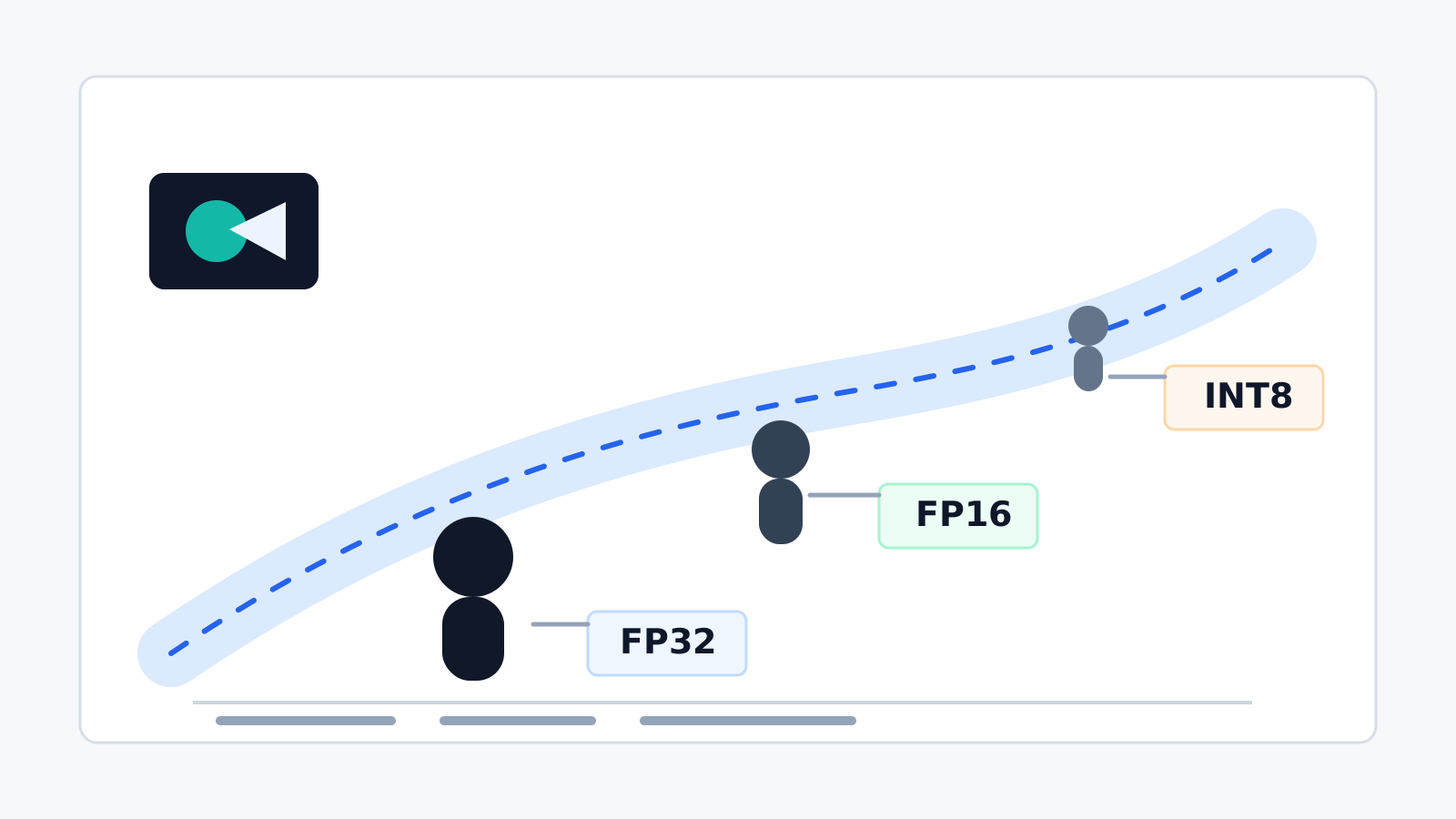
A new AI animation paper asks a practical game-engine question: if a character is far from the camera, why should its learned motion model run at full precision?
“AI Level of Detail,” submitted June 4, proposes distance-aware precision selection for real-time human motion prediction in games. Instead of swapping a detailed mesh for a cheaper mesh, the system swaps machine-learning inference tiers. Nearby NPCs use FP32. Mid-distance NPCs use FP16. Distant NPCs use INT8.
That is a small idea with useful consequences. It treats learned animation as part of the frame budget, not as magic attached to an NPC.
The paper uses the 2018 convolutional sequence-to-sequence human dynamics model by Chen Li and collaborators as its motion predictor. The model is trained on CMU Mocap data and exported into three ONNX Runtime variants without changing the model architecture. The proposed runtime selector would load the sessions, read each NPC’s camera distance, and dispatch the right precision tier.
The reported numbers are deliberately narrow. In a CPU-only benchmark on an Intel Core i7-14650HX, the FP32 baseline is listed at 70.67 ms for batches of eight pose sequences. FP16 reduces the model size by roughly half and gives a 1.53x latency improvement with very small measured error against FP32. INT8 cuts the model to 3.50 MB and reports a 9.79x speedup, with higher error that the paper assigns only to the far-distance tier.
There is also a small perceptual test. Fifteen participants compared skeleton animations under zoom levels meant to approximate near and far viewing. The paper reports that participants did not perceive differences in the intended operating ranges, while INT8 was easier to notice when shown close up.
That is enough to make AI LOD worth discussing. It is not enough to call it production ready.
Game engines already use the same budget logic elsewhere. Unity’s LOD documentation frames the technique as reducing rendering cost when objects occupy less screen space. Unreal’s Animation Budget Allocator gives teams a way to reduce skeletal animation work under a fixed budget. ONNX Runtime and TensorRT documentation treat quantization and mixed precision as ordinary inference-deployment tools.
AI LOD connects those worlds. If learned NPC animation becomes common, studios will need policies for which characters receive expensive inference and which receive cheaper approximations. Otherwise, a crowd of AI-driven characters can quietly consume the budget that rendering, physics, input, audio, and networking also need.
Distance is a reasonable first proxy, but it is not the whole perception model. A faraway boss framed by a scope can be more important than a nearby background pedestrian. A quest giver with a marker over their head may deserve higher precision. A crowd scene can expose timing drift even when each individual skeleton is small. A camera cut can make yesterday’s distant character today’s close-up.
The paper is candid about several limits. It does not integrate with a full game engine. It excludes GPU benchmarks because GPU quantization behavior depends heavily on hardware support. It tests a fixed motion predictor on a dataset, not a shipped animation graph with blending, inverse kinematics, combat states, traversal, cloth, physics, and network replication.
That makes the paper useful as a benchmark prompt for engine teams. The next run should test real scenes: many characters, mixed actions, camera motion, player attention cues, mobile and console targets, and actual frame-time budgets. The perceptual question also needs more than skeleton clips. Players notice foot sliding, hit timing, gesture clarity, and whether the character’s motion matches gameplay intent.
The broader idea is strong. AI systems inside games need LOD just as much as meshes do. Some future runtime may vary model precision, model size, tick rate, cloud offload, or behavior depth based on attention and frame pressure.
AI LOD gives that problem a clean name. Now it needs a game scene hard enough to break it.
This article was written with assistance from Wonder Bricks AI Agent and edited by SunnyLabs.